
Exhibit recalls early days of Fredonia college
EExhibit recalls early days of Fredonia college
Trending
The Darwin Barker Museum in Fredonia is celebrating SUNY Fredonia's 200th anniversary with a reminder that the university has seen gigantic changes since its 19th century inception.
The museum's Max Walters gave the OBSERVER a tour that started back in 1822, four years before the school opened.
Walters pointed out a document where villagers agreed to fund construction of a building for what was then called the Fredonia Academy. "This was 1822, this was a farming community. There was some of what we call 'country pay,'" he said.
That means farm animals or grain, a set period of work, or construction materials. The document is an itemized list of what everyone offered to the project. Money is prominent on the list, but so is livestock.
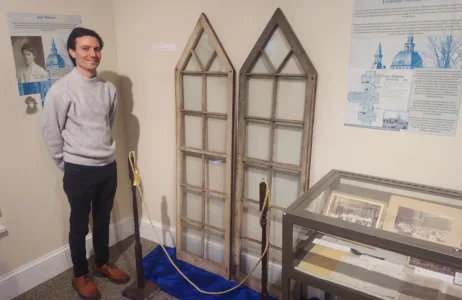
The building, located on the current site of Village Hall, was finished in 1824 but did not host its first class until October 1826. "It was a pretty simple wooden building, with spires on either side," Walters said.
The exhibit contains a window from the building. The window is on loan from the Fredonia Opera House adjacent to Village Hall. No one is exactly sure anymore how the window ended up at the opera house, according to Walters.
The average age of Fredonia Academy students in 1826 was 17 ½ years, and Walters said it is best to think of it as something like a high school. Such academies filled an education gap that existed between public schoolhouses and colleges.
The exhibit features a Fredonia Academy diploma, textbooks, and hymnbooks. Walters said students always started their school days by singing a hymn.
The Barker Museum has a student register for the academy, which lets historians know who went there, what classes they took, and how much they paid. That is also on display.
The academy focused on science and the classics, but "teacher training has always been a big part of their mission," Walters said.
In fact, Fredonia Academy turned into the Fredonia Normal School in 1867. "Normal," in this case, refers to a school that educates future teachers to work in a state-administered system with "normalized" standards across the state.
Walters said Fredonia Academy was in financial trouble in the 1860s, and made a successful push to get a state Normal School designation. Albany named four institutions as Normal Schools and Fredonia Academy was one.
Fredonia Academy always received some state funding, but "the more state money came in, the more the (Board of) Regents had control over curriculum," Walters noted.
The exhibit highlights several 19th century students. One was Helen Wright, who was hired immediately as a teacher at Fredonia Academy after graduating from it. Wright later acted as the campus "preceptress," which basically meant she was in charge of female students.
The exhibit touches upon the saddest day in Fredonia’s higher education history: The Dec. 14, 1900, fire that claimed seven lives. The school had recently moved to a complex on Temple Street that is now the site of One Temple Square.
A Fredonia Censor edition describes the fire, which killed six students and a janitor. The exhibit also displays photos of the fire, and the heartbreaking horse-drawn carriage funeral procession down Day Street for the six female students who died. The young women were buried in a mass grave not far from the main entrance of Forest Hill Cemetery, where they rest to this day.
Walters pointed out a haunting artifact: An engraving from a fall 1900 student publication, published just weeks before the fire. It portrays "A moonlight serenade" of young, romance-starved men on the ground calling to women standing in third-floor windows. The death of the six female students was partially attributed at the time to a lockdown of their dorm rooms, caused by too many incidents like the one shown in the engraving.
According to Walters, the school moved on quickly. It didn't even suspend classes, holding them for several years in various downtown Fredonia buildings. The gym and dining hall were the only parts of the campus not destroyed -- and they were reutilized for the complex built in 1903, which exists to this day as One Temple Square.
Walters said he wanted the exhibit to focus on the history of the college until the fire. He admitted that Barker Museum doesn't have much material from after that period.
The school bought what was mostly farmland between Temple Street and Central Avenue in the early 1930s for a new campus. However, the Great Depression delayed construction work until late in the decade. Mason Hall opened on the site in 1941, and the college gradually shifted its focus away from the downtown Temple Street campus.
That came around the time New York State was revamping its higher education system again, and Fredonia's college received a State Teacher's College designation in 1942. The modern State University of New York system was established later in the Forties, and Fredonia's college was part of it from the beginning.
Walters said the Barker Museum holds numerous yearbooks from SUNY Fredonia and its earlier iterations, and he invites exhibit spectators to look at them.
The Barker Museum is open Tuesdays from 4 to 8 p.m., and Fridays and Saturdays from 1 to 5 p.m.