
Health officials offer water timeline
Trending
Chautauqua County Health Department officials discussed Fredonia's latest water woes Monday.
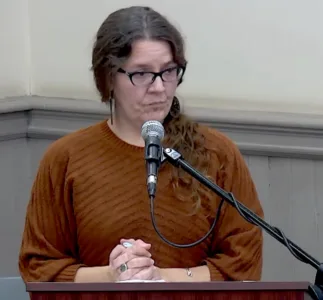
Department head Jessica Wuerstle and water specialist Natalie Whiteman visited a village Board of Trustees workshop to talk about Fredonia's recent boil and conservation orders. The boil water order has ended, but the water conservation order remained as of Tuesday morning.
Wuerstle offered a timeline of recent events, to begin 45 minutes of splashing around on Fredonia's latest water woes.
She started the timeline on Oct. 21, when she said water treatment plant chief operator Luis Fred noted elevated levels of organic material in the reservoir. Wuerstle called it "natural for the season, we all see the leaves falling. It's a seasonal fluctuation in water quality."
Fred called the Chautauqua County Health Department. Their officials consulted supervising staff from the state's Department of Health, which allowed temporary pre-treatment with chlorine in the clarifier of the treatment plant, in an attempt to address that organic material before it got to the filters.
Wuerstle continued that on Friday, Oct. 23, Fred requested and received a water conservation order. She said the Chautauqua County Health Department sent out a press release on behalf of the village, but Fred identified the issue and determined it was an appropriate course of action.
The conservation was ordered "Due to the raw water quality coming into that reservoir and the high level of material in that raw water, causing the filters in that water treatment plant to be mucked up, essentially."
Wuerstle briefly branched off to explain the recent weird taste and odor in Fredonia water. She said it was due to that seasonal organic material, such as algae. Fredonia's treatment plant "Doesn't have all of the equipment and technology to remove the different compounds that are created as the algae is decaying."
Wuerstle went back to her timeline, stating that by the evening of Oct. 23, the village's Webster Road water storage tank was empty. Also, a clear well used for washing filters was not at a high enough level.
"At that point, that's considered a critically low level, and that's the point we would consider Fredonia in an emergency situation," she said. The county reached out to the state about opening up an interconnection with the city of Dunkirk to obtain more water.
Wuerstle noted concerns about Fredonia's use of an anti-corrosion chemical on its pipes. However, "the greater public health risk" was that Fredonia just wouldn't have water. Valves between the Dunkirk and Fredonia's systems were "eased open so there wouldn't be a negative impact on either of the systems."
Water production issues continued on Oct. 24, exacerbated by a water main break. However, by the evening of Oct. 25, the Webster Road storage tank was starting to refill and the filter backwash clear well was full enough to use again.
The water was still safe for drinking at that point, Wuerstle said. "Unfortunately, that progressed later in the week."
Officials decided on Monday, Oct. 26 that the interconnection with the city could be shut off. But the next day, Fred contacted the county Health Department "because he is aware of the regulations and the turbidity measurements that are required in your treated water," Wuerstle said. "Unfortunately, turbidity in your treated water was exceeding the standards."
Chlorine readings were also no longer meeting standards. Wuerstle said that high turbidity means chlorine can get prevented from hitting pathogens in the water.
Trustee Tim Mulholland asked her if harmful things were actually detected. "This is more preventative," Wuerstle said, soon adding, "The point of those regulations is to protect the most vulnerable members of our population."
Mayor Michael Ferguson commented on the village's run of boil orders in the past four years. It's up to 11 now, by the OBSERVER's count. The mayor asked Wuerstle how many other municipalities in the county have had boil orders in that time. She couldn't recall full municipalities having any, though there were one or two localized orders
Wuerstle said that after the boil order was placed on Tuesday, turbidity was "moving in the right direction, back in compliance" by Wednesday. However, a boil order can't be lifted until at least two consecutive days of clean water samples. Samples on both Thursday and Friday mornings came back clean, but Wuerstle explained that it takes 24 hours for a test result to come in. That's why the boil order was not lifted until Saturday morning.
Ferguson, who has blamed lack of rain for the boil and conservation orders, questioned if that was a reason for them. Wuerstle said the dry recent weather was an indirect reason. "It's not flushing out the reservoir. The water and the organic material in the reservoir basin is just sitting there."
Like a stream encountering rocks, the conversation surged into several different directions. Here are some of the most prominent droplets:
-- Mulholland asked for advice on lessons to be taken from the latest boil order, in the hopes of reducing future problems. Whiteman said her most important advice is to "Change the media on your filters. Your filler media hasn't been changed in quite some time." She said the last time the treatment plant filters were switched out was at least 2020, possibly earlier.
-- Trustee Paul Wandel stated if the village wants to keep its water plant long-term, it needs a third clarifier. Its current two are already at "choke point," said Wandel, who "just wanted to get that out there." Wandel is a strong proponent of the village's plans to shut down its treatment plant and reservoir and buy water from the North County Water District, whose sole supplier is Dunkirk.
-- Mulholland wondered when the conservation order will get lifted. "We are going to have that conversation with Luis, and when he is comfortable that the plant is acting like it does on a normal fall day, we will lift that order," Whiteman responded.
"But truthfully, and kick me if I'm wrong, we've seen little to no decrease in the production rate since this order has been put in effect," she added. "People have not been conserving very well," Wuerstle chimed in.
-- Wuerstle complained the news media picks and chooses what it wants to run from her department's releases, and accused it of not providing the full details on events. She suggested that people check the county Health Department website for full, unedited releases on newsworthy events.