
Latest plan moves beach, keeps road open
Latest plan moves beach, keeps road open
Trending
The newest edition of a plan to revamp Wright Park Beach and Lakefront Boulevard moves the beach slightly west and keeps the road open.
The city of Dunkirk Planning and Development Department held a joint online meeting with the Buffalo Niagara Waterkeeper organization Tuesday to describe the latest plan.
"This has been a fantastic project that has helped some of the best coastal engineers of the country look at Wright Park and Lakefront Boulevard as a system," city Planning and Development Director Vince DeJoy said.
"It’s been a fabulous team effort and it doesn't end here," he said. The plan discussed Tuesday "represents 30% (of the) design and engineering" for the improvement project. "We have submitted a grant application to get to a full design and engineering, to allow us to then apply for grant funding for implementation," he said.
DeJoy noted that he will be moving to North Carolina shortly, but talked up his deputy director EJ Hayes, stating that Hayes should be able to fill his shoes seamlessly on the project.
The presentation listed the following big-picture objectives for the project:
-- Develop resilient coastal solutions to erosion.
-- Create a cohesive public waterfront vision.
-- Emphasize nature-based strategies, habitat preservation and creation.
-- Protect critical infrastructure along Lakefront Boulevard, along with the nearby wastewater treatment plant.
The project is wrapping up preliminary site investigation and design. The next phase is "Phase 3," the comprehensive design, development and permitting process DeJoy alluded to. That is slated for 2027-28.
Planners have a goal to "preserve and enhance" the Main Street beach, while the main goal for Lakefront Boulevard is protection of the road from storm surges.
Previous proposals envisioned closing Lakefront Boulevard to vehicular traffic. That was dropped after negative feedback from city residents.
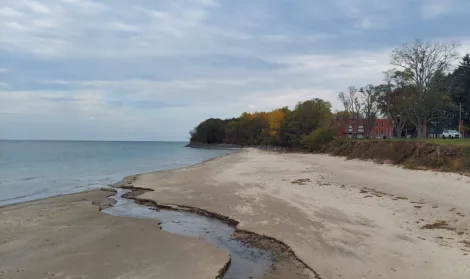
Improvement of access to the Wright Park beach is sought, but planners also want to restore and protect the current beach area, located directly beneath a bluff that experiences erosion problems. The wastewater treatment plant sits atop the bluff.
The proposed solution is to move the swimming beach a few yards to the west, across the Hyde Creek outlet. The current beach would be turned into an "eco beach"-- open to the public but laid out with protective dunes and a cobbled section.
Offshore breakwaters, an improvement city officials have sought for years, are envisioned all along Lakefront Boulevard. The breakwaters are supposed to offer storm surge protection and help replenish the beach along the road.
Extended outwash barriers for Hyde Creek, along with Goose Creek near the Main Street beach, are also envisioned. A similar barrier is sought for the outwash of the wastewater plant.
Finalized coastal engineering for structures and stormwater engineering is necessary. A "beach nourishment” analysis is also needed.
Finding more funding is an important next step. Project planners are exploring state and federal grants.
A question came up after the presentation about what would happen if no barriers were put in the lake. The questioner was told that with regular sand replenishment on the beaches, the barriers would not really be necessary. However, trucking in sand was called a "Band-Aid, not a solution to the problem."
Someone else noted that the new plan gates off the road to the wastewater plant. That's apparently not only for security but to discourage parking on the bluff. Parking there supposedly contributes to the erosion problem at the site.
More public meetings are promised on the waterfront project, but it's not clear when the next one will happen. Project planners want to make sure they have Phase 3 funding before going to the public again.
Dunkirk launched the design phase of the shoreline protection effort in 2025, partnering with the Great Lakes and St. Lawrence Cities Initiative, LimnoTech and SmithGroup, as part of the Cities Initiative's Resilient Coastal Projects Initiative. The design effort was backed by funding from the National Fish and Wildlife Foundation. Outreach and community discussion for the project is being facilitated by Buffalo Niagara Waterkeeper.