
Trending
CHAUTAUQUA LAKE -- Herbicides are an effective tool against weeds and algae in lakes, including Chautauqua Lake.
Yet what happens to those herbicides once they're introduced into a lake?
That question arose at an Aug. 18 Chautauqua-Lake-focused public-information session in the Casino in Bemus Point.
In short, the answer -- from a state-government official -- is that herbicides by and large biodegrade.
That's good news.
It's really good news.
And it's good that an audience member thoughtfully raised the question and received an easy-to-understand answer.
♦♦♦
The Chautauqua Lake Watershed and Management Alliance sponsored the public-information session.
Several alliance-board members attended. According to its website, board members include
● Chautauqua County government officials.
● Officials from the towns and villages on the lake, and
● Representatives from the Chautauqua Lake Association, the Chautauqua Lake Partnership, and the Everwild Land Trust (formerly known as the Chautauqua Watershed Conservancy), but not the Chautauqua Lake Property Owners Association.
♦♦♦
The other good parts of the alliance's public-information session were the words of alliance-board chair Pierre Chagnon, who -- with his usual calm, reassuring, gracious, and knowledgeable presence -- welcomed guests, offered closing thanks, and gently dispatched with an audience member's assertion that the alliance is "paying reporters" at a particular press outlet.
Chagnon offered to talk privately with the questioner afterward, but the questioner left immediately after the event.
Afterward, one knowledgeable person confirmed what this column suspected: The alliance doesn't pay reporters.
♦♦♦
As for the rest of the session, please recall that the alliance billed the event as a public-information session.
Yet if the goal of a public-information session is to provide information to the general public, then it's crucial to provide information in a way that the general public can understand.
Those who went to this public-information session already deeply knowledgeable about the issues may well have understood the presenters. Such audience members likely weren't in over their heads.
By contrast, state-government presenters in effect talked over the heads of audience members lacking such deep knowledge. Such audience members heard
● uncommon words and phrases that went undefined and
● explanations that were otherwise hard for such audience members to follow.
Could such audience members have asked questions? Sure. Yet the presentations lasted 45 minutes. They would have been hard to clarify in the remaining 15, even if those deeply knowledgeable about the issues had asked no questions.
Moreover, although state-government presenters repeatedly stressed pursuing results, language that such presenters otherwise used implied that they're--at least significantly--process oriented too.
That's understandable. One need not question people's motives to appreciate that those trained in process and whose living depends on process can quite naturally orient themselves toward process.
♦♦♦
Nevertheless, such a process is a longstanding challenge even apart from this context.
Think of the countless meetings and studies over several decades. It's way past time to shift the focus so we have fewer meetings and studies, and more action.
True, planning is crucial to success. Crucial to planning are efforts to bring people into the process and have them think through an effort before it begins. But all too often we have meeting after meeting, study after study. Then at the end, one of the few things decided is when the next meeting or study will be.
Our model should always be, "Ready, Aim, Fire," not "Fire, Aim, Ready." But at the same time, the model should not be, "Ready, Ready, Ready, Aim, Ready, Ready, Ready, Aim, Don't Fire Yet. Have another meeting. Have another study."
Too often some think so much about organizing, prioritizing, and visualizing that they think way too little about what they're organizing, prioritizing, or visualizing. In other words, they're not sure where they're going, but they seem quite sure they're doing a great job getting there. Planning becomes the end, not the means.
And statists, being especially enamored with government power, government planning, and government regulation, are especially vulnerable to falling into this trap. After all, many meetings and studies focus on increasing government power. Statists like that.
The rest of us shouldn't.
♦♦♦
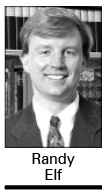
Dr. Randy Elf's paternal grandparents had a cottage at Cheney's Point on Chautauqua Lake for 40 years. For more on the state wetlands law that affects lakes and is under challenge in state courts, see the interview of him at 0:17.10 to 0:23.10 of https://accesschautauquacountytv.org/episode/GVbIPKfKKmw.
COPYRIGHT © 2026 BY RANDY ELF