
Trending
As a part-time writer, musician and non-tenured teacher, I might qualify as a struggling artist (as if there were any other kind). The struggle has been real, and throughout my life I've periodically relied on house painting to make ends meet and facilitate my other, sometimes less lucrative vocations. It was, and still is, the kind of work I do alone, where I'm free to choose my hours and to imagine all sorts of things as I move up and down ladders with all the primitive tools -- rag, scraper, knife, tube gun, brush and bucket.
Much of my painting has been outside during summers. I've always relied on word-of-mouth referrals to get work. Often what I get is what commercial painting companies don't want to deal with -- houses that are old, weather-beaten, and time consuming. In short, I get houses that might be more trouble than they're worth. Regardless, as I have entered the fourth season of life, I count the blessings that allow me to continue working. And, while house painting is not an artform requiring great skill or talent, it is nonetheless a kind of performance that, for me at least, provides a sense of pride and freedom.
But it is laborious. Scraping blistered paint off old houses is hard on the arms, wrists, hands, shoulders, hips, knees, the whole body. Going up and down ladders to scratch, gouge and flail at some decrepit old wall can make you feel like Sisyphus. Even worse, it's one of those things in life where you never know when enough is enough -- if you quit too soon, it'll show badly when you paint. Or, if you obsess over details, it could be winter before you’re ready to paint.
There are other drawbacks to this line of work. Big old homes have their own ecosystems. Even in the city, Mother Nature is in a forever war against man, trying to reclaim territory he has taken from her. Clematis, wisteria, honey suckle, English ivy and poison ivy -- all types of climbing vines present themselves as defenders against painters. Old ferns grow tough roots on the ground's surface that are wound tighter than strings in a baseball. Thorn bushes ambush you every chance they get. Toddler trees rise up under scant sunlight along concrete foundations.
And then there is the ever present threat of an aerial assault. Wasps, hornets, yellow jackets, and bees are never happy to see you, and if you let down your defenses or move carelessly, you will suffer the consequences. Warning: they especially do not like ladders!
There are other critters that lurk in the jungles surrounding an old house, most of them relatively harmless, and I've come to welcome them as companions of sorts. The sudden appearance of a toad, mouse, snake, caterpillar, spider or ant sometimes serves to bring me out of a repetitive-motion-induced stupor. It's as if they have initiated a conversation, inviting me into their little world behind a facia board, under a window sill, or through a crack in the concrete foundation.
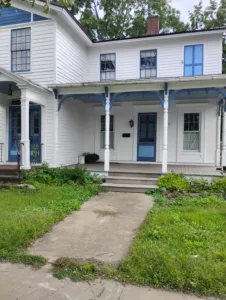
Recently, I painted a house in Fredonia that was built in the 1830s. The house belongs to a dear friend, Kathy Howard-Petersen, and it's the third time in as many decades I've worked on it, each time revisiting the same peaks and walls, and looking through the same windows into the heart of the home. Each time new old memories are conjured up, and there is a strange familiarity about the process, as if pieces of the past materialize, like half-ghosts adrift between what was and what is.
I'm remembering Tim Cudney, a talented musician and woodworker and my closest friend during those times. He was part of Kathy's heart and home for many years before he suffered a stroke-induced motorcycle accident. I can see him through a window into the living room, a free spirited young man finger-picking a Hot Tuna song on acoustic guitar. Then again in middle age, a bearded, consummate professional fashioning the wooden neck to a bass violin. And then, in those last sad years, he is wheelchair bound and very ill, staring at the walls inside the house. I want to believe he was imagining another world, far away from this one. Perhaps he was already there.
Now, as I look at my own hands -- spotted, veins like swelling rivers, yet still able to hold this brush and to cut straight lines along the window frame -- It doesn't seem fair.
Yet we must take what we are given in this temporary world. We all face a wall at some point, and what lies beyond we cannot see. We can only imagine. And while I retired my big ladder, I still get high enough now and then to see the lay of the land, to paint pictures in my mind as I do my little part in trying to add a bit of fresh color to the world.
Pete Howard, author of "Rosebud Dreamworld," lives in Dunkirk.