
Trending
CHAUTAUQUA - Let's pick up where we left off 23 weeks ago, with a speech by U.S. Supreme Court Justice Clarence Thomas at the University of Texas.
Progressivism is a form of statism more commonly known in the United States as liberalism.
Thomas explained that "progressivism" -- the most prominent early proponent of which in the United States was President Woodrow Wilson -- is incompatible with the Declaration of Independence.
"Progressivism was the first mainstream American political movement--with the possible exception of the pro-slavery reactionaries on the eve of the Civil War--to openly oppose the principles of the Declaration. Progressives strove to undo the Declaration's commitment to equality and natural rights, both of which they denied were self-evident. To Wilson, the inalienable rights of the individual were 'a lot of nonsense.' Wilson redefined 'liberty' not as a natural right antecedent to the government, but as 'the right of those who are governed to adjust government to their own needs and interests.' In other words, liberty no longer preceded the government as a gift from God, but was to be enjoyed at the grace of the government. The government, as Wilson reconceived of it, would be 'beneficent and indispensable,'" Thomas said. Thus, "progressivism seeks to replace the basic premises of the Declaration of Independence, and hence our form of government. It holds that our rights and our dignities come not from God, but from the government. It requires of the people a subservience and weakness incompatible with a Constitution premised on the transcendent origin of our rights."
* * *
Robert George is the sixth person to hold the McCormick chair in jurisprudence at Princeton University. Wilson was the first.
Speaking to the morning-lecture audience in the Chautauqua Institution amphitheater on Aug. 7, George rightly observed that "the pursuit of happiness"--a phrase from the Declaration--means not a state of feeling but a moral state of being.
The pursuit of virtue--not liberty degenerating into license--was the essence of the founders, he said.
* * *
George also rightly observed the Bill of Rights is a check on government, yet the more reliable checks are
● federalism: the division of authority between the federal and state governments, and
● the separation of powers: the division of authority within the federal and state governments.
Nevertheless: Important though the "words on the page" are, the "words on the page aren't enough," George said. The people must stand behind them.
Along that line, George said America can't maintain a republic if the people are ignorant of its founding.
"We've let it slide," he said.
* * *
Think about that though: Whose ends does "let(ting) it slide" serve? Why, it serves the ends of those who don't seek to maintain the republic.
That leads to the next question: Who doesn't seek to maintain the republic? One answer is: Many self-styled progressives. Please re-read the long paragraph above about Wilson.
What stands in self-styled progressives' way?
Well, for one, the Constitution as the framers established it stands in their way.
Which may be one reason that self-styled progressives have little regard for the Constitution as the framers established it.
What else stands in their way?
Well, the Supreme Court of the United States--as currently constituted--largely does, thanks to justices such as Thomas, the presidents who appointed them, and those who support such presidents.
Which may be one reason that self-styled progressives have little regard for justices such as Thomas, the presidents who appointed them, and those who support such presidents.
Oh, self-styled progressives were fine--just fine, thank you very much--with the high court when it was a font of liberal judicial activism and reliably enacted what they favored.
They're not fine with the high court anymore though.
Not anymore.
Not anymore.
* * *
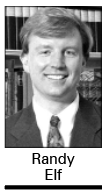
Randy Elf encourages Never Trumps to imagine what would have become of the law if Donald Trump had lost the 2016 presidential election and not filled the three Supreme Court vacancies from 2017 to 2020.
COPYRIGHT © 2026 BY RANDY ELF