
GRIDIRON 2022: Mahoney the Talented
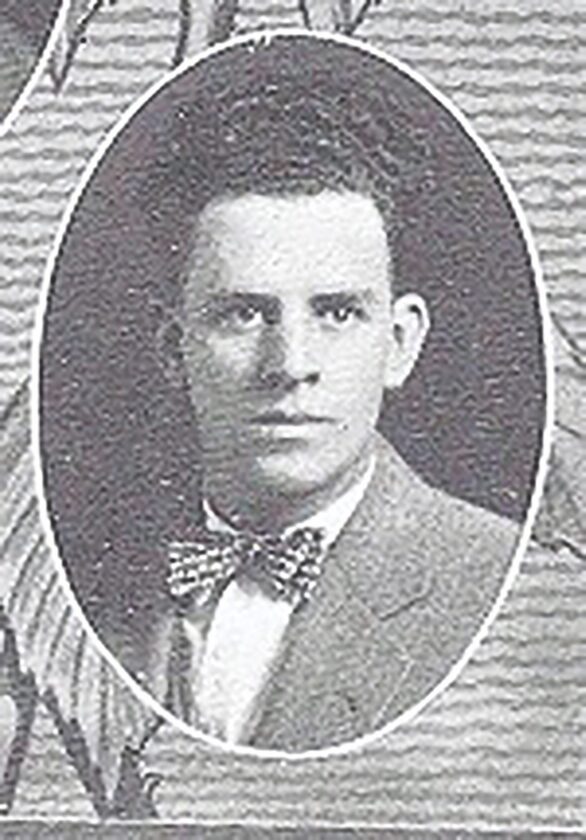
Eugene Mahoney graduated from Jamestown High School in 1926.
Jamestown High School has had its share of outstanding football players throughout its storied history. For confirmation, all one has to do is take a drive to Strider Field and check out the first-team all-state players whose names and jersey numbers adorn the back of the grandstand.
But one Red Raider who doesn’t appear there, but who certainly has a compelling gridiron odyssey, is a man named Eugene Mahoney, whose name was uncovered on the Red Raiders’ football website earlier this week under the category “major Division I college players.”
Here’s his backstory: A 1926 JHS graduate who lived on Buffalo Street in the city, Mahoney was an accomplished football player who led the Red Raiders to a 6-1-1 record during the 1925 season when they outscored their opponents 197-32. Mahoney was so talented, in fact, that he ended up playing for the University of Notre Dame and its legendary coach, Knute Rockne.
Internet searches and an obituary for Mahoney that appeared in The Post-Journal in 1990 confirm that. And thanks to the resourcefulness of Chautauqua Sports Hall of Fame president Randy Anderson, there’s more to the story than just a listing of Mahoney’s name on the Fighting Irish roster.
It comes in the form of a letter from Rockne to Mahoney that was dated Aug. 23, 1927.
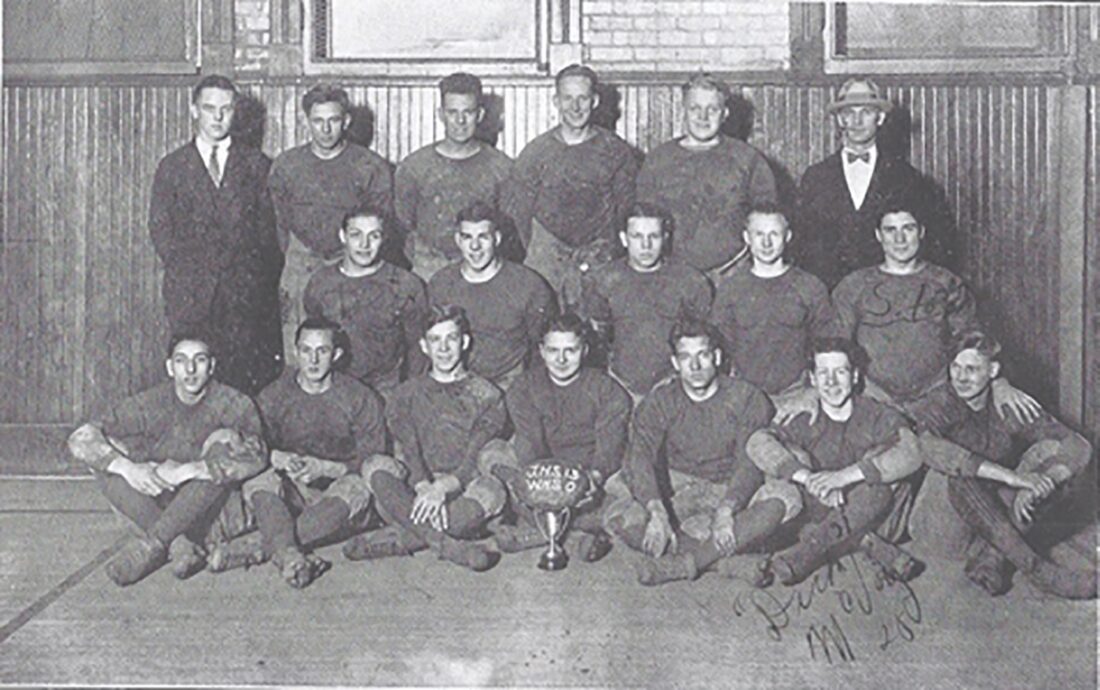
Above are members of the 1925 Jamestown High School football team that finished 6-1-1. Standing in the back row, third from the left, is Eugene Mahoney who, two years later, was playing varsity football at the University of Notre Dame for Coach Knute Rockne.
“I googled Eugene Mahoney and that (letter) was one of the first two or three things that showed up,” Anderson said. “I just started clicking on different links and that’s when I discovered that letter. Somebody had apparently offered it for sale (online).”
Following is Rockne’s missive to Mahoney:
Dear Eugene:
I passed right close to your town this summer driving through to Bucknell at Lewisburg, Pennsylvania, but was in such a hurry that I couldn’t detour enough to drop over and visit Jamestown.
I will write you regarding your friend in a few days as soon as I get a chance to talk to Father McBride.
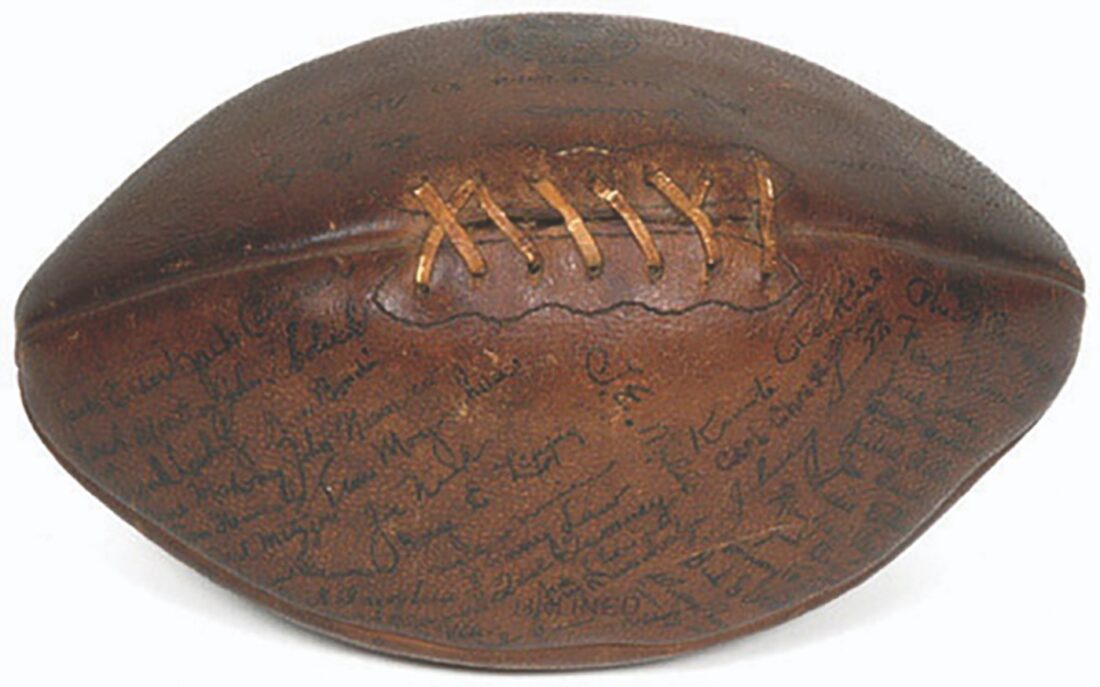
Eugene Mahoney’s signature on the thought-to-be 1928 football from the Notre Dame-Army game at Yankee Stadium can be found “between 7 and 8 o’clock.” Coach Knute rockne’s signature is located just to the right and below the laces. The ball sold at auction for $28,750.
Regarding yourself, however, with Hogan not returning to school this fall and Boland and McManmon graduating, the tackle situation doesn’t look any too well unless you and one or two others come through. You certainly came along nicely this spring and showed splendid improvement — your play in spots was good enough for anyone but in other spots it lacked things that I feel quite confident that you will develop this fall, so come back determined to be one of the right tackles at any cost. I am counting on you.
Hope you have had a pleasant summer and with every good wish, I am
Yours sincerely,
K.K. Rockne
Director of Athletics
Inspired by his find, Anderson did a little more Internet digging. What he found was that Mahoney only played on the Notre Dame varsity for one season (1927), and by 1929 he was playing semi-pro football in Jamestown.
“Eugene Mahoney wasn’t only a good athlete in football at JHS, he was also a heck of a baseball player at JHS. He was a catcher, and most of the references that I found on fultonhistory.com show him playing in a lot of baseball leagues in the Jamestown area in the 1930s.”
Outside of sports, Mahoney — according to the obituary — once owned and operated with his brother the Oriole Field on Buffalo Street and was employed with the former Community Chrysler Plymouth Agency for 15 years, retiring in 1970. A communicant of St. John’s Catholic Church, Mahoney was married to the former Sybyl M. VanMarter, with whom he celebrated their 50th wedding anniversary Nov. 4, 1989. They had a daughter, three sons and eight grandchildren.
Mahoney died on June 15, 1990 at the age of 83. Ironically, he passed away at his home at 731 Buffalo St., the same address where Rockne sent the letter 63 years earlier. He is buried in Lake View Cemetery in Jamestown.
MALONEY CONNECTED TO ‘GIPPER’ BALL?
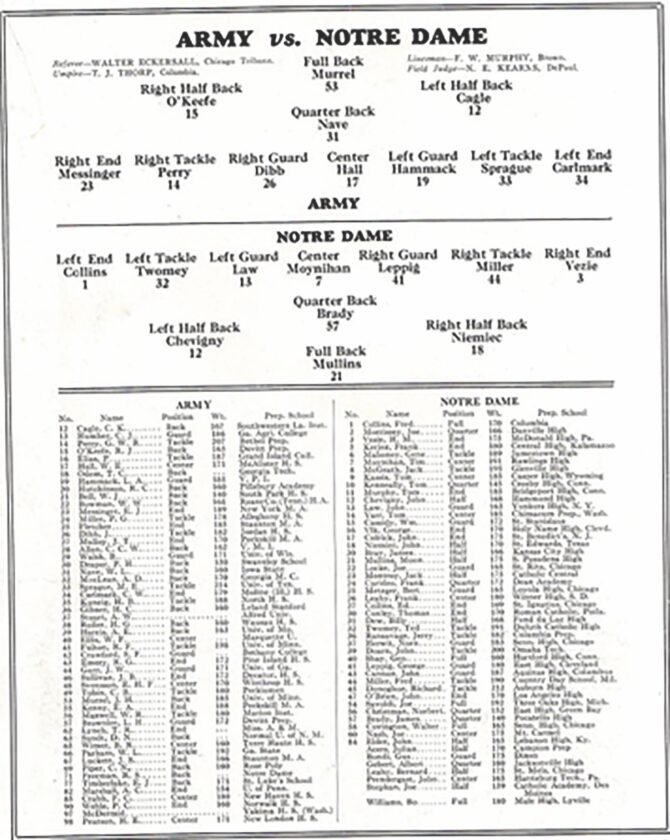
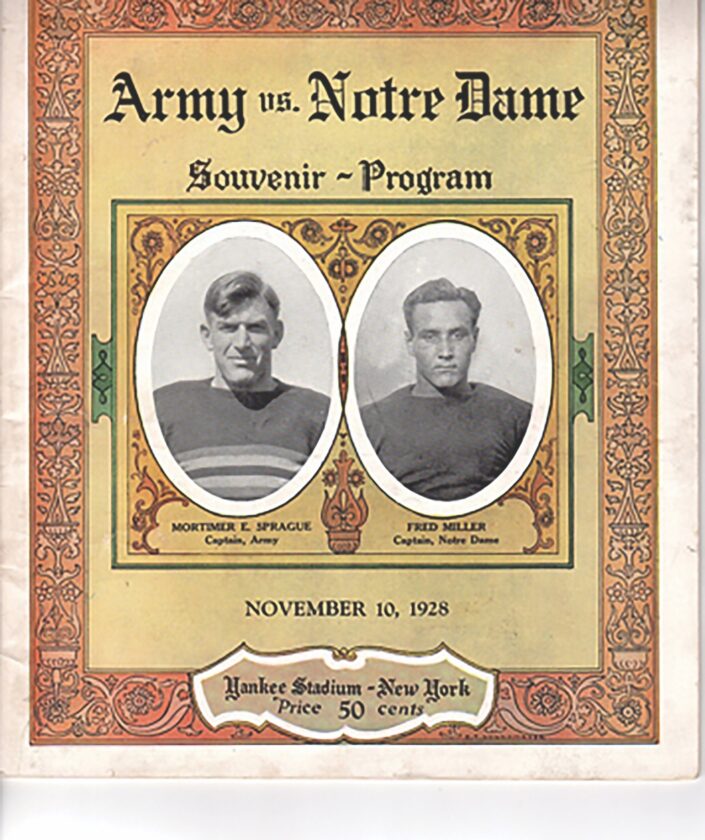
Gene Mahoney is listed as No. 6 on the Notre Dame roster.
Eugene Mahoney. That name is listed in a link on the Jamestown High School football website, just above the names of two all-time great Red Raiders — Sam Restivo and Jim “Nate” Davis — and just below another all-timer, Jim McCusker, who joins Stephen Carlson as the only alums to play in the National Football League.
The last three men I’m familiar with.
Restivo and Davis were contemporaries of mine. I graduated with Davis, an all-state running back, in 1979.
Restivo, who will be inducted into the Chautauqua Sports Hall of Fame in February, graduated from JHS in 1980 after an all-state career as a dominant linebacker/fullback.
Davis went on to the University of Michigan, coached by Bo Schembechler.
Restivo played for Bobby Bowden at Florida State University.
And, of course, McCusker (JHS Class of 1954), a charter member of the CSHOF, was an All-American at the University of Pittsburgh, played seven years in the NFL and won a championship in 1960 while a starting offensive tackle with the Philadelphia Eagles.
Why is Mahoney on this list?
Until two weeks ago, I had no idea who the 1926 JHS graduate was. And now?
Well, his story gets more and more interesting seemingly by the day.
The Post-Journal — thanks to the efforts of CSHOF President Randy Anderson and CSHOF 2012 inductee Greg Peterson — has chronicled the journey that Mahoney made from his days as a Red Raider to his three years at the University of Notre Dame under legendary coach Knute Rockne.
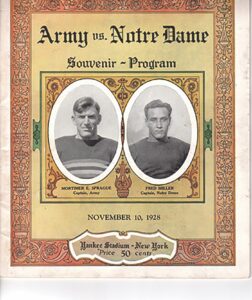
Included among the items uncovered in a little more than a week are: an online letter from Rockne to Mahoney from August 1927; and a program — owned by Peterson — from the 1928 game between the Fighting Irish and Army in which Rockne delivered his famous “Win One for the Gipper” halftime speech at Yankee Stadium.
And, now, there is another online artifact to add to the list, uncovered by Mahoney’s son, Terry, who lives in Fredonia, and who passed it on as an attachment in an email to Anderson.
“Terry Mahoney, Gene’s son, called to tell me he found the alleged 1928 ND v. Army ‘Win One for the Gipper’ game ball,” Anderson wrote in an email. “See link above for more details. If you blow up the photo you will clearly see Gene Mahoney’s signature between 7-8 (o’clock). Rockne signed it just to the right and below the laces.”
The “details” were from the Robert Edwards Auction website, which chronicles the history of the ball from arguably the most famous game in college football history. While the auction house says it “cannot prove with 100% certainty that his football, signed by the entire 1928 Notre Dame National Championship team, including Knute Rockne, is the actual game ball,” it makes a pretty strong case why it is the historic pigskin.
“Whether this is, in fact, the actual game ball may never be known, or may always require a leap of faith,” the REA website notes. “It requires no leap of faith, however, to recognize this as an extraordinary and unique 1928 Notre Dame team-signed football, with an extraordinary story, and, very possibly, (a) most extraordinary significance to the history of the game of football. The signatures grade overall an ‘8’ on a scale of ‘1 to 10.’ The ball is in excellent condition.”
The ball was eventually sold by REA for $28,750.
The connection that Mahoney has made nearly a century later between his hometown and the football program from South Bend, Indiana? Priceless. n
Photos courtesy of the Chautauqua Sports Hall of Fame
-
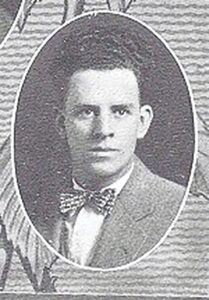
- Eugene Mahoney graduated from Jamestown High School in 1926.
-
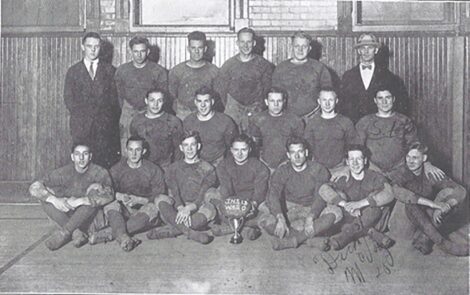
- Above are members of the 1925 Jamestown High School football team that finished 6-1-1. Standing in the back row, third from the left, is Eugene Mahoney who, two years later, was playing varsity football at the University of Notre Dame for Coach Knute Rockne.
-
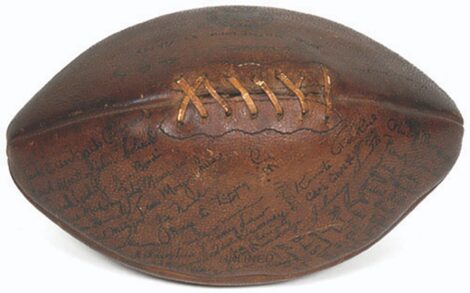
- Eugene Mahoney’s signature on the thought-to-be 1928 football from the Notre Dame-Army game at Yankee Stadium can be found “between 7 and 8 o’clock.” Coach Knute rockne’s signature is located just to the right and below the laces. The ball sold at auction for $28,750.
-
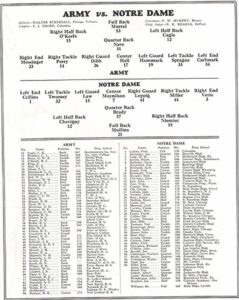
- Gene Mahoney is listed as No. 6 on the Notre Dame roster.
Local Sports

Muddy waters, clear fishing opportunities
Hoose returns to Southwestern, wins 2nd state title
2026 OBSERVER/Post-Journal Boys Wrestling All-Stars
Ottawa rallies past Buffalo 4-1, keeps Sabres from ending the drought

God, grit and the great outdoors
JCC Golf Classic returns to Holiday Valley
ELLICOTTVILLE — Jamestown Community College’s annual Golf Classic will return to the Holiday Valley Double ...