
Changing face of fishing
-
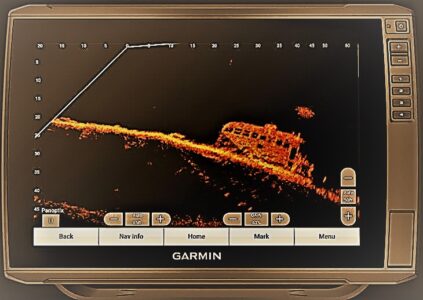
- Photo courtesy of Garmin The new Forward-Facing-Sonar units, aka LiveScope, allow anglers, boaters and divers to see well-defined underwater images as deep as 500 feet in freshwater.
-
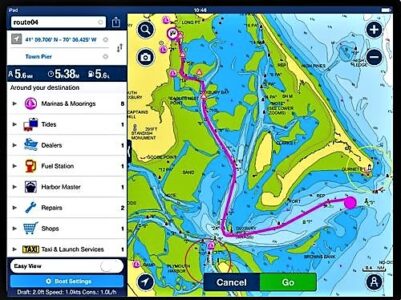
- Photo courtesy of Garmin Add navigation-mapping aids, sonar, GPS location technology and memory to modern marine boating units and the world of adventure on the water has been revised.

Photo courtesy of Garmin The new Forward-Facing-Sonar units, aka LiveScope, allow anglers, boaters and divers to see well-defined underwater images as deep as 500 feet in freshwater.
Last year, in the National Walleye Tournament held in Lake Erie from Dunkirk Harbor, Berkley pro-John Hoyer and his co-angler Collin Martin won the 2022 championship here. They bagged 39.81 pounds of walleye (five fish) on day one, 30.79 pounds on day two and 31.73 pounds on day three to seal the victory. It was Hoyer’s second time to win the NWT Championship, and more impressive, was the margin of victory. Second place was a distant 11.46 pounds behind. Even more impressive was the way he caught his winning bag of fish. He was casting for every fish he caught. Every local angler in the region knows that walleye are deep-water fish in summer, right? Every angler that followed this exciting tournament discovered some mighty big walleye that are not deep in summer. John Hoyer taught us all a lesson.
Casting a Berkley Powerbait Champ Swimbait in bluegill color, Hoyer rigged the supple tail on a three-quarter ounce Berkley Fusion19 jig head. He then threw to fish he located in 8 to 15 feet of water.
Using forward-facing-sonar, aka LiveScope, he would find the fish near the structure, then cast to the fish, let the heavy jig head sink to the bottom, then rip it hard about 6 feet and let it drop back to the bottom.
“Every fish had it choked,” Hoyer said, “so I was able to get a good hook set and get them to the boat.”
He was throwing the lure using a Fenwick 7-foot medium-heavy action rod with a 10-pound Fireline braid main line and 15-pound Berkley fluorocarbon leader. No one in any of the local walleye tournaments run from Chautauqua County has ever done this before, to my knowledge. Most walleye anglers are trollers with the conventional lead-core line, downriggers and deep diving planes to get lures to the suspended thermocline levels of schooled deep-water walleye. So now, there is a new sheriff in the fishing world. Forward-facing-sonar, or LiveScope, may be here to stay. This year, the NWT Championship competition is at Devils Lake, North Dakota, John Hoyer is in fourth place at the time of this writing.

Photo courtesy of Garmin Add navigation-mapping aids, sonar, GPS location technology and memory to modern marine boating units and the world of adventure on the water has been revised.
LiveScope fishing is a technology and new word developed by the Garmin Company for use in fishing. It combines sonar and live imaging technology to provide anglers with a real-time, high-resolution view of what’s happening beneath the surface of the water.
Here’s how it works: SONAR-LiveScope uses traditional sonar technology to send sound waves into the water. These sound waves bounce off objects, fish and the bottom of the water body, creating echoes. Live Imaging — What sets LiveScope apart is its ability to provide live imaging of the sonar echoes. It translates the sonar data into a clear, easy-to-understand visual representation. Anglers can see fish as they move, their size, and how they react to bait or lures in real time. It provides age-old anglers with a new set of eyes. It does the same for the more adept young anglers eager to fish in tournament competitions. The younger angler kids are really good at using this new technology. Ease of Use — LiveScope systems have user-friendly displays and can be mounted on fishing boats or used for ice fishing. Anglers can see precisely where the fish are and adjust their tactics accordingly, improving their chances for fish-catching success.
Bass Pro Gerald Swindle, alias “G-Man” on the bass fishing circuit, says, “Using LiveScope allows me to learn. I like to keep up with knowledge, so I use a Hummingbird 360 up front and a Garmin LiveScope unit to see all I can see.” Once anglers can find the fish, their location and depth, these new units also allow for the perception of fish size. You can choose to only fish for big fish and let the little guys alone.
LiveScope fishing technology has revolutionized how anglers locate and catch fish, making it easier to find and target specific species. It’s handy for finding fish in deep or challenging underwater terrain, too. Anglers everywhere are working hard to learn how to use it. Mind you, anglers still have to rig up the proper bait, present it properly and then hook and land the fish.
The new technology has started a controversy in fishing. Some say it should be outlawed. Others say it’s the best thing since peanut butter and jelly. Lowrance, Hummingbird and Garmin’s big three sonar gear manufacturers all make similar units. The units cost from $1,500 to $3,000, depending on various choice factors. To learn more about forward-facing-sonar and LiveScope, visit YouTube at https://youtu.be/ZBmXQEJVeJU. Now, add lake maps, GPS, and memory storage — well, I wonder what Izaak Walton would say? I noticed while observing a recent fishing competition on TV that viewers got to watch pro anglers looking at a sonar screen for 10 minutes before they ever cast a lure. I doubt fishing competition on TV will ever be exciting again with LiveScope. I switched over to Gunsmoke after 20 minutes for some honest action. Thank you, Matt Dillon.
Local Sports
Youth soccer
MODIFIED/JAYVEE/COED LEAGUE Chase Card's five goals sent the Thunderbirds to a 7-6 victory over the Green ...

Westfield Winter Classic rescheduled for end of week

High honors

Allen could use a break in finale

Flooded creeks to feathered hooks
Sherman boys take down Silver Creek
SHERMAN — Jacob Ferranto provided a double-double with 23 points, 14 rebounds and two steals to send Sherman past ...