
Three bald eagles take flight
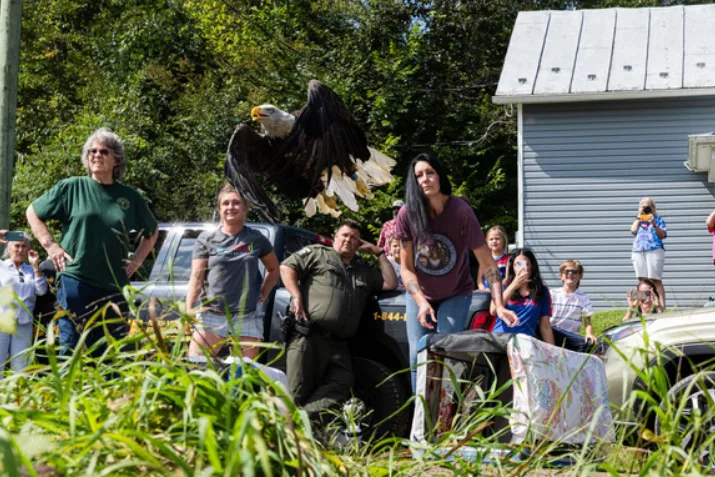
Photo courtesy of NYSDEC An adult Bald Eagle found injured on June 11 in Centerville in Allegany County, was nursed back to health, and released back to the WNY wilds early in September.
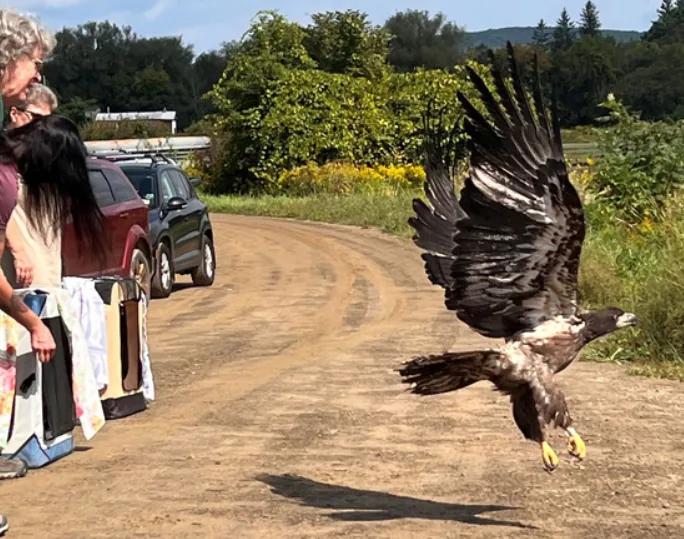
Photo courtesy of NYSDEC Two juvenile Bald Eagles were nursed back to health by Messenger Woods Wildlife Care Center after their nest came down in Montezuma Wildlife Refuge. Both young birds were recently released in Allegany County.
Photo courtesy of NYSDEC An adult Bald Eagle found injured on June 11 in Centerville in Allegany County, was nursed back to health, and released back to the WNY wilds early in September.
Photo courtesy of NYSDEC Two juvenile Bald Eagles were nursed back to health by Messenger Woods Wildlife Care Center after their nest came down in Montezuma Wildlife Refuge. Both young birds were recently released in Allegany County.
Trending
Few sights capture the spirit of conservation quite like a Bald Eagle rising into the sky on powerful wings. In Western New York, that sight has become increasingly common--and it represents one of the region’s most remarkable wildlife conservation successes.
On September 13, approximately 50 bird lovers gathered in Belfast, Allegany County, to witness the release of three Bald Eagles returning to the wild. New York State Department of Environmental Conservation (NYSDEC) Environmental Conservation Officers Calanni and Damrath assisted with the release of the birds, each of whom they had played a role in rescuing during the previous year.
The three eagles--a pair of juveniles and an adult--had endured very different circumstances. The adult was found injured in Centerville, Allegany County, on June 11. The two juveniles were injured when their nest came down at Montezuma National Wildlife Refuge in Wayne County. They were admitted to the Janet L. Swanson Wildlife Hospital at Cornell University on June 19 before all three eagles were transported to Messinger Woods Wildlife Care and Education Center in Holland, Erie County.
There, wildlife rehabilitator Marianne Hites and her team provided the treatment and care needed to prepare the birds for their return to the wild. On release day, all three eagles took to the sky without incident, soaring high above the crowd--a fitting conclusion to a remarkable journey of rescue, rehabilitation and recovery.
Their return is part of a much larger conservation story. In 1976, New York had just one known nesting pair of Bald Eagles. Decades of conservation efforts helped increase that number to 389 nesting territories by 2015, transforming the Bald Eagle from a rare sight into an increasingly familiar symbol of healthy waterways and thriving ecosystems.
Bald Eagles typically nest in heavily wooded areas near water, where tall trees provide nesting and perching sites and rivers and lakes provide abundant fish. Adults can reach about 30 inches tall with wingspans of six to seven feet. Their distinctive white heads and tails make mature birds unmistakable, while juveniles are predominantly chocolate brown.
Western New York offers exceptional opportunities to see these magnificent birds, particularly during winter. Eagles arrive in December, with numbers often peaking in January and February. In Chautauqua County, notable viewing locations include the Audubon Community Nature Center’s Big Pond, Point Gratiot Park and the Dunkirk City Pier.
The next time a Bald Eagle appears overhead, it is more than simply a spectacular wildlife encounter. It is a reminder of what conservation, cooperation and dedicated wildlife professionals can accomplish--and a symbol of how far New York Bald Eagles have come.
Gotta love the outdoors.