Formerly a church, Adams Art Gallery needs an Academic Revival
Building Blocks: A look at historic structures in the area
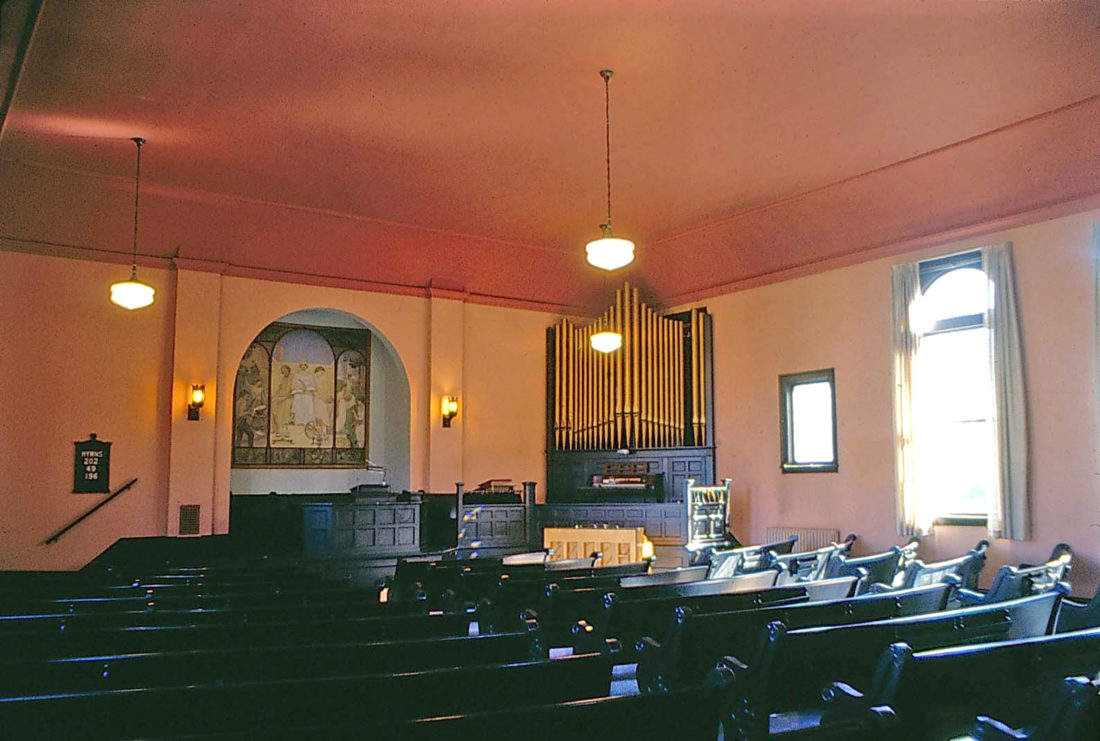
Submitted Photos For 65 years, the building at 600 Central Avenue was Adams Memorial Church.
-
- Submitted Photos For 65 years, the building at 600 Central Avenue was Adams Memorial Church.
-
- The Adams Art Gallery, which sits at 600 Central Ave., Dunkirk, was originally Adams Memorial Church. In 1978, the building was gifted to an arts organization. In 2005, Access to the Arts, Inc. took over the building. It has been closed the last couple of years.
-
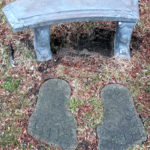
- Pictured is a bench that sits outside the building
-
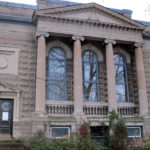
- The Adams Art Gallery, which sits at 600 Central Ave., Dunkirk, was originally Adams Memorial Church. In 1978, the building was gifted to an arts organization. In 2005, Access to the Arts, Inc. took over the building. It has been closed the last couple of years.
-
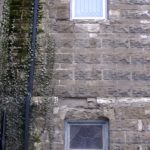
- There are many problems with the Adams Art Gallery.
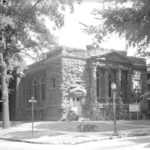
According to Dr. Daniel Reiff, SUNY Distinguished Service Professor Emeritus and historical architecure expert, the former Adams Art Gallery, built in the first decade of the 20th century, is “a beautiful example of Academic Revival, based on the Erechtheum at the Acropolis in Greece, with ionic order columns” — essentially, the columns at the front of the building have a band around the top and special details that mark them as ionic, a popular style of column in historic Greek buildings. The Erechtheum is a temple built to honor Athena, goddess of civilization, wisdom and inspiration, in addition to her more well-known trait of being the goddess of war.
Now, more than 100 years after its first stone was set into the earth, the former Adams Art Gallery sits, crumbling, a shelter for neither a worshipping congregation nor an assembly of artists.
HISTORY & HERESY
The former Adams Memorial Church would never have existed if not for the then-radical notion of one reverend, who didn’t think eternal damnation fit with the idea of a loving, forgiving God.
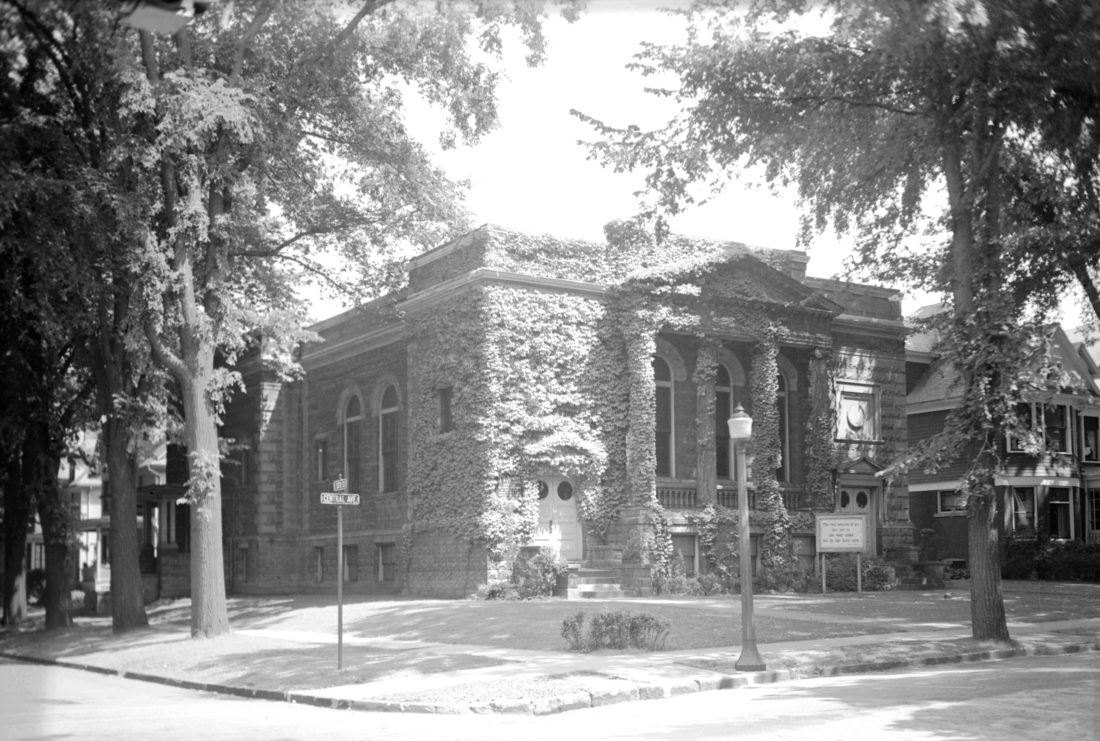
The Adams Art Gallery, which sits at 600 Central Ave., Dunkirk, was originally Adams Memorial Church. In 1978, the building was gifted to an arts organization. In 2005, Access to the Arts, Inc. took over the building. It has been closed the last couple of years.
In 1880, “The Reverend Edward Adams, minister at the Dunkirk Presbyterian Church, publicly repudiated the doctrine of everlasting punishment as inconsistent with a loving God,” states the 30-year celebration pamphlet of the Unitarian Universalist Congregation of Northern Chautauqua County. “He was suspended, but 90 of 120 parishioners sided with him, and they began meeting at Dunkirk City Hall on Sunday mornings.”
He was tried for heresy. After all, he was spouting things that weren’t exactly approved. But Adams didn’t end up roasting on a spit, or anything quite so old-fashioned. In 1899, the “City Hall Congregation” joined up with the American Unitarian Society. Sadly, the Reverend Adams himself passed away in 1897, and didn’t get to witness all the ways in which his flock would grow.
Inspired by their late reverend’s dedication and galvanized by growing numbers, members of the congregation were able to break ground on the Adams Memorial Church in 1903, opening in 1907. The building, made of reinforced concrete with windows facing every direction, was stunning. With its Classical Greek style, it signified the kind of enlightened beliefs that Unitarian Universalists still hold true: liberal Christianity, guided by rationality and logic and clarity. In this community, everyone is treated with fairness and dignity — prejudices and stereotyping aren’t welcome.
One of the building’s most beautiful features is a “triptych-style” mural on one wall, painted in 1934 by artist Arie Heyn. It’s called “The Spirit of Liberal Religion,” and is 8 feet square. Painted at the bottom are the words: “The Truth Shall Make You Free,” a statement the congregation voted on, according to documents shared by the Historical Society of Dunkirk.
Those documents also say that the Adams Memorial Church gained national attention in 1959; funeral services were held there for Congressman Daniel A. Reed of Dunkirk. News crews swarmed the streets and cameras flashed, with media representatives and mourners alike pushing to catch a glimpse of the prestigious and somber service.
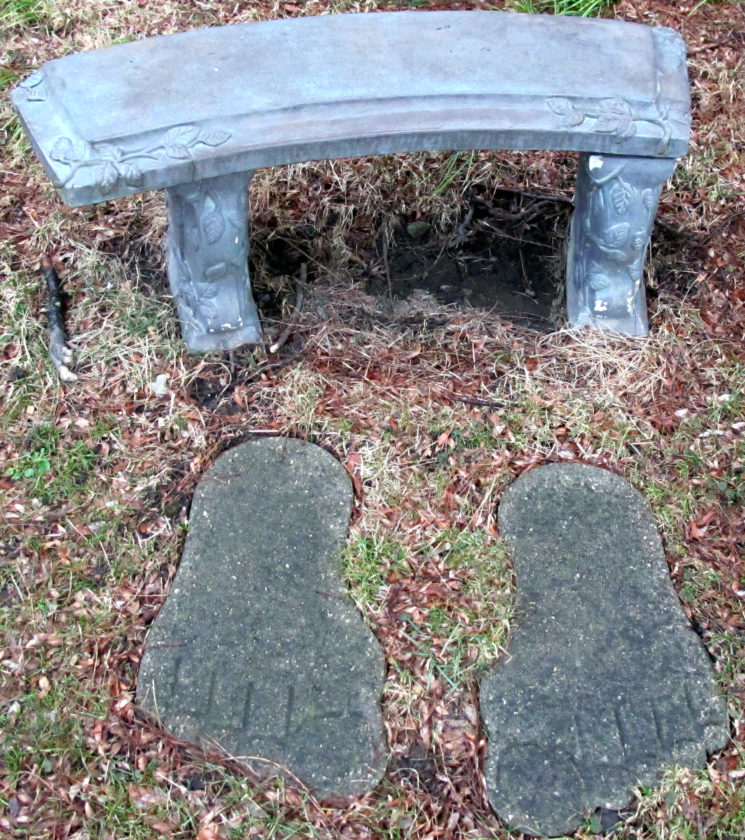
Pictured is a bench that sits outside the building
Wendy Westwood, of the Unitarian Universalist Congregation of Northern Chautauqua, told the OBSERVER that “two separate denominations — Unitarian and Universalist — merged in 1961, forming the Unitarian Universalist Association.”
DECLINE & DIVESTMENT
Sixty-five years after the Adams Memorial Church was built, Westwood said, the congregation’s numbers began to dwindle. In 1972, its members decided to lease the building to the Mormons, who were looking for a place of their own to call home. The Mormons didn’t stay long, though. In 1978, with only a few members of the congregation left in town, the space was gifted to either the Chautauqua County Association for the Arts or the Lakeshore Association for the Arts — sources differ on this information.
But what all documents agree on is that in 2005, a different arts group took the building over — Access to the Arts, Inc. — run by local people who wanted to give artists and art lovers a gallery space, and also to have a place for workshops, lectures and more.
One of the most popular events was the Urbscheit Art Show, which featured the work of local high school students. The gallery also exhibited the creations of local artists as well as student artists studying at SUNY Fredonia. Once, it even held a fundraiser for Lakeshore Humane Society, selling artwork that depicted animals.
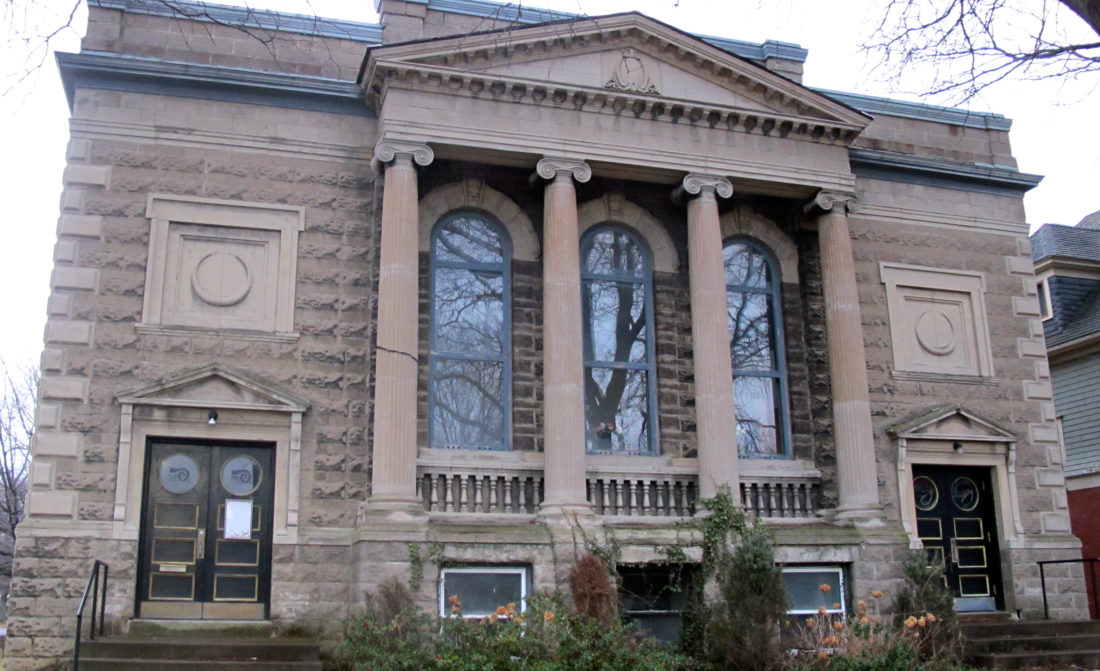
The Adams Art Gallery, which sits at 600 Central Ave., Dunkirk, was originally Adams Memorial Church. In 1978, the building was gifted to an arts organization. In 2005, Access to the Arts, Inc. took over the building. It has been closed the last couple of years.
The “I Love NY” website states that “the building has 22-foot ceilings, a fusing of natural and track lighting and (a) classical interior (that) reflects its origin as a church … (its) spaciousness (is) especially well suited to the display of contemporary art works.” This information, clearly dated, gives readers an idea of what the building’s interior looked like a decade or so ago.
It took less than 10 years for that shine to wear off.
Chris Schaeffer was one of the Access to the Arts, Inc. administrators in 2005. He told the OBSERVER that even then, the building was showing its years, and community arts groups had a hard time managing its maintenance issues.
“The Arts Council moved to Jamestown, and we were basically running the gallery (in 2005),” Schaeffer said. “They had transferred the title to us, because they really couldn’t afford to keep (the building) either.”
After a handful of years of occupying the space, Schaeffer said, the organization felt it was running out of options.
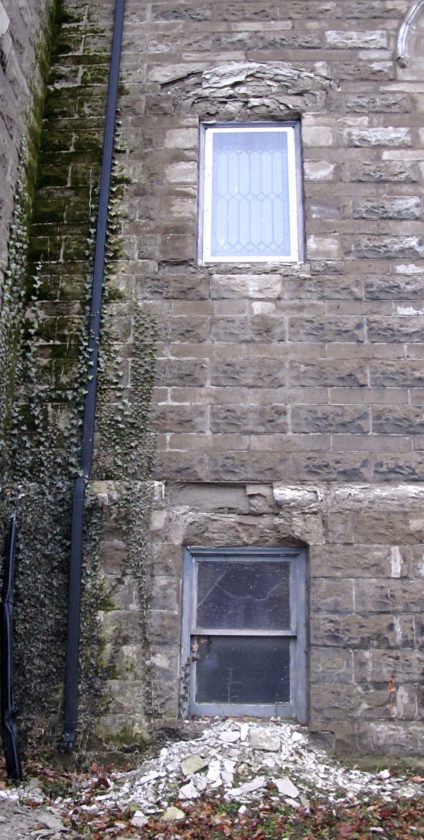
There are many problems with the Adams Art Gallery.
“We never really had the funding for maintenance,” he said. “Then that ‘deferred maintenance’ took a toll; even at that time the roof needed to be replaced. We were spending hundreds of dollars each year patching it, then just patching patches. We couldn’t raise enough money to fix it.”
Schaeffer said his group tried a crowdfunding campaign, and secured pledges of only a few hundred dollars — thousands and thousands short of what they needed to fix the roof and do other repairs.
“There was no grant money,” he said. “No one has deep pockets around here. There aren’t grants for buildings, just for programs.”
The last event at the Adams Art Gallery took place in 2013 or 2014. After that, it closed “temporarily” for repairs, and hasn’t opened since.
CRUMBLING PRESENT, UNCERTAIN FUTURE
With the damage to the building only worsening with each winter snowfall and spring shower, it’s uncertain just what kind of future the former Adams Art Gallery will see — or if it will see one at all.
Schaeffer disclosed that because of the leaks in the roof, the interior of the building has been damaged. There is also damage from the electric and gas being shut off, he said.
So what’s the price tag? Schaeffer estimates that it would cost about $500,000 to fix it.
“Once you fix the roof, inside it’s mostly just drywall work,” he said. “Putting some things back together. We were looking at a couple hundred thousand to replace the roof — but that was years ago — and to put some flashing around the sides. The plumbing was never right. The sewer lines in there are over a hundred years old. They need to be reworked.”
The basement has also had flooding issues in recent years.
“(Fixing the building) is just beyond most people’s budgets,” Schaeffer said. “We’ve talked with other organizations (that) are looking for space, but it’s expensive.”
Schaeffer and Access to the Arts, Inc. have put the building up for sale a couple of times since the Adams Art Gallery closed, but they haven’t been able to negotiate a successful deal. The building was basically gifted to the last two groups that took it over, and no one has been especially eager to pay for the privilege of dealing with it.
The idea of saving the building isn’t totally dead, though, Schaeffer noted.
“More recently, we’ve been talking with partnering with someone else (to open it again),” he said. “People are looking to see if they can get (funds) together; maybe collaboration would do it. People are trying.”
Many people in the community would like to see the building metamorphose into some type of third life — it’s been a church, it’s been an art gallery — but with a little imagination, it could be something else, too. A space for learning and lectures and art, yes, but it could also be a commercial space, or a restaurant, or a dance studio. It could be a place where people Zumba or practice yoga. It could be a community theatre. It could be all of these things at once, since pooled resources, as Schaeffer said, could be the ticket to the building’s restoration.
All of those, any of those, would be better than one more building falling into ruin in Chautauqua County.
Lifestyles Editor Gib Snyder contributed to this article. Special thanks to Wendy Westwood and the Unitarian Universalist Congregation of Northern Chautauqua; Diane Andrasik, Peter Komada, Stephanie Pulvino and the Historical Society of Dunkirk and Dr. Daniel Reiff.
Do you live or work in a historic building in northern Chautauqua County? Would you like to see it featured in a future Building Block? Email rcuthbert@observertoday.com.
TOP STORIES
High winds down trees, wires in county
High winds were the culprit of downed trees and wires throughout Saturday. National Weather Service spotters said ...
Spectator inks awards at state conference
Church spreads joy at Fredonia Place
School 7 lists top students
In honor of Conor