A rewind of 2019
Lake Shore Hospital closure tops local events
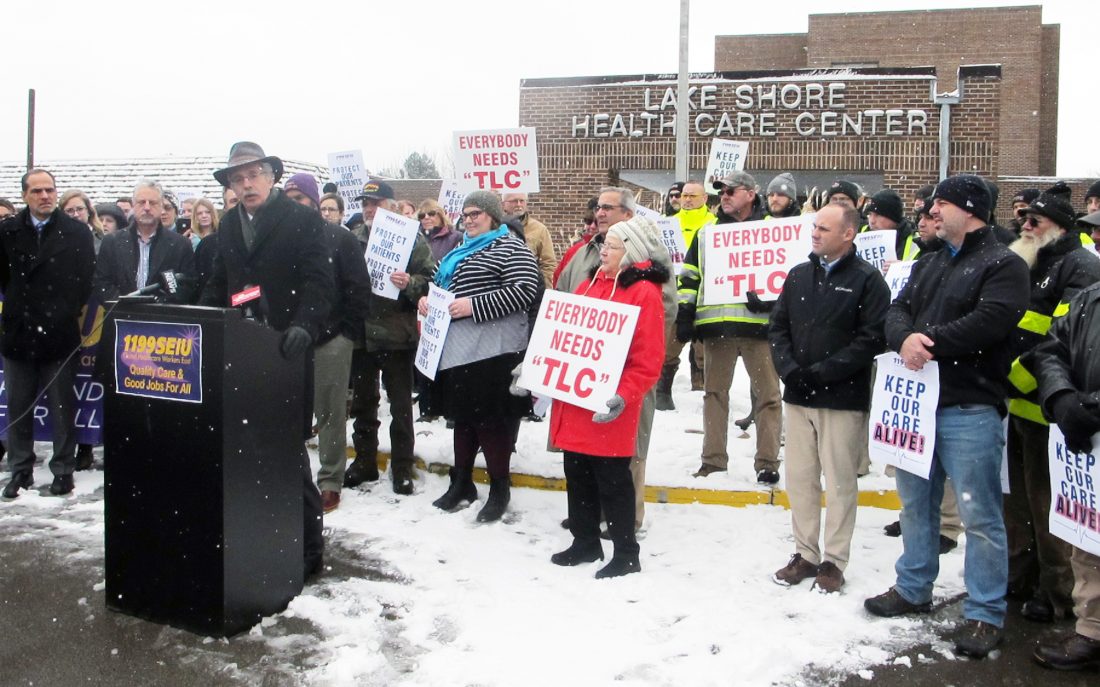
OBSERVER File Photo A rally was held earlier this month to keep Lake Shore Hospital open. It is scheduled to close Jan. 1.
OBSERVER Staff Report
When looking back on 2019, the decision to close Lake Shore Hospital was selected as the biggest local event of the year. Unless something changes this upcoming week, Lake Shore Hospital will permanently close its doors Wednesday.
This is the third time this decade Lake Shore Hospital news made the top 10. In 2013, Lake Shore Hospital was scheduled to close, but following rallying by the local community, the state decided to keep it open. That year, Lake Shore’s tentative closure was number 2, which was beat out by NRG’s approval to become a natural gas plant. That plan never happened.
In 2014, the rally cries which helped keep Lake Shore open was also number two. The number one story that year was the planned closure of Carriage House in Dunkirk and Fredonia.
Brooks Hospital, which is also part of TLC, came in at number 2 this year for its plans to move relocate to the village of Fredonia. In 2017, Brooks was expected to go to the town of Pomfret and that was the top story for that year.
The construction of the roundabout at Routes 60 and 20 came in at number 3 for 2019, with number 4 being the returned remains of a Korean War veteran from Dunkirk.
Dunkirk’s remodeled pier came in at 5, while the stabbing death of a local teenager came in at 6. It was the only murder in the northern end of Chautauqua County.
Items 7 through 9 focused on politics. George Borrello went from county executive to state senator, Dunkirk returned its mayor, while Fredonia did not.
Finally, the controversy of wind towers placed 10th, this time focusing on Villenova. The construction of wind towers in Arkwright came in last year at number 2.
Here’s a summary of our top stories of the year:
1) Lakeshore Hospital to close
Early in December, the Brooks-TLC Hospital System made the announcement in what it is calling a difficult decision, which is closing the Lakeshore Hospital in Irving. The announcement made clear that the hospital would be totally shut down on Jan. 1, pending patient transfers.
The closure impacts all services at the TLC Campus including outpatient and support services and chemical dependency services. Christopher Lanski, chair of the Brooks-TLC Hospital System Board of Directors, said that operating losses of more than $6 million annually at TLC have been funded though the New York State Department of Health for the last few years, but such funding cannot be sustained going forward.
A lot of residents and government officials around Chautauqua County are concerned about what kind of effect this will have on the county. Even in Gowanda, the police force is concerned about the hospital’s closing because of the fact that they bring a lot of people to the hospital on a weekly basis for chemical dependency services.
Community members are also highly concerned about the economy of the county now as well. Over 200 jobs will be lost as of Jan. 1 with the hospital’s closing, although some positions could be transferred to other area hospitals. With it being right after the holidays, a lot of families will be struggling to find new jobs on such short notice — even the employees of the hospital did not know of it’s closing until they announced it earlier this month.
As for the future of the campus, no set decisions have been made. Some rumors have started, but nothing is planned for the future of this campus.
$6 million annually at TLC have been funded though the New York State Department of Health for the last few years, but such funding cannot be sustained going forward.
A lot of residents and government officials around Chautauqua County are concerned about what kind of effect this will have on the county. Even in Gowanda, the police force is concerned about the hospital’s closing because of the fact that they bring a lot of people to the hospital on a weekly basis for chemical dependency services.
Community members are also highly concerned about the economy of the county now as well. Over 200 jobs will be lost as of Jan. 1 with the hospital’s closing, although some positions could be transferred to other area hospitals. With it being right after the holidays, a lot of families will be struggling to find new jobs on such short notice — even the employees of the hospital did not know of it’s closing until they announced it earlier this month.
As for the future of the campus, no set decisions have been made. Some rumors have started, but nothing is planned for the future of this campus.
2) Brooks Hospital selects site in Fredonia, gets village approval
There’s not one sign of it at the site yet, but Brooks-TLC Hospital System received approval in June from the village of Fredonia to build a new hospital. Community concerns over congestion in the area were softened when Brooks-TLC officials agreed to add a second entrance and exit, off Route 60, to their plan.
The site, a former Cornell Cooperative Extension vineyard that fronts on East Main Street, remains covered in grape vines as Brooks-TLC navigates severe financial difficulties and the thicket of approvals and contracts required to get things started. However, Brooks-TLC leaders assured the OBSERVER in November a groundbreaking on the $70 million project is planned for the spring. The 100,000-square foot building is intended to replace Brooks Memorial Hospital in Dunkirk — a fact which has some people upset, as evidenced by a February rally and a petition which advocated keeping the hospital where it is.
3) Roundabout lawsuit dismissed, construction begins
The to-be-completed roundabout in Fredonia on the intersection of Routes 20 and 60 began construction this past year and is expected to be finished by summer of 2020.
The Department of Transportation’s project overview website states the construction contract was awarded April 25. The contract award was for $3,685,957.
The project was delayed early on because Enrico Francani, owner of the nearby McDonald’s, sued the DOT over what he alleged would be a loss of business due to the configuration of the roundabout. He petitioned the State Supreme Court that DOT didn’t sufficiently study the project’s economic impacts on nearby businesses. State Supreme Court Judge Tracey Bannister dismissed that suit Thursday.
Alan Bozer, Francani’s lawyer, told the OBSERVER, “Our client is disappointed in the ruling. While we respect the court’s decision, it is troubling that safety issues we identified will not be addressed, and that local businesses will be adversely affected both by the construction and by the big new roundabout and medians.”
Francani and his legal team accused the DOT of not taking a “hard look” at project impacts, but Bannister wrote that reviewing the record made it clear the department did do so.
“As indicated in the court’s decision, it is a high burden to overturn a decision by a New York State agency. The court was satisfied that the DOT took a ‘hard look’ at the matter. That is all the law requires,” Bozer said. “The court did not evaluate the merits of the DOT’s plans, or decide there are no safety issues, or that business interests are protected, only that the DOT considered them.”
4) Remains from Korean war veteran returned to Dunkirk
Moments before he died, U.S. Army Sgt. Gerald Raeymacker was scurrying on the battlefields, helping a wounded friend to safety in North Korea. It was a letter from fellow U.S. Army soldier Louis Reel that gave details to the Raeymacker family in 1953 on how their brother and son from Dunkirk died while serving his country.
During Raeymacker’s eulogy, his sister, Kareen Briggs Simmons, read the letter from Reel. This letter revealed the horrors and dangers of what her brother was facing in the Korean War.
In the letter explained the last moments of Raeymacker’s life. Reel described in his letter the horrific sounds of his friend being shot and killed in battle. He granted Raeymacker’s last wish, which was to be buried under the haystack they were hiding behind.
Raeymacker was a member of Battery B, 57th Field Artillery Battalion, 7th Infantry Division, 31st Regimental Combat Team. He was reported missing in action on Dec. 6, 1950, in the vicinity of the Chosin Reservoir, North Korea, when his unit was attacked by enemy forces. Following the battle, his remains could not be recovered.
On July 27, 2018, following the summit between President Donald Trump and North Korean Supreme Leader Kim Jong-un in June 2018, North Korea turned over 55 boxes, purported to contain the remains of American service members killed during the Korean War.
Then, on Oct. 17, 2019, at around 11:15 a.m., Raeymacker’s remains arrived in Dunkirk. A procession after the funeral followed him to his grave. Raeymacker was finally returned home, to be buried respectfully.
5) Dunkirk celebrates remodeled pier
The newly renovated Dunkirk Pier was completed in August and brought with it many new updated features including improved pedestrian access to Lake Erie, better connections to Dunkirk’s waterfront trails, increased seating and green space, improved fishing and water recreation opportunities, new lighting and new wayfinding and signage.
This project was a part of Dunkirk’s $2.5 million grant provided by Empire State Development’s Smart Growth Community Fund, awarded in 2017. The project is one of three major revitalization projects in the city supported by this grant.
“The investments made at the Dunkirk Pier and Harbor will help to boost the area as a waterfront destination,” said Lieutenant Governor Kathy Hochul, who was present at the ribbon cutting. “Our Smart Growth fund is a recognition of the importance of pedestrian access and growing downtowns across Western New York. These improvements will ensure local residents and visitors have a world-class experience during their visit to Chautauqua County and strengthen the local economy.”
6) Fatal stabbing in Dunkirk, arrest made
On May 15 at around 4 p.m., Dunkirk Police responded to the 100 block of Lincoln Avenue in the city of Dunkirk for a reported fight. Upon further investigation, it was learned that 15-year-old Jefrena Brown was stabbed during the altercation and then transported to Brooks Memorial Hospital by a personal vehicle. There she was stabilized and StarFlighted to Erie County Medical Center in Buffalo for further treatment, she died the following day.
A warrant was issued for person of interest Ashlyann M. Lopez-Lopez on May 26 and on May 30 was taken into custody where she was charged with first-degree manslaughter and arraigned in City Court by Judge Kuzdale with her bail set at $500,000/$1,000,000. On July 1, her charge was lessened to second-degree manslaughter and Lopez-Lopez pleaded innocent in Chautauqua County Court, the grand jury indicted Lopez-Lopez on a reduction of charge, after presentation of the known facts; bail was also reduced from $500,000 to $150,000 accordingly.
The case is expected to go to court in early 2020.
7) BORRELLSO TAKES STATE SENATOR POSITION WHEN CATHY YOUNG RESIGNS
In March, longtime state Senator Catharine Young, left office to pursue a position with Cornell.
The seat was left vacant until the November elections, when George Borrello won the seat to become the next representative for the 57th District. The businessman and Irving resident had just completed his first term as County Executive.
“It is an incredible honor to assume my new role,” Borrello said. “This immediate seating means that I can begin my Senate responsibilities even as I continue to assist with the transition efforts in the County Executive’s office.”
Even just in the last month, Borrello has proven to be supportive of our communities — he rallied at Lake Shore Hospital against its coming closing. When he was seated, he stated “Never before has it been more important that we have a strong voice in Albany, advocating for our region, our rights and our way of life.”
8) Rosas re-elected with GOP council
A 48 vote difference is how it played out in the city of Dunkirk election Nov. 5. The leader at that time was incumbent Mayor Wilfred Rosas; however is would take almost two weeks before being officially declared a winner. On Nov. 17 that winner was still Rosas, who took in 1,660 votes to Republican candidate Shaun Heenan’s 1,601 votes.
With Rosas’ re-election however came a shake-up in the city’s Common Council, as two seats turned over from Democrat to Republican and the Third Ward council seat retained a Republican candidate. This change put the city firmly with a Republican council and a Democratic mayor.
“I want to thank all of my supporters and especially my family, my wife and my children and my two brothers,” Rosas said last month. “It was a tough election, but now that the election is over we need to unite and move the city forward. We do that by working together and making decisions that are in the best interests of the city.”
First and Second Ward council seats remained with Don Williams and Marty Bomonto respectively, while Third Ward went to James Stoyle, Fourth to Nancy Nichols and Councilman-at-large to Paul VanDenVouver. Swearing in of all the candidates will take place Jan. 1.
9) Landis out as mayor in Fredonia
Four years ago, Fredonia residents elected their first female mayor, choosing outsider Dr. Athanasia Landis.
She worked hard to make connections in Albany, including meetings with state economic development officials, the regional development councils and the governor’s office. Those efforts led to the award of a $2.5 million smart growth grant from New York state in 2018 — a major achievement when you consider the neighboring Dunkirk won the same award in 2017.
But the most trying days were likely the key moments that led to her Election Day defeat. Former village Administrator Richard St. George in July 2018 announced his resignation due to a perceived hostile work environment with blame firmly tilted toward Landis. When his position was not refilled, it led to a major division between the trustees and a segment within the village.
In the end, village residents decided to elect Douglas Essek as mayor, one of the trustees she often locked hors with. Essek, a Republican, will have to work with a Democratic board.
10) Villenova eliminates planning board, OKs tallest turbines against community wishes
Although there are wind turbines in Chautauqua County, the thought of more of them upsets many residents, especially in Villenova.
On Oct. 9, the Villenova Town Board elected to dissolve what they considered to be their long dead planning board. Many residents were against this, such as Nancy Huber, who applied to be a member of the board, “it’s so blatantly obvious that you don’t want any input from your citizens and it’s very disappointing to me,” Huber had said. The dissolution passed unanimously with Town Supervisor Yvonne Park stating that “there is no requirement that a town have a planning board.”
Later that month, on Oct. 31, the town held a special meeting to okay the height changes to 37 wind turbines in the Ball Hill Wind Energy Project. The towers grew by 100 feet, from 499 to 599, making them the largest turbines in the onshore continental United States, bypassing the current record holder, the Hancock Wind Project in Maine, by 25 feet. The vote for this was passed unanimously as well.
TOP STORIES
Ferguson calls for closure of Route 60 hotel
Fredonia Mayor Michael Ferguson wants the shutdown of a Route 60 motel notorious for violent incidents. “I have ...

Construction of Chipotle begins
Dunkirk plants trees for Arbor Day

Legislature approves electric lawn equipment rebate program
Wdowiasz proposes dog shelter fees