Town water project goes with flow
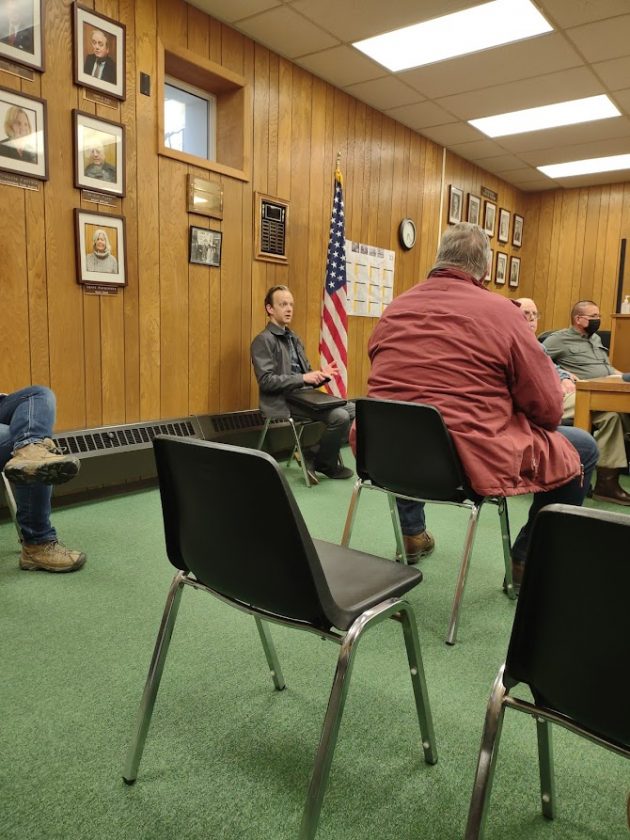
OBSERVER Photo by Anthony Dolce CPL engineer Seth Krull discusses the project in the town of Dunkirk.
Last week, the town of Dunkirk held a public hearing to hear the concerns of residents in regard to the Shorewood Water Line installation. The cost of the project is not to exceed $2,295,000.
Seth Krull, the engineer for the project from Clark Patterson Lee, was on hand to answer any questions residents may have had about the project.
One general consensus echoed by those in attendance is that the work needing to be done is supported, though people are concerned about the state of the roads as the project is being done. Dunkirk Town Councilman Jay Bishop said that he’s been front and center to several excavations on Shorewood because of the state of the water system and his road has endured many projects.
“When they dig up the road, the equipment they bring down doesn’t dig up the road,” Bishop said. “We have neighbors down at the other end of the road who have done huge break wall projects, and so far, that hasn’t ruined our road. I think it’s an integral part of what needs to be done on our particular road.”
Bishop noted the town of Dunkirk has ample experience with waterline projects before, and with this one being as big a need as it is, it should be trusted that the town’s experience will have as little interference with the lives of residents as possible.
“This isn’t our first rodeo for the town of Dunkirk to promote water projects to improve accessibility and water service,” he said. “We did a huge project on Bennett Road that involved residential houses, we’ve done a huge project on Roberts Road.
When they turned the water on, nobody’s homes blew up and I don’t think there were any fountains in people’s front yards, as far as I know.”
One question Krull was asked is if the utilities will have 10 feet of separation off the existing sanitary, which will be adhered to as best as possible to avoid cross contamination, and if it gets closer than 10 feet, sanitation requirements are met due to the material the piping is made of.
“What we’ve been doing with other projects in the area, and the Health Department has accepted, is that in areas with less than 10 feet of separation, the pipe will be wrapped in effectively a bag, mainly used for metal pipes,” said Krull. “In this case, PVC pipe is proposed, but we can further augment that by wrapping the plastic pipe.”
After the public hearing, the board approved a resolution that the proposed improvements are in the best interest of the town, and will proceed with the Shorewood Water project.
TOP STORIES

Beaver Club donation aids Fredonia Little League
Mayor responds to contract clamor
Aspire looks ahead to WCA Home move
Imagine Forestville, residents plant trees
Tax on vacation homes could hit county
Some state legislative Democrats are proposing extending Gov. Kathy Hochul’s proposing a pied-a-terre tax on ...