
Clean slate bill passes state Assembly and Senate
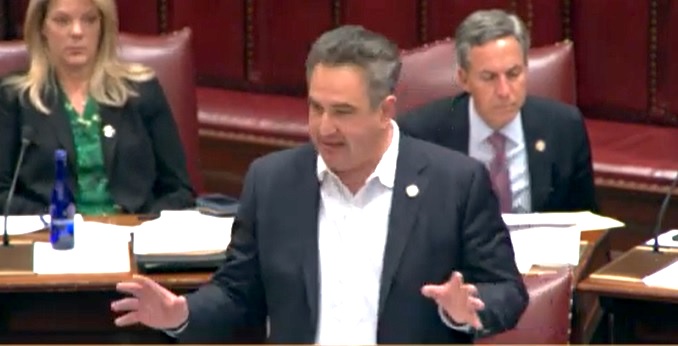
Sen. George Borrello, R-Sunset Bay, is pictured debating legislation to seal criminal records.

Assemblyman Andrew Goodell, R-Jamestown, debates legislation to seal criminal records in the state Assembly.
Sen. George Borrello, R-Sunset Bay, is pictured debating legislation to seal criminal records.
Assemblyman Andrew Goodell, R-Jamestown, debates legislation to seal criminal records in the state Assembly.
Trending
Gov. Kathy Hochul will now have the final say on legislation that would seal millions of criminal convictions each year.
Both houses of the state Legislature approved A.1029C/S.7551-A after hours of debate as the state legislative session drew to a close over the weekend. Assembly debate on the bills took more than five hours while Senate debate took nearly 90 minutes, an eternity for a Senate debate. Approval in both chambers was largely along party lines.
Assemblyman Andrew Goodell, R-Jamestown, voted against the legislation, as did Assemblyman Joe Giglio, R-Gowanda. Goodell said those with criminal convictions can ask for a Certificate of Relief from Disabilities from the court or, for crimes happening outside of New York state, from the state Department of Correctional Services. There are also certificates of good conduct or a formal sealing of the record that is available by petitioning the court where the case was decided. The Jamestown Republican also said the New York has multiple multiple protections in its Human Rights Law for those with criminal records who feel they are shut out of the job market because of their criminal convictions.
"Throughout this debate today there seems to be this underlying current or belief that if you have committed a crime there is no second chance in New York -- that your criminal record will follow you forever for the rest of your life, that it's a perpetual punishment, that there's no break for you," Goodell said in his comments on the Assembly floor. "That is just not true. … Because we have a comprehensive program in place, sir, we don't need to eliminate all judicial discretion and grant automatic sealing, which is what this bill does and I can't support it. "
Convictions for traffic infractions and misdemeanors will be sealed after three years. Misdemeanor convictions will be sealed after at least three years have passed from the defendant's release from jail or the imposition of a sentence from the judge if jail time was not part of the sentence.
If a person is convicted of a crime before the prior conviction is sealed the calculation of time for the prior conviction begins when the second criminal conviction sentence begins.
Felony convictions would be sealed eight years after a defendant is last released from prison or from the date the sentence is imposed if there is no prison sentence.
The Clean Slate legislation doesn't apply to sex offenses or sexually violent offenses under Section 168 of the state Correction Law or to class A felony offenses.
"Today we begin to change the lives of more than 2 million New Yorkers," said Assemblywoman Catalina Cruz, D-New York City and sponsor of the bill in the Assembly. "I want to thank my colleagues for helping us give people a second chance at life. This legislation isn't about criminal justice only. It isn't just about public safety, it isn't just about economic justice. It isn't just about equity and fairness. It's about redemption. People can change. People can get better. People can repent. People can be forgiven. Our society should not be judged on the behavior of one member at its worst moment but on our abiltiy to forgive them and to give them the ability to move forward and heal and to become productive members of our society. At the heart of all the oposition I keep hearing it's he belief that people cannot change or that they're solely defined by the worst thing they have ever done in their life. Mr. Speaker, there are more than 2 million New Yorkers who made a mistake, 2 million New Yorkers who perhaps got caught up in the system or who maybe even pled to something they were not even guilty of because they wanted to move on with their lives … This is perpetual punishment."
Sen. George Borrello, R-Sunset Bay, also voted against the bill in the Senate. He noted he has someone with a criminal record on his payroll currently in his private business, but said he made the decision with knowledge of the worker's past. Borrello questioned why the Business Council changed its perspective on the Clean Slate Law from opposition to being in favor -- saying the council's change of heart may have come with the addition of a liability shield protecting big employers from lawsuits if a business hires someone with a criminal record unknowingly and that employee commits a crime on the job or hurts a fellow employee. Borrello said the state Legislature has passed several pieces of legislation in recent years giving private right of legal action on a variety of issues, but rarely gives a liability shield to companies or groups.
"Well I really believe it has a lot to do with this civil liability shield," Borrello said. "Now, this applies to everyone, small business, big business, individuals -- I get that. But if you're a small business owner, and, you hire someone, you have no knowledge of what they have done, and something goes wrong, chances are it is going wrong to you. or your loved one, the family member that works in your business or the people that you know. What happens if it goes wrong at an Amazon warehouse, a guy that has a history of violence, assaults, fellow worker in the Amazon warehouse? Well, do you think that Jeff Bezos gives a damn? No. But he he wants that liability shield. He wants to be protected from having to pay the price."
Borrello also called for the state to do more to track whether employment increases for those with criminal convictions or if the Clean Slate Law helps decrease the rate of those accused of crimes committing further crimes.
"So there are a lot of flaws pointed out but, at the end of the day, I do believe in a second chance. But with this bill and the unlimited number of times that people get, I don't believe in a 22nd chance, so I'll be voting no."