
Buffalo Dem wants simpler election ballot
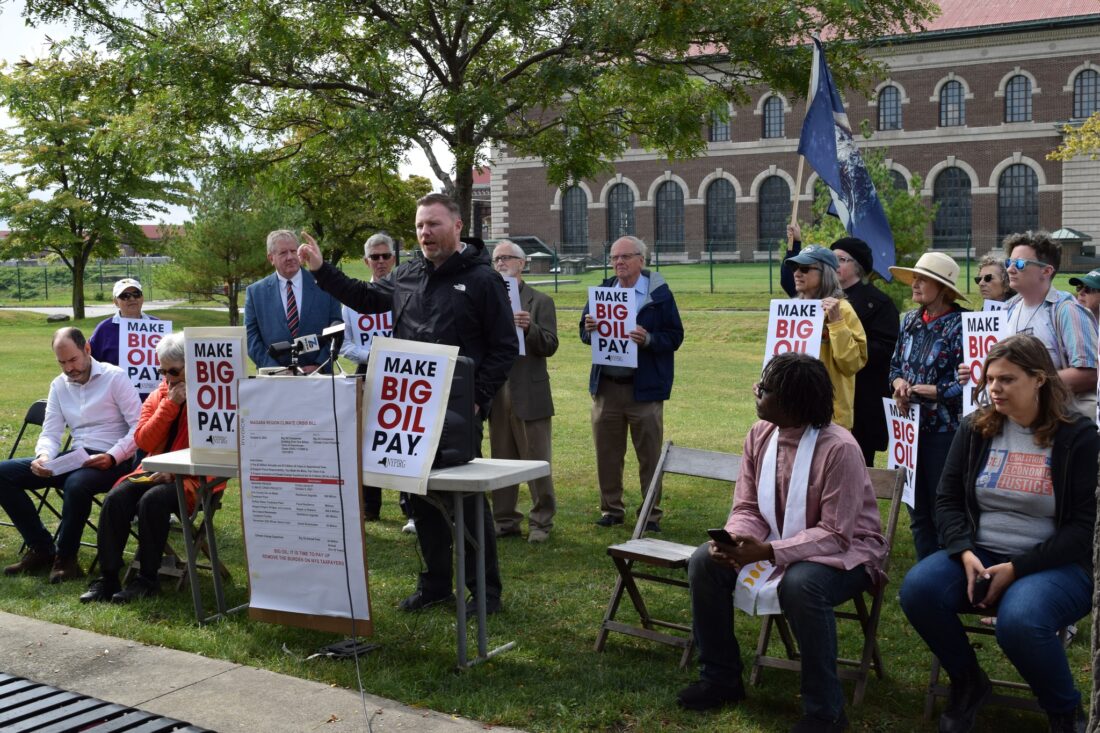
Assemblyman Pat Burke, D-West Seneca, speaks during a news conference earlier this month.
If Assemblyman Pat Burke, D-West Seneca, has any say in the matter, your election ballot will look a lot different in the future.
Burke recently introduced legislation (A.8178) that would remove party lines from ballots for any election that doesn’t involve the U.S. presidency or governor of New York state. Candidates would only be listed once, with the exception of presidential and gubernatorial races, with party nominations listed next to a candidate’s name rather than listing candidates on a party row or column..
“Current New York law allows candidate names to appear more than once on the ballot, creating a confusing and convoluted ballot that can be difficult for many to navigate, especially seniors,” Burke wrote in his legislative justification. “New York’s grid based design counter-intuitively requires voters to potentially select more than one candidate per column.”
Ballot position would be determined by the party that received the highest number of votes in the previous election, with those candidates appearing first followed by other parties’ candidates in descending order.
Burke said his proposal doesn’t change New York’s status as one of five states that allow fusion voting, a system that allows more than one political party to nominate the same candidate. If a candidate receives multiple nominations, the candidate will either appear on the general election ballot multiple times or once with all affiliations listed. Fusion voting would certainly remain intact for presidential and governor’s elections, but having local candidates on one line of the ballot is fusion voting in name only since voters wouldn’t be able to choose between a candidate on the Republican line or the same candidate on the Conservative Party line on the ballot.
“A ballot is possibly the most important interaction between a government and its citizens,” Burke wrote. “Thousands of votes are lost in elections every year because of poorly designed and confusing ballots, and these very often make the crucial difference in determining who wins election. In 2022 alone, there were three state legislative races decided by less than 20 votes. Simple, straightforward ballot design saves votes and evades
electoral controversy. … This bill is solely to streamline state ballots to ensure that voters feel more comfortable navigating the voting process.”
In 2020, Gov. Andrew Cuomo streamlined the ballot by raising the threshold for third political parties to appear on the ballot. In the past, to achieve statewide ballot status, minor political parties needed to earn 50,000 votes for their candidates in the previous election. Cuomo proposed, and the state Legislature approved, rules that require minor parties get at least 130,000 votes or 2% of votes cast in the election. And, rather than tying the qualifications to presidential and governor’s races that happen every four years, minor parties are required to qualify every two years, which includes local elections like this year’s that generate less interest across the state.
The Supreme Court recently denied a writ of certiorari petition for an appeal brought forth by the Libertarian Party of New York and the Green Party of New York. The decision ends a three-year legal battle the parties had waged against the state over the 2020 ballot measures.
“”We are frustrated and disappointed by the Supreme Court’s decision to not hear our case,” said Andrew Kolstee, a Jamestown resident and chair of the Libertarian Party of New York in a statement on gp.org. “It’s a harsh blow to the future of third parties in New York State, despite a growing number of people identifying as independent and yearning for alternatives; the duopoly’s stranglehold continues to stifle the voices of diverse political movements. The Supreme Court missed an opportunity to address items such as the lower courts’ disregard for New York’s nation-leading signature-per-day requirement as well as their contention that third parties must endorse Republican or Democratic candidates to attain ballot access.”
TOP STORIES
Petition opposes idea of data center
Dunkirk man charged in narcotics probe
An investigation into narcotics activity in Pomfret has led to the arrest of a Dunkirk man. A search warrant ...
Comedy Center Seeks $200K for Pittsburgh, Cleveland marketing
City schools talk budget amid sadness over loss
Village vote can ice water debate
County puts fire districts on notice for lack of payments
A pair of fire districts are facing the loss of future support regarding a lack of payment to Chautauqua ...