Proposal would end in-play sports bets in New York
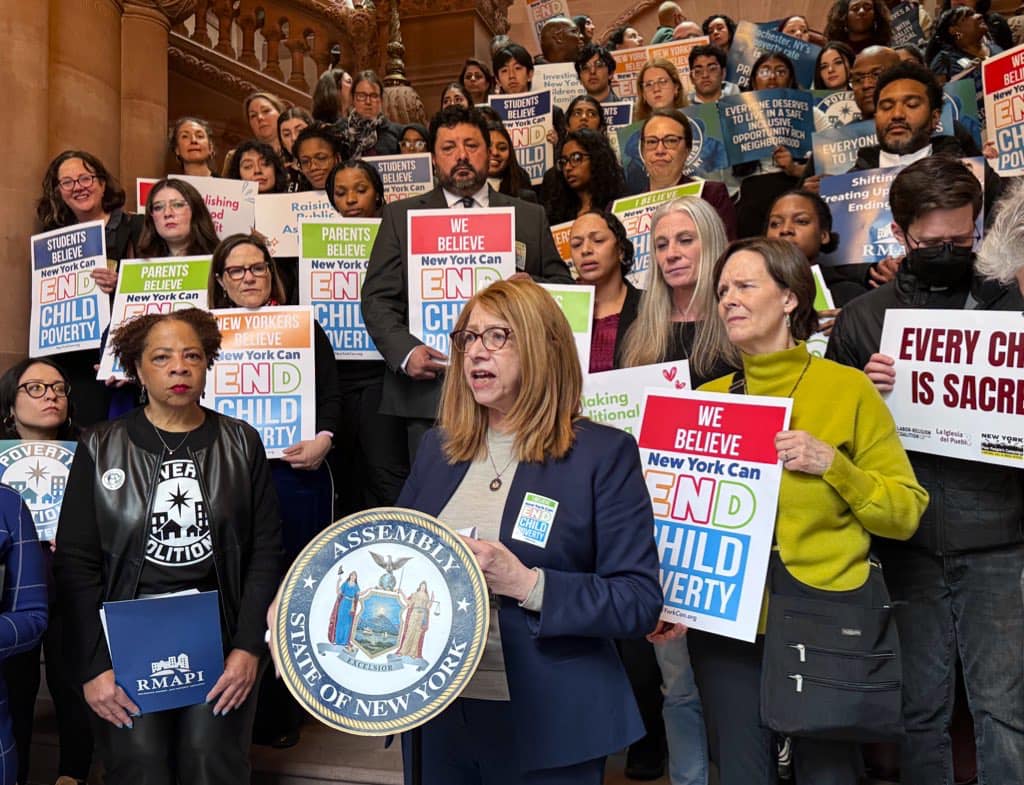
Assemblywoman Linda Rosenthal, D-New York City, is pictured during a news conference earlier this year.
Yet another piece of legislation has been introduced seeking further limits on sports betting in New York state.
Assemblywoman Linda Rosenthal, D-New York City, recently introduced legislation (A.9343) that would no longer allow casinos and mobile sports betting platforms to accept in-play wagers. In-play sports betting, also known as live betting or in-game betting, is the practice of placing wagers on a sports event after it has already begun and is actively in progress. Unlike traditional pre-match betting, where all bets are placed before the event starts, in-play betting allows you to react to the action on the field in real time.
Rosenthal said in her legislative justification that a 2024 study conducted by the National Council on Problem Gambling found that 20 million adults had reported experiencing “at least one indicator of problematic gambling behavior many times” throughout the year; this includes 19% of people who made online bets.
In addition to being accessible to bettors 24/7, an analysis conducted by optimove Insights, a marketing platform for sports betting, found that people placed larger wagers during live action events than those who placed bets before the beginning of a game. A 2018 paper published in the Journal of Gambling Studies found that 78% of people who placed live action bets were classified as problem gamblers, which is higher than for other forms of betting.
“New York state has an obligation to protect consumers and address concerning public health trends. As such, this legislation will prohibit mobile sports betting licensees, operators and casinos from accepting in-play wagers in New York state,” Rosenthal wrote in her legislative justification.
Rosenthal’s proposal, which could be taken up when the next legislative session begins in January, isn’t the first piece of legislation aimed at sports gambling.
Legislation introduced recently in the state Assembly would prohibit mobile sports wagering operators from providing counseling, therapy, and treatment services for bettors in New York.
Assemblywoman Carrie Woerner, R-Round Lake, said the prohibition contained in A.9146 would ensure that individuals seeking counseling, therapy, and treatment for problem gambling through mobile sports wagering websites and platforms are directed exclusively to the New York State Office of Addiction Services and Supports (OASAS) for help rather than treatment providers who may have a financial arrangement with sports betting providers.
If approved, Woerner’s bill will require mobile sports operators to direct individuals seeking counseling, therapy, and treatment services for problem gambling exclusively to the problem gambling webpage maintained by OASAS.
“Problem gambling is a growing public health concern in New York, particularly with the rapid expansion of mobile sports wagering,” Woerner wrote in her legislative justification. “OASAS was established as the designated state agency for addiction services, including services for problem gambling. It oversees one of the nation’s largest addiction services systems with more than 1,700 prevention, treatment, and recovery programs for New York residents. … Crucially, OASAS administers the credentialing for problem gambling, counselors, prevention practitioners, and prevention specialists, and all services are available regardless of ability to pay.”
Lawmakers from both sides of the political aisle are seeking changes to the way mobile sports betting advertising is handled.
(A.8925) comes from Assemblyman Phil Steck, D-Schenectady, who proposes banning advertising by or on behalf of mobile sports wagering license holders during the broadcast of any live sporting event. The bill could be up for discussion when the state Legislature begins its next session in January.
Steck said in his legislative justification that sports betting advertising on television has increased from $17.6 million in 2018, the year the Supreme Court struck down the federal ban on state-authorized sports betting, to $278.4 million in 2022. In that same timeline, Steck said, monthly calls to the National Problem Gambling Hotline increased by 124%.
“Because of the extensive proliferation of sports betting ads during live sporting events, viewers who are at risk for developing a problem gambling addiction or are struggling with a problem gambling addiction may be tempted to engage in gambling based on these advertisements,” Steck wrote. “Thus, to avoid the temptation, they have to limit the amount of live sports they watch. To address this issue, this legislation will ban all mobile sports wagering advertisements during live sports.”
Assemblyman Robert Carroll, D-Brooklyn, introduced his own bill (A.7962) earlier this year that includes its own version of a ban on advertising during live sports events by banning advertising between 8 a.m. and 10 p.m. and during live sports events. Carroll’s bill also includes a limit on wagers by an individual of $5,000 during a 24-hour period and prohibits advertising practices including “odds boosts” and promotions designed to induce gambling through “bonus bets” and “no sweat bets.” Bettors would also no longer be allowed to place more than five deposits during a 24-hour period while mobile sports betting operators would face limits regarding targeting minors and prohibitions on providing information on placing sports wagers. The bill didn’t make it out of committee during the 2025 legislative session but could be up for discussion in 2026.
Legislaton was also introduced prohibiting sports betting operators and platforms from sending push notifications or text messages and to require sport sbetting operators to establish default betting limits on their platforms and to notify sports bettors of their ability to opt-out of default betting limits.
In October Gov. Kathy Hochul signed legislation (S.1550/A.1118) requiring all advertisements for gambling and sports betting to include warnings about the potential harmful and addictive effects of gambling. The previous law states that each advertisement must clearly and conspicuously post a problem gambling hotline number.
TOP STORIES

Proposal would end in-play sports bets in New York

Biggest headlines: Looking back on top stories of 2025
Years of fulfilling Christmas dreams
Marcy’s vacation week offers a holiday column excerpted from her book, Rounding Third … originally from ...

CLCS hosts outdoor hiking workshop

$3M in state funding coming to county