Portugal adventure gets off to rugged start
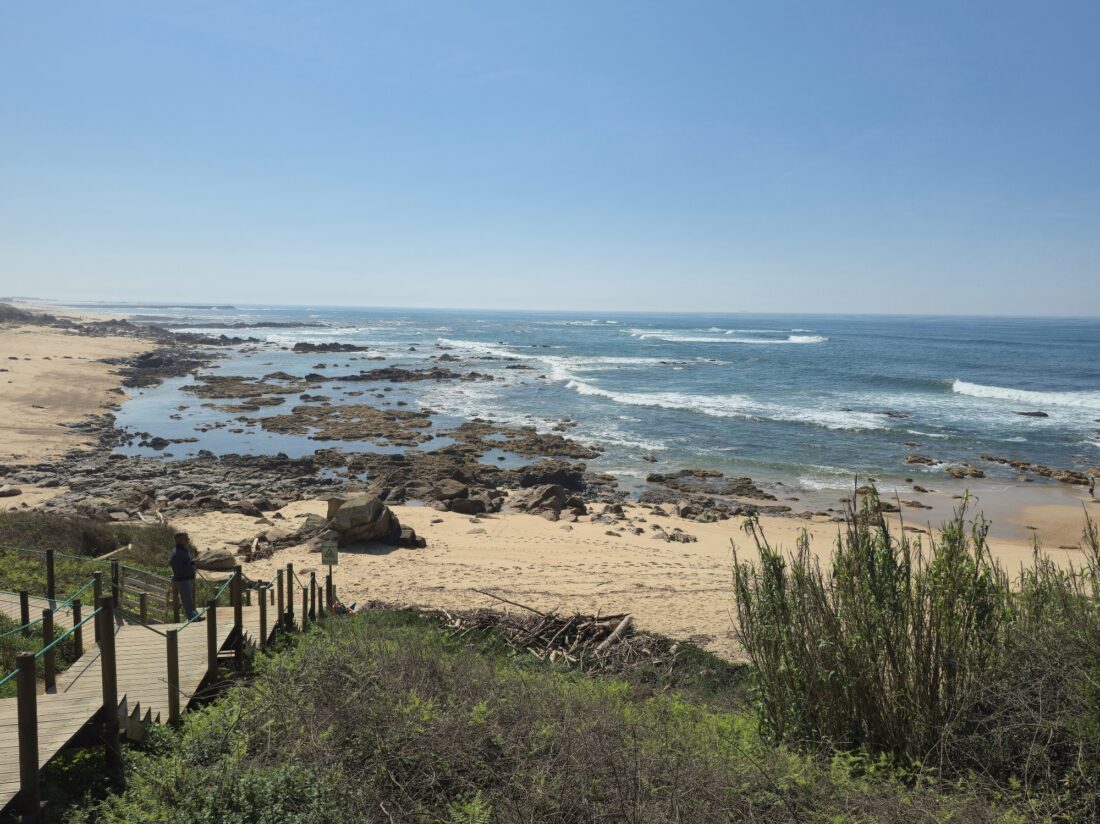
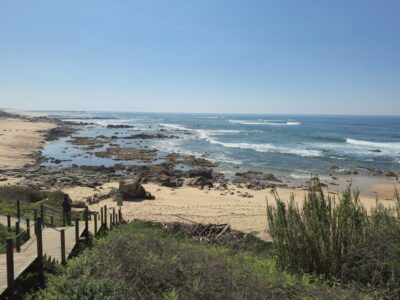
Half of the journey followed a path right along the rocky and angry Atlantic coast.
Editor’s note: This is the first of three parts.
Buen Camino is a friendly greeting to Pilgrims or “Peregrinos” from everyone and anyone who encounters others on the long trek along “The Way” of the Camino de Santiago in Portugal and Spain.
In Portugal it is Bom Camino! In English the phrase means have a good Camino! The journey ends at the magnificent cathedral in Santiago de Compostella, Spain, which contains the remains of Saint and Apostle James the Greater.
Residents of those countries have seen those on this pilgrimage since the 9th century when the relics of Saint James were discovered in northwestern Galicia, Spain. The greeting has been part of the culture for centuries, as well as recognition of the spiritual journey of those upon the path. In 1492 the Pope officially declared the Camino de Santiago to be one of the three great pilgrimages of Christendom. Each Peregrino carries an oyster shell tied to their backpack to signify that they are on “The Way”.
I was fortunate to hear Bom or Buen Camino spoken to me countless times in April as I chose to give the Portuguese route a try. This route started in Porto and led up the rocky ocean coast 180 miles to Santiago de Compostella. To put that distance in perspective it would be like walking from Dunkirk to Syracuse, or Dunkirk to Lorain, Ohio. There are several routes leading to the cathedral at Compostella. Another, more popular route is the Camino Frances, which starts in France, and is about 500 miles long. I thought that to be a bit much for my first trip out. Technically though, Peregrinos only need to walk 100 kilometers or about 62 miles to get official credit for completing the trek.
Originally, I intended to do this endeavor alone, but I was joined by my son Patrick. I am starting to get the sense that my children think that somebody needs to keep an eye on dad. Perhaps…I do tend to fully engage life. It turned out to be a nice, once in a lifetime three-week father and son trip, with only a couple small dustups.
My pilgrimage began with a flight from Washington to Lisbon, Portugal. Lisbon is close to Fatima, so I decided to first visit the site of the great and most significant appearance of The Blessed Virgin Mother in 1917. I don’t really have a bucket list, but if I did Fatima would be high upon it. In my mental preparation for this long trip, I decided to dedicate it for a very specific Catholic purpose related to St Mary. So, it was important and fitting to visit the great church and shrine in Fatima. That stop was more meaningful to me than the traditional focus of visiting St James in Compostella.
The next day we took a bus to Porto, Portugal, checked into the prearranged hotel and walked around the old part of the city. The pilgrimage starts at the cathedral in Porto, Portugal so we visited that great building and got our first stamp in our pilgrim passport. This booklet is official proof that one has walked the Camino. Stamps in the passport prove a Peregrino’s progress along The Way, and stopping for passport stamps at cafes, churches, or other businesses was a nice way of interacting with the local population. At the end of the journey the passport is presented to the Pilgrim office in Santiago de Compostella where they issue a very nice, personalized certificate printed in Latin known as the Compostella.
After dinner near our small hotel in Porto, it was bedtime. Unfortunately, I was still on east coast time, and it was a five-hour difference. Anticipating the start of the journey in the morning on foot was also on my mind and street traffic on cobblestones kept me awake. As a result, there was little sleep. Nonetheless, a significant endeavor on foot was about to begin.
In the morning, with Pilgrim passports in our pockets we set out on a great adventure.
The first day’s walk was directly along a straight rocky coast so the destination 12 miles away was always in sight. From a distance I could see two tall buildings which seemed to never get closer. In my mind, as the day wore on, I started thinking more about a cold beer and a nice bed rather than the beautiful scenery or the spiritual journey.
Upon reaching the hotel and a good relaxing hot shower, my son and I found a very rustic tavern where they served us white wine out of wooden casks. Dinner was at a nearby very nice small restaurant. Bread and olives were always presented in Portugal along with the first drink. An older, very sweet lady happily greeted us. Although we didn’t know Portuguese, smiles and gestures go a long way to mutual understanding. W were served pan fried fish along with more white wine and desert. I never did get those beers on the first day. After all of this it was finally time to sleep. I was out within a minute.
The first day, and really every day of the 14-day trek on the Portuguese Camino was sunny, breezy and springtime warm. The course of our path followed a rugged and rocky coast during most of the journey. In the early days of the trip we encountered a seaside fishing village, classic stone city centers with narrow streets and cafes, a seaside surfing town with a wide sandy beach, and ancient stone Catholic churches that were stunning in their architecture and statuary. These felt like holy places.
The walking surface in Portugal was composed of square cobble stones, beach boardwalk and country lanes until we reached the Spanish border on day five. It seemed as if the entire surface of Portugal was composed of this ancient appearing square cobblestone. This surface quickly became hard to walk on, and by Day three the blisters began to appear.
NEXT WEEK: The trip heads north.