Fredonia Masons to celebrate tricentennial with June 20th picnic
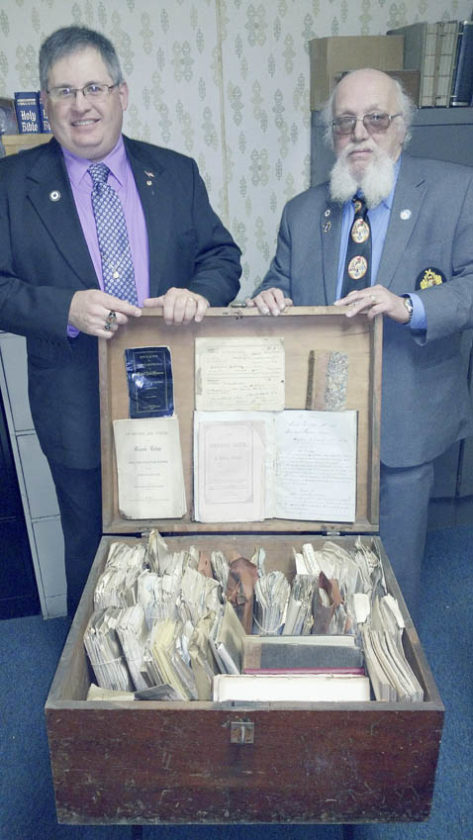
Submitted Photo Richard Newton (left) and Jim Stoll display archives of Forest Lodge. The wooden chest full of membership and financial documents was retrieved from the ruins of the old lodge hall at 16 West Main Street, after that section of the Fredonia’s business district was destroyed in an early morning blaze on February 28, 1973. According to a front-page article published in the Observer, damage from the flames was estimated at nearly $1 million. The fire reportedly broke out shortly before 2 a.m. in the kitchen of the Village Squire Restaurant at 22 West Main Street.
The Freemasons of Forest Lodge No. 166 will celebrate three centuries of fraternalism with a barbecue at the Fredonia Masonic Temple, 321 E. Main St. from 6 to 9 p.m. on Tuesday, June 20.
After dinner, an open house will feature a tour of the lodge hall and its collection of antique paraphernalia and documents, some dating to the lodge’s founding in 1816 and signed by Grand Master (later Governor) DeWitt Clinton.
“Our third-Sunday pancake breakfasts are popular, but our annual barbecue this year is a truly special occasion,” said Richard Newton, who as Worshipful Master presides over the 201-year-old lodge. “We wore tuxedos for our bicentennial last summer, so everyone can dress casually for the tricentennial this year.”
On St. John the Baptist Day, June 24, 1717, members of four lodges met in London to establish the Grand Lodge of England. Over time, an organized system of grand lodges laid the foundation for the growth of the world’s oldest fraternal society which internationally includes five million men from every walk of life.
While some historians trace Freemasonry back thousands of years to ancient Egypt, its origins more likely stem from the guilds of stonemasons and other trades that arose in the Middle Ages to the Medieval Period (11th-13th centuries).
The oldest surviving lodge charter was issued in 1057 A.D. by King Malcolm III of Scotland. These “operative” Masons are best known for building the castles and cathedrals of Europe during the Renaissance (14th-17th centuries), many of which are still in use today. A handful of Masonic stonemason lodges still exist.
Spreading globally as members traveled and sought fellowship with other men of character, Freemasonry evolved into a system of moral instruction as the building trades declined. In the U.S. today, there are well over one million Masons and thousands of lodges, most of which are tied to the history of the local community.
Neither a religion nor a civic organization, Freemasonry has survived wars, persecution by dictators, and clashes with theologians who misconstrued its benevolent teachings. There was even a brief period of national political unrest called the Anti-Masonic movement which started with an incident in upstate New York in 1826 known as The Morgan Affair, but which had faded out by 1838.
Historic documents survived fire
A recent lodge housecleaning yielded a reminder that Freemasonry in Fredonia has spanned an impressive two-thirds of the fraternity”s last three centuries. A foot locker dating to the Civil War was found in a storage area which contained records of local Freemasons going back to the early 1800s, when Fredonia, then known as Canadaway, was being settled.
“Our current building was constructed in 1976 and, like a typical home with a big family, it gradually got filled with many items that hadn’t been looked at in a long time,” said Jim Stoll, lodge secretary. “During our lodge bicentennial last year, we decided it was time to get better organized and identify anything of value not already in our archives.”
Stored in a less-damaged part of the old building, the singed chest and its contents were all but forgotten in the current lodge hall until recently. The box and papers still smell strongly of charcoal, however, suggesting they were nearly incinerated.
The lodge is carefully cataloging the dozens of petitions, receipts and letters. Many documents are in the handwriting of members and include information of interest to genealogists, such as members’ birth dates and professions.
Several of the lodge’s oldest records are signed with names that are familiar to residents even today, such as Leverett Barker, who served as the first commander of the Chautauqua County militia. He was the father of Darwin Barker, whose home at 20 East Main St. is now the Darwin R. Barker Library and Historical Museum.
Local/Region
CLCPA delay passed by legislature
New York state is poised to delay the Climate Leadership and Community Protection Act - though the 10-year delay ...
Music, Movement classes for infants begin Saturday
SILVER CREEK — Families with little ones can get ready to sing, dance, move, and play as Saturday Morning Music ...
Geological history focus of library program
WESTFIELD — Tom Hegna, associate professor of geology at SUNY Fredonia, will present “The Geological History of ...
Promoter of canceled shows won’t be on future Reg schedules
A pair of canceled performances at the Reg Lenna Center for the Arts in recent weeks are not uncommon to Jamestown ...

Lesson in life