
Jamestown Housing Committee discusses homeless shelters
Trending
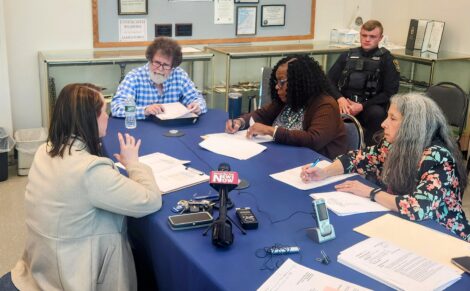
Crystal Surdyk, city director of development presented reports from both the Joy Fellowship and the Mental Health Association's "code blue" emergency homeless shelters to the Housing Committee Monday night, highlighting the success of the two shelters and the need for plans to continue to address homelessness in the future.
After successfully operating since late December, Surdyk said that the city's funding for the Joy Fellowship homeless shelter ran out mid-March, causing Joy Fellowship to make the difficult decision that March 18 would be the last evening the emergency shelter would be able to host homeless individuals during "code blue" situations.
While Joy Fellowship had to close its shelter in the middle of March, Surdyk said MHA's homeless shelter at the Gateway Center has continued to stay open.
"The county's funding was just approved last week, so we can work with them to make sure that any outstanding invoice costs, what have you, are all taken care of and paid," she said.
Surdyk told City Council members that both Joy Fellowship and the Mental Health Association are "interested" in continuing to serve as "code blue" shelters next winter, which she said is a "great thing," especially with the amount of funding and effort that was required for preparing both facilities to serve as emergency homeless shelters this winter.
"As you can see, the need is certainly there," she said. "We anticipate it will continue to be there and all of the efforts to bring them up to a place where they were able to accommodate the numbers of people will not be in vain."
While Surdyk said Joy Fellowship's spacing limitations allowed for the accommodation of eight guests and MHA's capacity could accommodate roughly 20 individuals, she said both shelters "pushed" those numbers several times in order to provide additional homeless individuals with shelter during "code blue" situations.
Based on the statistics provided by Surdyk, Joy Fellowship hosted homeless individuals at its shelter 77 different nights from December 20 to March 18.
While the shelter averaged only two guests per night during the end of December and four guests per night in January, Surdyk shared that by March, the average number of guests was seven, with the shelter even stretching capacity to 12 guests for one night.
"They hosted a total of 64 different guests, so 64 different individuals, with an average number of encounters per guest being six," she said. "Of those 64 people, on average, they stayed at that shelter six times, with the highest number of encounters for one individual being 24 times."
Surdyk added that out of the 77 nights the Joy Fellowship Shelter hosted homeless individuals, there were four nights where the shelter was closed for singles in order to accommodate families. Based on the church's insurance, the shelter was only able to accommodate either families or individuals at one time.
"Anyone who came to Joy Fellowship seeking shelter that were not able to stay would then be taken over by JPD or Uber or if they had another means to get there over to the other shelter," Surdyk said.
From December to March, only nine incidents were recorded at Joy Fellowship's shelter, with four incidents resulting in police intervention. Surdyk told City Council members that a "net total" of three individuals were not allowed to return due to the incidents or repeat incidents in a couple cases.
Several of the homeless individuals who stayed at Joy Fellowship became volunteers, with some guests earning trust to serve as unsupervised volunteers. Additionally, a few guests expressed a desire to become peer advocates as the shelter considers ways of expanding its services for the homeless population in the future.
Surdyk also emphasized that Joy Fellowship's shelter provided an alternative for individuals who were not able to be served at other homeless shelters.
"Though they didn't capture the data, a large percentage of those with five or more encounters were individuals not able to be served in other shelters for some reason or otherwise sanctioned by services for a variety of reasons," she said.
While Joy Fellowship provided a report on the full service of its emergency shelter, Surdyk said the Mental Health Association has recorded its information "a little bit differently." Nevertheless, she said the city administration is working on "translating" the information to make it comparable with Joy Fellowship's reporting prior to submitting the reports to the Department of Housing and Urban Development as well as the Chautauqua County Office of Temporary Assistance.
"I do have a meeting with them tomorrow, so I'll get updated numbers, but this is about a month and week and a half," she said. It's really not a whole lot of time, about 45 days of reporting."
Based on just the limited reporting, Surdyk said 114 different individuals have been served at the Mental Health Association's homeless shelter, with 437 visits and 432 stays by individuals.
"What that means is 437 times individuals came to the shelter; of those times, in five instances, individuals that were there left for some reason," she said. "That could be because they were asked to leave, that could be because they chose to leave and once you leave, you're not allowed to come back."
Of the 114 individuals, 83 individuals were male, and 36 individuals were female, with 318 stays by males and 114 stays by females.
In addition to tracking the number of individuals staying at the Gateway Center, MHA also tracked where each of the referrals for homeless individuals came from. MHA's emergency shelter received referrals from the Mental Health Organization, the Jamestown Police Department, Joy Fellowship, the Department of Social Services, the hospital, The Chautauqua Center and a couple individuals in the community, as well as walk-ins.
"This is again just 45 days, so I'll have more to update you on and I'll be really interested to see their final numbers, especially to see how things may have changed once Joy Fellowship had to close their doors if that significantly impacted them," Surdyk said.
Surdyk said one of the reasons for keeping MHA's shelter open "a bit longer" is to provide information, referrals and peer advocacy for individuals who may need additional resources in order to become sufficient without the aid of "code blue" emergency shelters or other homeless shelters.
"They're continuing to stay open, because when we submitted the applications and did a budget amendment to DSS's code blue application, we accounted for them to be able to be open until the end of April and possibly a couple weeks into May and that was approved, so they will continue to serve until that budget is expended," she said.