
FAIR News Act heads to Hochul for signature
Trending
The state Legislature has passed legislation that will require notification if news organizations use artificial intelligence while generating news content.
The legislation passed the Senate 53-7 with Sen. George Borrello, R-Sunset Bay, among the no votes. The Assembly vote was 130-1 with both Assemblymen Andrew Molitor, R-Westfield, and Joe Sempolinski, R-Canisteo, voting in favor. It will be sent to Gov. Kathy Hochul for her signature over the summer.
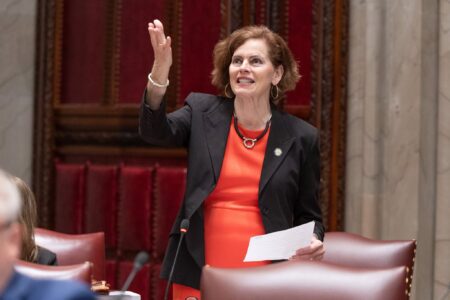
"Perhaps one of the industries at most risk from the use of artificial intelligence is journalism, and as a result, the public's trust and confidence in accurate news reporting," said Sen. Patricia Fahy, D-Albany and Senate sponsor of the FAIR News Act. "AI is reshaping our economy at a pace faster than the Industrial Revolution. To protect the public's trust in reporting at a time when trust in media and reporting is at an all-time low due to attacks on the press, I'm proud that we were able to pass my NY FAIR News Act with Assemblymember (Nily) Rozic to break the national mold on this issue, and I look forward to working with my colleagues in the State Senate to continue enacting common sense guidelines that protect New Yorkers from the unintended consequences of AI."
The bill would require conspicuous disclosure when news media content was substantially created by generative AI. If the content is eligible for copyright registration, the disclosure would not apply. The legislation mandates that news organizations operating in New York fully disclose to the public when they use generative AI to create news content, articles, or media. According to the National Broadcasters Association, more than 76% of Americans report being concerned about AI stealing or reproducing journalism and local news stories
Fahy said in her legislative justification that AI technology can quickly generate articles, summaries, news scripts,
audio/visual, and other media content that may seem professionally done to the uninitiated despite ample evidence the work contains false or misleading content, and generative AI plagiarizes by deriving its content from original source material without permission or proper citation.
Borrello said he didn't disagree with the general idea behind the NY FAIR News Act, but questioned the way the legislation is written and the authority it gives to the state Attorney General. Borrello questioned the legal standard that would trigger the disclosure, such as whether or not the information is copyright eligible, copyright pending or rights reserved. Fahy said if news articles are eligible for copyright protection they wouldn't fall under the FAIR News Act. Fahy also made clear that technology assistance such as spell check doesn't apply.
Fahy and Borrello also debated the meaning of the phrase "substantially composed" that was used in the legislation and who would determine if that standard is met. There was also debate over empowering the Attorney General's office to pursue legal action in FAIR News Act cases that could become politically motivated cases rather than prosecution of a lack of AI disclosure.
"I think this is well intentioned in some ways, but has the ability to quickly go off the rails and be in violation of the First Amendment, so I'll be voting no," Borrello said.
Fahy said when she introduced the legislation in July 2025, it didn't take long for an AI story to pop up saying the legislation had passed. The website where it was posted had no directors, no source and was very clearly generated by AI, Fahy said.
"It was very clearly AI generated and very clearly misrepresenting the matter by saying the bill had passed as opposed to just being introduced," Fahy said. "So every day I think we're inundated with content that does not have a human element or human oversight or is not human generated. It is rather disturbing and undermining trust in our media, which undermines trust in our governing institutions as well."
Hochul is likely to sign the bill. Last week the governor said legislation she signed in December creating the nation’s first law to boost AI transparency in advertising in the film and television industry is now in effect. The law, signed in December 2025, requires persons who produce or create an advertisement to identify if it includes AI-generated synthetic performers.
AI-generated synthetic performers are digitally-created media that appear as a real person. AI-generated synthetic performers are sometimes used by advertisers to sell products, and with easy access to technology, there has been an increase in the use of AI-generated performers across all forms of media, including on social media and in digital advertising. Without notice that the content the public is viewing is not real, AI-generated synthetic performers and manipulated media can undermine one’s ability to accurately distill fact from fiction.
"In New York, we are setting the rules of the road instead of letting AI run the show," Governor Hochul said. "Requiring simple, honest disclosure when an ad uses synthetic performers protects consumers, respects our creative workforce and keeps New York at the forefront of responsible innovation."