When the world’s eyes centered on our city
Group to mark Dunkirk to Dunkerque Day anniversary
-
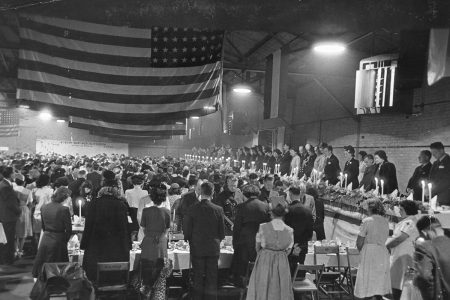
- A large U.S. flag hangs above the dinner served in Floral Hall, the last event of Dunkirk to Dunkerque Day. Dignitaries attending the event stand at the head table at right.
-

- Above, French Ambassador Henry Bonnet, Actor Charles Boyer, Mayor Murray, and Mrs. Bonnet stand on the review stand watching the parade pass. The building behind them is the Hotel Gratiot (Francis Hotel).
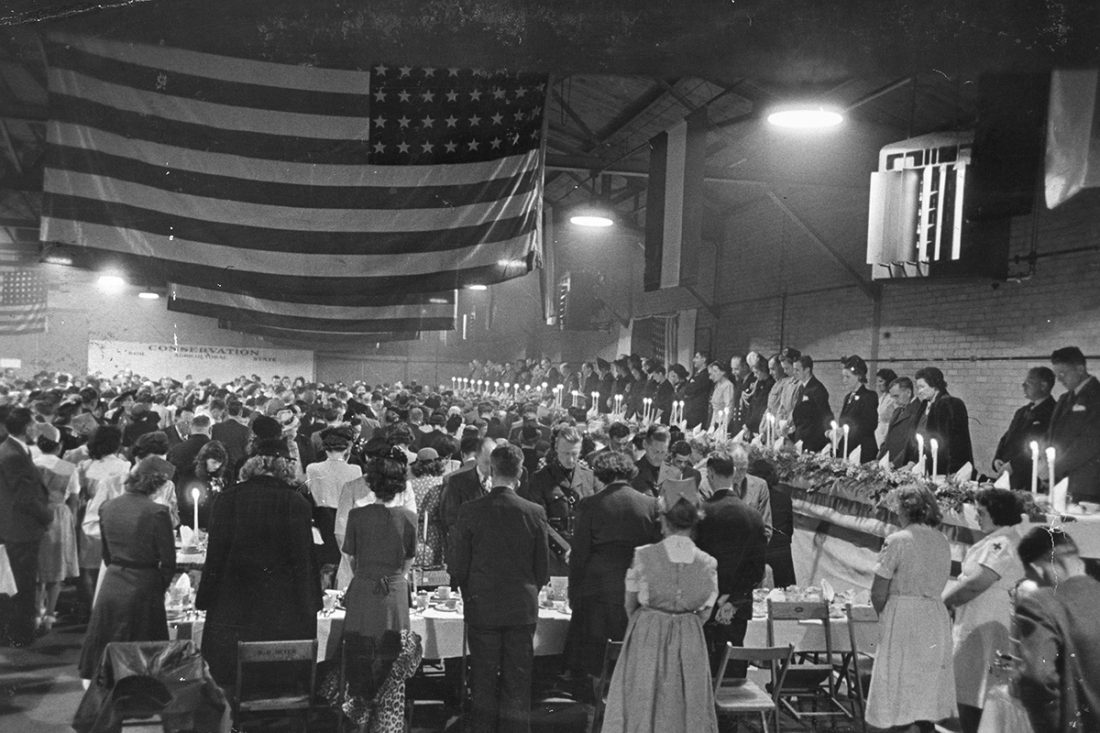
A large U.S. flag hangs above the dinner served in Floral Hall, the last event of Dunkirk to Dunkerque Day. Dignitaries attending the event stand at the head table at right.
On Saturday, the Historical Society of Dunkirk will sponsor a celebration of the 75th anniversary of Dunkirk to Dunkerque Day. Events will begin in the afternoon at 5 p.m., with displays at the museum, brief speeches by City Historian and others, food trucks on-site, a performance of The “96 Highlander Pipes and Drums” of Jamestown, and the showing of the movie “Dunkirk” at dusk.
All this to keep alive the spirit of generosity that may stand as the highlight of Dunkirk history
If Dunkirk were to point to a highlight in its history that is a moral moment of generosity and self sacrifice, the most important moment might be Dunkirk to Dunkerque Day, the effort of Dunkirk’s people to provide goods and donations for the stricken city of Dunkerque, France, after World War II. Dunkirk raised between $75,000 and $100,000– in today’s money an amount equal to $1,073,381 to $1,431,175.
How was that miracle achieved? It was achieved by a unique coalition of persistent leadership in Dunkirk and marketing know-how by a New York City-based relief organization led by Dunkirk native Charles Todd. Dunkirk’s leaders were presented with a plan, key leaders saw the importance of that plan, and those leaders united Dunkirk to carry it out.
World War II started when a disturbed man attempted to dominate the world. It ended after the deaths of 75 million people, including 20 million military personnel. Soon after the USA established the Marshal Plan to prevent deterioration of postwar Europe and create stable economies. By 1953, The U.S. had pumped $13 billion into Europe, and many believe this aid resulted in peace in Europe for 75 years.
Above, French Ambassador Henry Bonnet, Actor Charles Boyer, Mayor Murray, and Mrs. Bonnet stand on the review stand watching the parade pass. The building behind them is the Hotel Gratiot (Francis Hotel).
Professional relief agencies formed to help distribute supplies to stricken countries, funded by the U.S. government’s “National War Fund.” That funding source ended, and fundraising evolved. In 1946 Madame Denise Davey became co-chairperson of “American Aid for France. Inc.,” with General Dwight D. Eisenhower serving as “Honorary President” and ties with French Ambassador Henri Bonnet. Todd, who had served as public relations officer in the Army during the war, became national publicity director for the National Campaign of American Relief for France. He thought an event that would “capture the imagination” of ordinary people in America was needed, “a symbolic gesture which will bring out the national media and appeal to all.” Todd suggested his own hometown of Dunkirk be the starting point, explaining how its working class nature, its adoption of the French city’s name, the presence of a harbor and fishing industry in both cities, the presence of industry next to vineyards–all these would be appealing. His group agreed, and Todd traveled to Dunkirk in September of 1946 to meet with old friend OBSERVER editor Walter Brennan.
Brennan reacted positively to the plan, aware this could capture world attention and put Dunkirk on the map. He met that same day with City Attorney Joe Rubenstein, Chamber of Commerce secretary Roman Waite, and several others, to discuss the idea, and support for the plan grew. Brennan traveled to New York City with Rubenstein and Waite to meet with ATTF leadership, and Todd wrote a proposal for his board of directors “that the nationwide AATF fundraising campaign for 1946-47 be launched in the city of Dunkirk, N.Y. on Thanksgiving Day, Nov. 29.” His proposal promised the presence of Ambassador Bonnet, Charles Boyer, and nationwide press coverage. Brennan wrote OBSERVER editorials appealing to the people of Dunkirk, and Mayor Murray formed a committee to lead the plan.
A contract was signed between the City of Dunkirk and AATF noting the responsibilities for city and agency, and at a mass meeting at the DHS auditorium on Eagle Street with civic, social, and fraternal organizations, Murray took the stage and pointed to various members in the audience, asking them to state what their groups would donate, and they did just that.
Donations flowed in, until Nov. 29 arrived, and with it a contingent of dignitaries. Ambassador Bonnet arrived with French, British and Canadian military attaches from Washington, government reps, heads of French Veterans groups, and journalists from Life, Time, Newsweek, The Herald Tribune, and Colliers magazines, the AP, and CBS radio.
The day’s events included breakfast at Shorewood, ceremonies at Memorial Park, presentation of a plaque forged in a Dunkirk foundry to the Ambassador, and student performances at the high school aud on Eagle Street. At 3, the mile-long parade of gifts from some 100 organizations masse the review stand, including medical and dental supplies, clothing and footwear, a truck load of tools, canned food, blankets, plows and cultivators, livestock, as well as toys for the French children. That night at a dinner held at Floral Hall, Russell Davenport, publisher and writer, spoke. He declared “Dunkirk plus Dunkerque Equals One World”.
This endeavor produced positive results. Dunkirk was showered with good will and praise from national papers and magazines, and from Eleanor Roosevelt, who praised Dunkirk in her weekly column, “My Day.” Mayor Murray formed “The Dunkirk Society” to serve as an information center for cities wanting to follow Dunkirk’s lead. The group raised donations the following spring for Anzio, and then Polish city. Other US cities followed Dunkirk’s lead, gathering donations for European cities they paired with.
The Historical Society of Dunkirk invites the public to take part in this event that celebrates Dunkirk’s generosity and its success.