
Panel defeats Borrello electric bus repeal
Trending
State Sen. George Borrello's latest attempt to put an end to the state's electric school bus mandate will not advance out of the Senate Education Committee.
That's not unexpected, especially after Shelley Mayer, D-White Plains, signaled her intention to vote against five bills brought by a vote by Senate Republicans through a Senate procedure that forces committee votes.
"I believe these motions are unnecessary," Mayer said. "I have significant substantive objections to the bills. I’ll be voting no."
Borrello's bill, S.4748, was first referred to the Senate Education Committee in February 2025. Borrello introduced a Notice of Committee Consideration in March 2025, though action wasn't taken last year. A Notice of Committee Consideration sponsors to bypass inaction and force a committee vote on a bill. Motions must be filed within specific deadlines, generally within 45 days of referral, and typically cannot be filed after the first Monday in May. Borrello filed another notice in March 2026, with the bill being scheduled for a brief discussion during a Senate Education Committee meeting this week.
S.4748 would have eliminated the zero-emission bus mandate as well as authorize the New York State Energy Research and Development Authority to conduct a study to determine the feasibility of converting school buses to zero-emission vehicles. Borrello specifically wants NYSERDA to analyze the conversion for rural, suburban and urban school districts.
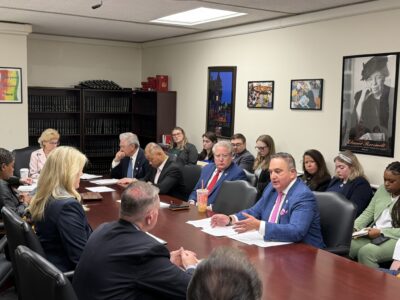
Borrello said during Tuesday's committee meeting that early adopters of electric school buses are running into enough problems to merit consideration of a delay in the transition from diesel buses as well as the NYSERDA study Borrello proposed. He said the Lake Shore Central School District launched 20 electric buses, and at least once this winter heating in the bus was cut back to spare the battery life. He also cited experiences in Naples where cold weather decreased electric bus performance and increased charging demands, pushing operating costs higher than anticipated. The Bethlehem Central School District in suburban Albany reported in its school budget mailing to district residents that it will not expand its current fleet of 10 electric buses due to ongoing performance and charge management issues that limit service miles, Borrello said.
"We have not studied what will happen," Borrello said while attempting to sway Democrats into backing S.4748. "This is a one-size-fits-all mandate. It doesn’t matter if you’re in Westchester or in Chautauqua County. Every school district must convert 100% of their fleet to electric buses. The challenge we have seen is that we are now finding early adopters, districts like Lake Shore School District near my Senate district, and Naples School District, the early adopters who stepped forward and acquired these buses are now having problems.”
In addition to higher operating costs, the upfront purchase price of electric buses, often exceeding $435,000, far surpasses the roughly $168,000 cost of a traditional diesel bus. Districts must also invest in new electrical infrastructure and charging capacity, further driving up costs.
Legislation passed in the 2022-23 state budget to help the state meet the 2019 Climate Leadership and Community Protection Act requires new school bus purchases be zero emission by 2027 and all school buses in operation be zero emission by 2035.
Borrello said his legislation would have allowed the state to take a data-driven approach by testing electric buses under a variety of real-world conditions before requiring universal adoption.
"This is not a harmless transition; it is an unfunded, unworkable mandate that forces schools to spend more for buses that, in many cases, do less," Borrello added in a news release after Tuesday's committee meeting. "Those costs will ultimately be borne by taxpayers, school districts, and students, as funding is diverted away from classrooms, programs, and essential services."