
Hanover eyes railroad quiet zone in Hanford Bay

John McGowan of the Hanford Bay Association gave a presentation on the establishment of railroad quiet zones on Hanford Road in Hanford Bay at a recent Hanover Town Council meeting.
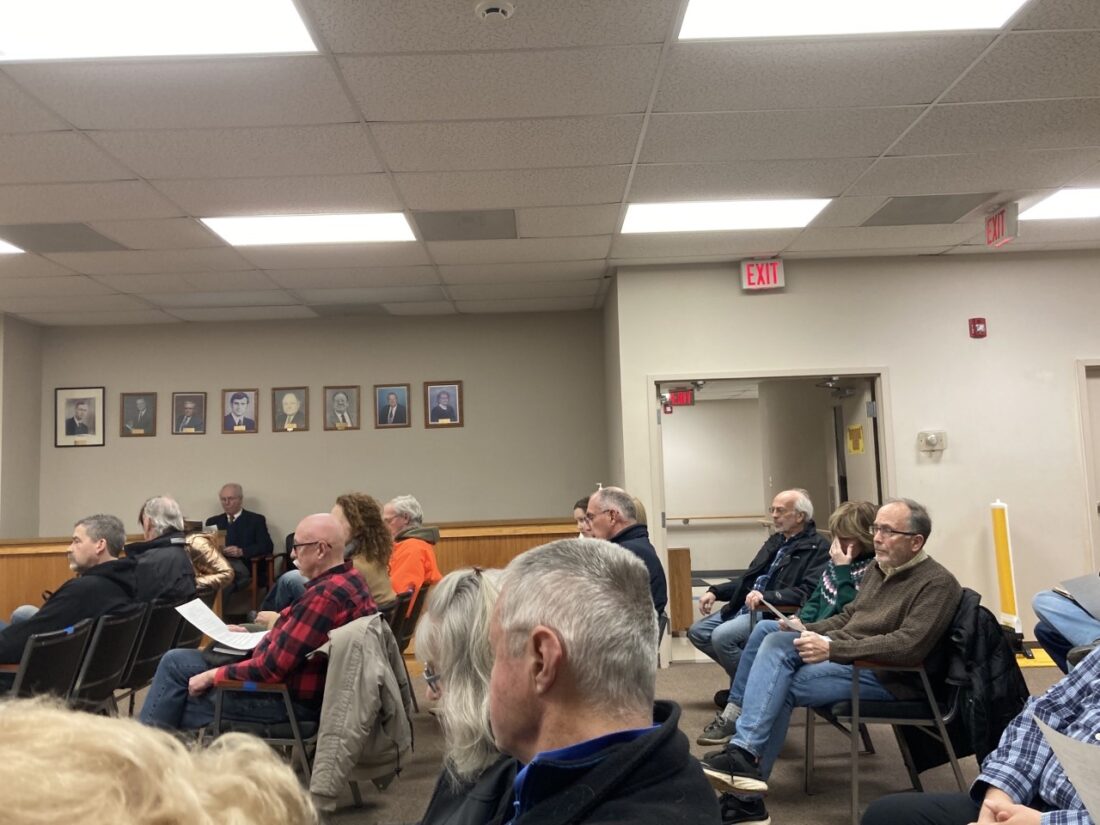
Approximately 20 people were in attendance for John McGowan’s presentation.

OBSERVER File Photo Pictured is the railroad crossing at the Hanford Bay entrance point in the town of Hanover.
John McGowan of the Hanford Bay Association gave a presentation on the establishment of railroad quiet zones on Hanford Road in Hanford Bay at a recent Hanover Town Council meeting.
Approximately 20 people were in attendance for John McGowan’s presentation.
OBSERVER File Photo Pictured is the railroad crossing at the Hanford Bay entrance point in the town of Hanover.
Trending
HANOVER -- A plan to hush the unwanted noise many residents of Hanford Bay have lived with for years appears near the finish line.
At the recent Hanover Town Council meeting, a public hearing was held to discuss the establishment of railroad quiet zones on Hanford Road in Hanford Bay. John McGowan of the Hanford Bay Association gave a presentation on the matter, which lasted slightly over 47 minutes including comments from the Town Council and approximately 20 members of the public in attendance.
The plan McGowan presented was to implement a system to keep drivers safe and to deter drivers from disregarding safety measures when a train nears the crossing. The system, which has been approved by the federal government, is an alternative to the use of train whistles, both for the noise concerns and also because of public safety.
"Is it safer? That's really what we all want to know. That's really why our administration decided to go forward with it," McGowan said. He cited a reduction in traffic violations in four states that implemented the same proposed system, with an overall 68% protection increase from the entire study.
"People driving around the crossings that are down, I've seen it all my lifetime," said fown Supervisor Todd Johnson. "That should be the number one selling point right there. It's not about the whistles blowing and people being disturbed.
It's about lives being taken because people are being ignorant and not obeying the traffic properly."
The OBSERVER first reported the town's interest in establishing quiet zones in Hanford Bay, along with Sunset Bay, in March of 2017. Since then, it has been determined it is more feasible to focus on Hanford Bay.
"We are in favor of it moving forward in Hanford Bay, even if it is moving forward without us," said Kelly Borrello of the Sunset Bay Association.
"Overwhelmingly, the response I've gotten from Hanford Bay has all been positive," said Town Councilman Bernie Feldmann.
Multiple members of the Town Council raised the concern that the system would cause an issue for emergency vehicles and snowplows to navigate the roads. McGowan responded by demonstrating how the obstacles can be driven over in case of an emergency and by saying he spoke with multiple fire departments that are not standing in the way of the project.
Hanover's Highway Department is planning to test driving over an obstacle that McGowan provided. The town anticipates the need to widen the road in Hanford Bay where the system would be implemented, but after discussion it appeared it was feasible to do so.
The town would need to vote on a resolution to adopt the system to implement it, even with most of the funding being raised privately by citizens.
Near the end of John McGowan's presentation, Jim McGowan offered his thoughts on the current system if nothing were to change.
"It just doesn't make sense to blow a horn a quarter of a mile away of what you're warning about. The purpose of the horn is to tell people a quarter of a mile away from here, there's going to be a train coming on the tracks. What this (system) does is focus the issue where the issue is, at the tracks," Jim McGowan said. "It doesn't make sense to blow horns where they are blowing them now. ... This system is a more effective way of making sure that intersection is safe. The sense that there is a nostalgia with train whistles is really stupid when you look at the purpose of the train whistle. Unfortunately, it was poorly designed and everyone along the tracks has suffered with it for generations."