Concerns raised over commercial chicken farms
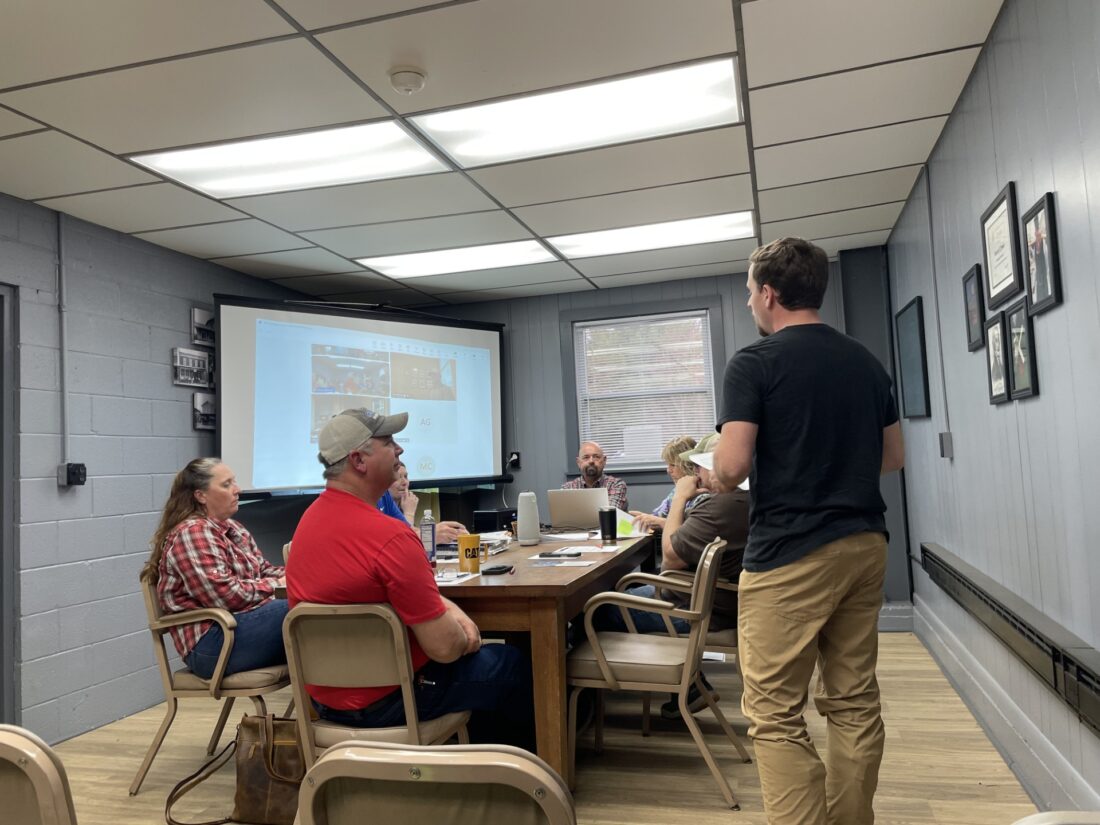
P-J photo by Sara Holthouse Clymer resident, Cole Gleason, speaks with the Clymer town board about his concerns regarding the building of large-scale commercial chicken barns in the town.
CLYMER — Large-scale commercial chicken farms are popping up both in the town of Clymer and neighboring communities, and one resident is expressing concern to the Clymer Town Board.
Cole Gleason approached the board to learn more about the chicken barns following him and his family recently buying a property in the town and having a neighbor approach them about working on getting permits for a chicken barn. While he said he did not know how far along the neighbor was in the permit process, Gleason began digging into it following the conversation and became more and more concerned as he went.
“As I started going into it it started making me more and more concerned for Clymer and the community in general,” Gleason said. “Obviously I haven’t lived here my whole life, but I’ve been here for about 10 years now and Clymer is a special place. I don’t just say that. … The difference with this is that these barns are not just farmer-owned, they are actually more runned by the commercial industry.”
Gleason said his understanding is that a particular commercial business comes in, finds land that would work for it to build, says it will supply the chickens and the feed, but the land owner will foot the bill and be paid by them depending on how well the chickens do producing eggs or how big they get if they are raised for meat.
A concern of Gleason’s down the road is that the commercial business running the farm could take the chickens away and decide they do not want to supply the barn with any more, leaving the owner with the risk of having a giant, vacant building, debt, and no chickens.
“Obviously it’s not our job to make decisions for people,” Gleason said. “They know what risks they’re getting into. But, I think it’s going to affect more than just them.”
Returning to the possibility of the barn becoming a big, vacant building down the road, Gleason said property values in the area will decrease so if he decided to move he would have a harder time getting what he wanted out of it. Another big concern for Gleason was that there are no zoning permits or requirements, meaning one of these barns could be built 10 feet from his property line.
Gleason added he is not the only one with concerns, especially as almost three of these large chicken buildings have been erected in both Sherman and Clymer in the past year. This includes one on Upper Road, which Gleason provided the board with a picture of. These buildings are 700 feet long or more and 60 feet wide. A lot of things will be going on with these farms including noise and transportation of feed and animals, which Gleason said will then change the sense of community in the areas where they are built, especially as it is not a family farm.
“To be frank, corporate doesn’t care about small town Clymer,” Gleason said. “They just don’t. So, what are they out if all of these buildings get shut down or these businesses go out? They’re not out anything. We’re the ones that are having to deal with it, and I’m just saying if three of these have gone up in the last year, what’s it going to say 10 or 15 in the next three? If we don’t pause then we could have 10 or 15 barns that could all go downhill fast, and we’re stuck with the problem.”
Gleason said his overall main reason for approaching the board was to ask for a pause or moratorium on permits for these kinds of barns to look more into it and see how these types of businesses would look or affect the community going forward. The moratoriums would be similar to wind and solar, which are also large corporations coming in to try and build things, and Gleason expressed that he did not want to see Clymer turn into a large, corporate business town. He also gave an example of something like a Dollar General opening downtown that would then affect all of the small town businesses there. Gleason added that his property is on Einink Road and that he would be willing to head up a committee or help look into this matter more. He noted that they would not want to tell someone what to do on their own property, but he feels that corporations running farms is a lot different than most of Clymer’s family-run farms.
Later in the meeting, the board brought the issue back up again. The board noted that the farms would fall under agricultural use, which then waives pretty much all zoning and special use permits.
“That’s something we can certainly discuss,” Town Supervisor Brian Willink said. “Other municipalities are taking the view that like he was saying, commercial versus family farm. There’s different things that we can take a look at.”
The overall zoning code and laws for the town of Clymer were last updated in 1992. Willink added that the town’s attorney has brought up needing to update the zoning laws before, especially as many things such as solar and commercial businesses fall outside of the current laws. Board members agreed that it now seems to be something to try to work on sooner rather than later, as multiple things now fall outside of the current regulations. One of the large chicken barns already exists on Upper Road, as mentioned earlier in the meeting, and it was said that there had also been word of a potential one on Cherry Hill. It was also noted that there would be a lot of semi truck traffic on roads not necessarily meant for that.
“I’m glad he came,” Willink said. “It opened my eyes to a few things. We’ll get the ball rolling and see what we can come up with.”
The board agreed to reach out to the town’s attorney to begin to move forward on updating zoning laws and to see if he had guidance on moving forward. The board also acknowledged the concerns brought up, adding more about fire concerns or fire suppression and other potential risks that should be taken into consideration.
So far, Willink said Clymer has one of these barns and so does Sherman, where he said they are also talking about how to approach it.
“It’s something that certainly has to be considered,” town board member Melissa Murphy said. “For the benefit of farmers, to protect them too.”
TOP STORIES
County issues statement after altercation
MAYVILLE — Chautauqua County has issued a statement regarding an incident Thursday at the clerk's ...
Tastefully done
Molitor, Borrello talk about state ‘fight’
Barker Common concert lineup released
Festivals Fredonia has announced a lineup for “8 Great Wednesdays in the Park.” The free, family-friendly ...
Forestville schools celebrate 2026 retirees