
Fredonia grapples with water main project
Trending
Fredonia's ever-flowing water saga briefly took a side branch away this week from discussion about connection with the North County Water District.
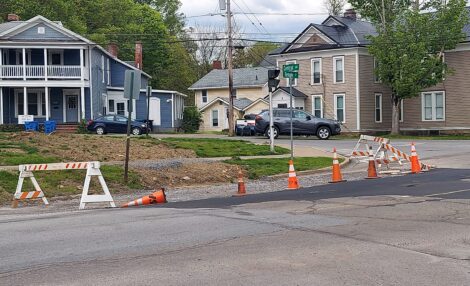
Village engineers LaBella floated plans for major work on village infrastructure, including the main near One Temple Square that catastrophically ruptured in bone-chilling January weather.
"This all originates from a significant water main break in January," said LaBella's Matt Higgins at the start of their presentation. "This is not currently part of the overall (NCWD connection) project. This is kind of geared to share information and ask how, if at all, the village board wants to move forward with this."
LaBella's engineers discussed the various sizes of water mains along Central Avenue and Temple Street corridor, ranging from six to 12-inch mains. It was noted that portions of the Central Avenue water main system are well over 100 years old and nearing the end of their service life -- and showing it, with multiple ruptures over the past year.
Portions of the main system that broke in January are also more than a century old. That incident led to another one of Fredonia's infuriating boil orders, in part because there are no shutoff valves operational in southern Temple Street, so the break could not be easily isolated.
"It was minus 2 degrees and we were there for 23 (hours) before we ended it up," moaned David Bird, Department of Public Works director.
LaBella's Jake Bower said the only realistic option for the Central Avenue main "would be to replace that... with a new 8 inch ductile iron water main."
Bower said six and 12-inch lines run parallel on Temple Street north of One Temple Square -- no one is completely sure why, though it seems to have something to do with SUNY Fredonia. Labella is proposing to transfer all the water service on that stretch to the existing 12-inch main.
On Temple Street south of One Temple Square, LaBella proposes new shutdown valves for emergencies.
The engineering firm laid out three cost options. Alternate 1 would do all of what was just mentioned for $6,038,000. Alternate 2 would do just the Central and South Temple work, leaving out the North Temple switchover, for $4,536,000. Alternate 3 would be just the new shutdown valves on South Temple for $302,000.
"We looked at all three because we were asked to look at all three," Bower said.
Funding for any of it, however, is not clear.
LaBella's Jenn Vaughn noted that the village has access to a $12.5 million no-interest loan for the NCWD connection project. She said the village could expand use of that loan to the infrastructure project. Vaughn, a grant specialist, is also hoping for a $4 million state grant.
LaBella laid out two timeline options. One is an "integrated and immediate" kickoff now, going out to bid by winter and doing construction in 2027. The "Separate and later" option kicks off preliminary project work in January 2027, with construction envisioned in 2029.
Bird said he thought it all could be constructed in as little as two months. "It's a fairly quick jump-into once we get going," he said.
Trustee LeeAnn Lazarony asked Treasurer Erlyssa LeBeau to comment. "I'm wondering how we're paying for it," LeBeau replied.
"So am I, that's why I'm asking you," Lazarony said. "Because I have no idea how we're paying for it." She added, "I hate to approve something that we don't know how we're going to pay for it."
LeBeau noted the project could be paid for from the $12.5 million loan, "but we would also have to pay everything out of the fund balance and wait to get reimbursed. We need to have that cash on hand, and we don't."
Lazarony said, "I understand there's these deadlines and timelines and all these things. I think we can all agree it should be done."
Mayor Michael Ferguson implored trustees to figure out a way to get it done. "The alternative is, this whole thing fails at one point and you no longer have a community -- I mean that sincerely."
Lazarony replied, "But if we commit ourselves to money we don't have, we fail our community also."
LaBella wants a decision by May 18, claiming that anything later will make the project ineligible for this funding cycle. The engineers offered yet another list of options: Communicate the desired alternative by May 18; authorize time sensitive steps such as engineering by May 18 without specifically deciding which alternative to do; or defer decision after May 18, moving the project to a future funding cycle.
Trustees seemed to favor the middle-ground option of authorizing preliminary work, but not deciding on an alternative.