Resident voices concern about school budget
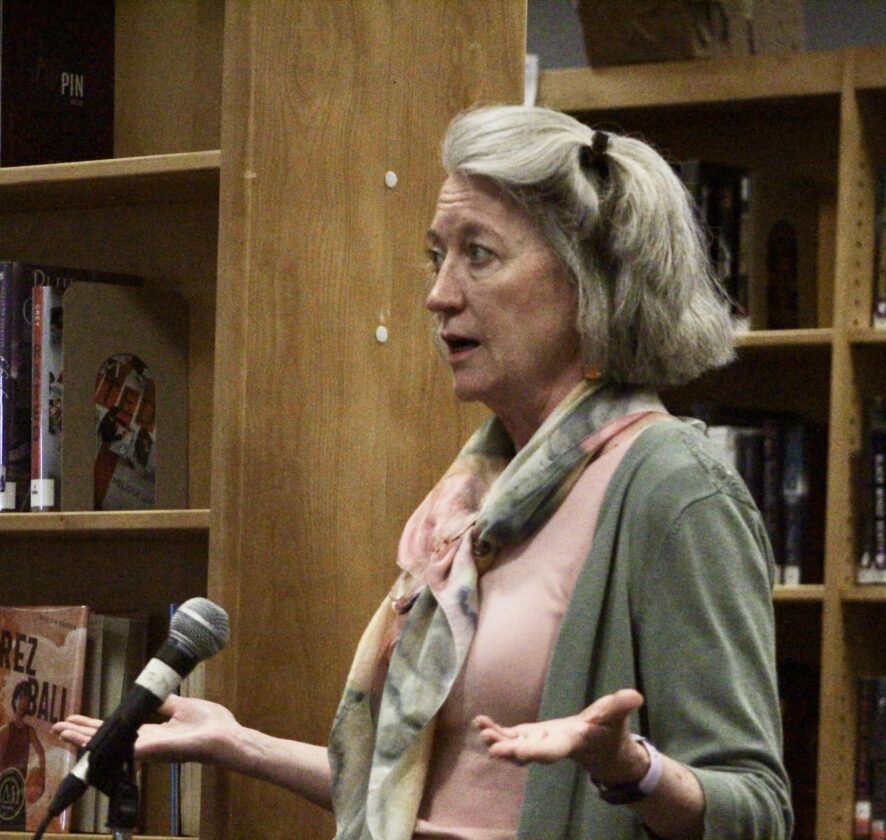
OBSERVER Photo by Braden Carmen Kathleen Dennison, a resident and Town of Pomfret Board member, raised concerns about the proposed Fredonia Central School District budget at the district’s budget hearing.
FREDONIA — Over the past few years, even though the Fredonia Central School District has asked its residents for tax increases, the district has seen its fund balance rapidly decrease. The latest budget proposal does not make that predicament any better.
In order to propose a 2026-27 school budget that does not exceed the tax cap, the district is applying $750,000 of unassigned fund balance, bringing the total budget amount to $39,574,249. The tax levy increase to residents is 2.44% – the maximum amount the district could propose without needing a supermajority – even after the funds are applied to the budget.
Kathleen Dennison, a district resident and Town of Pomfret Board member, shared her concerns regarding the amount of fund balance applied to the budget at the district’s recent budget hearing. She clarified that her comments were her own, not on behalf of the Town. In addition to serving the Town, Dennison has served as a budget director for Chautauqua County, accounting supervisor for the County Sheriff’s Office, and as an adjunct professor of accounting at Jamestown Community College.
Of the district’s application of $750,000 worth of fund balance, Dennison said, “That gives me pause. … I think the use of fund balance is a problem.”
Dennison is not alone. Even the Office of the State Comptroller took note of the district’s low fund balance. In its latest audit report, Fredonia has seen its unassigned fund balance fall to just 2.32%, which led to the Office of the State Comptroller’s characterization of the district being “susceptible to financial stress” in each of the past two years. Most districts maintain an unassigned fund balance of at least 4% of the succeeding year’s budget, and the state suggests 4% as a target for districts. Many financial experts suggest even more than 4%.
Business Administrator John Forbes said on several occasions that he wished he could avoid applying such a high portion of the district’s unassigned fund balance to the 2026-27 budget. However, the increases in district costs in many areas made it hard to find an alternative.
The latest draft of the proposed budget shows a 3.61% increase in expenditures from the previous year’s budget. That was even after four rounds of cuts and reallocation of resources, as Forbes reduced the initial proposed budget amount by nearly $2 million.
Salaries and benefits account for 68.8% of the proposed budget. Another 3.95% of the budget is allocated for debt service payments. Many of the other costs are also locked in at this point, like BOCES program costs and other contractual costs, such as transportation and utilities. The district is projecting approximately $20 million in State Aid in 2026-27, representing roughly 50% of the overall budget.
The district plans to reduce staffing by not replacing two elementary teaching positions vacated by retirements. The district also made reductions in equipment and supplies requests, and a total of 38 budget lines were adjusted in some way.
Still, after all that, the budget is still utilizing $750,000 of fund balance and is proposed at the tax levy increase limit of 2.44%. That increase does not close the gap for a budget increase of 3.61%, and although the final State Aid figures are not set, it is unlikely that the district will make up the difference in aid alone. That is why the district kept $750,000 of unassigned fund balance in the budget, rather than reducing the amount to keep more money in the bank moving forward.
“I appreciate the efforts that have been made to bring the budget (down) to the tax cap. I have no problem increasing the levy to the tax cap,” Dennison said. “I do have a problem with being at the tax cap and still deficit spending. That means the budget is not balanced.”
Dennison said there are “opportunities” within the budget to reduce expenses, such as additional staffing cuts. She took issue with the six positions the district added in the past with American Rescue Plan Act (ARPA) funds, which included a social worker, a school counselor, a Special Education teacher, an Elementary STEM teacher, a speech therapist, and a Hispanic outreach coordinator. Dennison called it irresponsible “to have initiated those positions that are recurring expenses with a revenue stream that is not recurring.”
Dennison urged the district to reassess each position that was added with the ARPA funds. She added, “It’s good work, I’m sure it has helped the district, but when you’re still in a position of deficit funding with those positions, I have an issue with that.”
Superintendent Dr. Brad Zilliox defended the district’s position to keep the six positions initiated with ARPA funds, stating, “We did think long and hard about the use of the COVID funding. … As we’ve moved across these five years, these positions have become more and more critical. We are trying to rightsize through attrition, to some extent, but again, we’re trying to meet the needs of students.”
Dennison also urged the district to reevaluate the use of the Wheelock campus. She suggested a potential lease or sale of the site could be a revenue source for the district, while also decreasing the district’s operating costs.
The budget vote will be held on May 19, from 2-9 p.m. in the High School Cafeteria. Absentee ballots are available at the District Clerk’s Office. Applications for an absentee ballot must be received by May 13 if the ballot is to be mailed to the applicant, or by May 19 if the applicant receives the ballot in person at the District Clerk’s Office. All absentee ballots must be received by the District Clerk in the District Office by 5 p.m. on May 19. Any ballots received after that time will not be counted.
There will also be two Board of Education seats up for election at the time of the budget vote. Courtney Gullo and Aaron Marshall have chosen not to seek re-election. Instead, three candidates have declared themselves as candidates: Marieanne Fabiano, Keana Sherlock and Randy Draggett. They are seeking five-year terms. A proposition will also be listed on the ballot to reduce term lengths of Board members from five years to three. If approved, the change will take effect for the next election cycle in 2027.