
Trip back in time: Old West mural brings extra meaning at Centaur Stride
Old West mural brings extra meaning at Centaur Stride
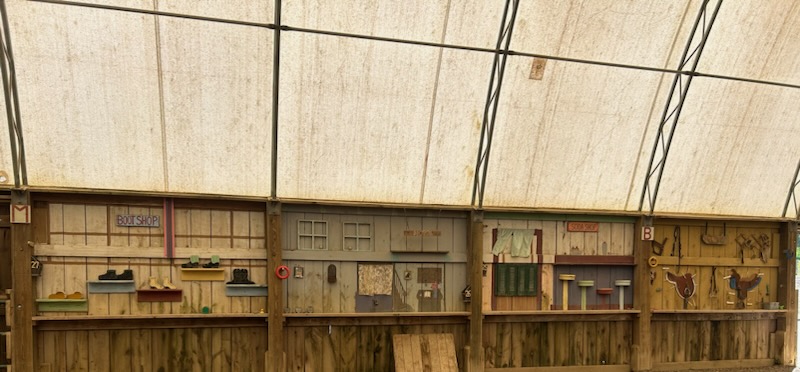
A boot shop, hotel and soda shop.
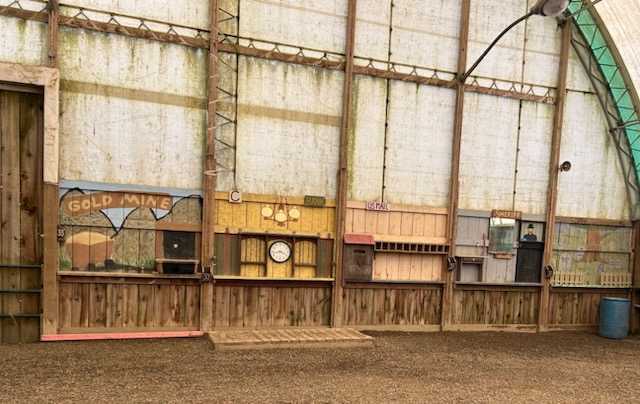
The mural shows a gold mine, bank, post office and sheriff.
A boot shop, hotel and soda shop.
The mural shows a gold mine, bank, post office and sheriff.
Trending
What does it really mean to have "life skills"?
At one time, life skills meant survival. Human beings needed food, water, shelter, clothing, and protection. Physical strength, adaptability, cooperation, planning, and ingenuity improved chances. Families grew and preserved their own food, communities worked together for safety, and individuals learned how to provide for themselves while contributing to the group. These were not optional abilities; they were essential to daily life.
At Centaur Stride, life skills are explored in meaningful and practical ways through experiential learning. Inside the indoor riding arena, an Old West Village mural becomes more than scenery -- it becomes a classroom for understanding how human beings once survived and adapted. Riders guide their horses through activities inspired by the Westward Expansion, the Gold Rush, the Oregon Trail, the Pony Express, and wilderness survival.
Participants are challenged to think critically and make decisions much like early travelers and settlers once did. They learned to travel light, barter for goods, homestead, forage, hunt, and plan ahead for uncertain conditions. Through games, prompts, clues, and team challenges, riders earned points by solving problems and making practical choices about survival and daily living. Tasks could be simplified or adapted as needed and were designed for progressive "experiential learning" while learning to communicate well with their horse.
The lessons went beyond history. Riders discovered the natural laws that shaped human society: supply and demand, cause and effect, while developing self-sufficiency, cooperation, foresight, and resilience. During Gold Rush activities, for example, riders quickly learned that while gold may have great value, it cannot buy necessities like food, water, shelter or material goods if they are unavailable.
These historical experiences also reveal how much the conditions for survival and success have changed over time.
Confusion still exists regarding what individuals truly need to thrive. In the United States, access to basic needs should be a right for all people. Unfortunately, those needs are not consistently met or used wisely, and society and government continue to debate who should provide support, how much assistance is appropriate, and how individuals can still be encouraged toward responsibility and growth, without being penalized for it.
Today, the phrase "life skills" has evolved into something broader and much more complex. While our basic human needs remain unchanged, the skills required to navigate modern society look very different.
In today's world, emotional intelligence often predicts success more accurately than physical or cognitive ability. Effective communication, managing emotions, resolving conflicts, and building healthy relationships are valuable assets. Ironically, practice in and tolerance for social situations has plummeted. Likewise, technological literacy now plays a major role. Individuals who struggle to understand modern information systems may become more vulnerable to scams, identity theft, manipulation, poor decision-making, dependence on others, and fall behind the times.
These concepts are equally important for individuals with disabilities. Life skills education is often designed to increase one's level of independence and quality of life through practical instruction in cooking, hygiene, money management, transportation, housekeeping, workplace readiness, communication, and personal responsibility. The goal is not perfection, but empowerment -- the opportunity to participate as fully as possible in everyday life.
As a result of "the times", the challenge of developing "life skills" is not limited to those with disabilities. Many people today struggle with motivation, accountability, and self-sufficiency regardless of background or ability. Traditional motivators such as hard work, merit, preparatory education, and responsibility can sometimes feel overshadowed by systems that create confusion about personal accountability and effort. As society changes, so do the "rules", who makes and upholds those rules, and who abides by them willingly. The understanding of justice, fairness and what it means to contribute meaningfully should not have to be subject to interpretation.
This raises an important question: What should life skills education truly accomplish?
Perhaps the answer lies in balance. A healthy society supports those who genuinely need assistance while also encouraging personal growth, responsibility, participation, and contribution. Independence does not mean doing everything alone. Rather, it means developing the ability to make informed decisions, care for oneself as much as possible, help others, and function to the best or one's ability within a community.
Ultimately, life skills are about far more than living independently. They are about living with dignity, purpose, adaptability, and connection to others.
That philosophy remains at the heart of every lesson at Centaur Stride. Each rider progresses at their own pace, building confidence, patience, communication, and responsibility alongside their equine partner. Every challenge overcome becomes a meaningful achievement. Every new skill opens another door toward greater independence and self-belief.
Those lessons--whether learned on the frontier long ago or in a riding arena today--remain timeless. For more information, go to linktr.ee/centaurstride.
Claudia Monroe is president and founder of Centaur Stride.