
Designs from past: Sheridan’s modest homes with great style
Sheridan’s modest homes with great style
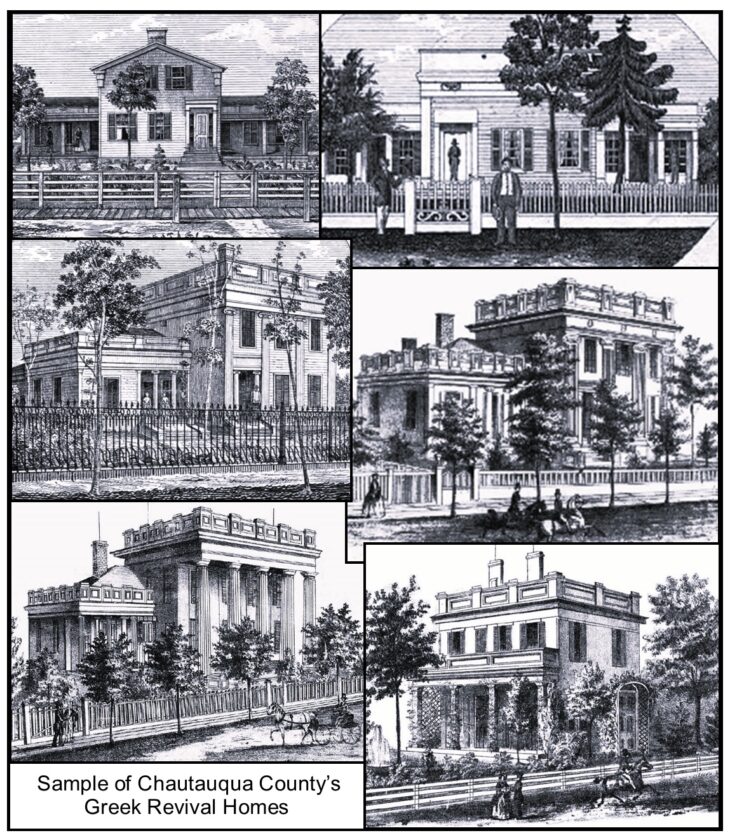
These Greek Revival homes were illustrated on the 1854 county map and on the 1856 Jamestown map, then scanned and enhanced by SUNY Fredonia Professor Emeritus Richard Sheil. The most popular style in the Town of Sheridan was similar to the 1.5-story pattern shown at upper left.
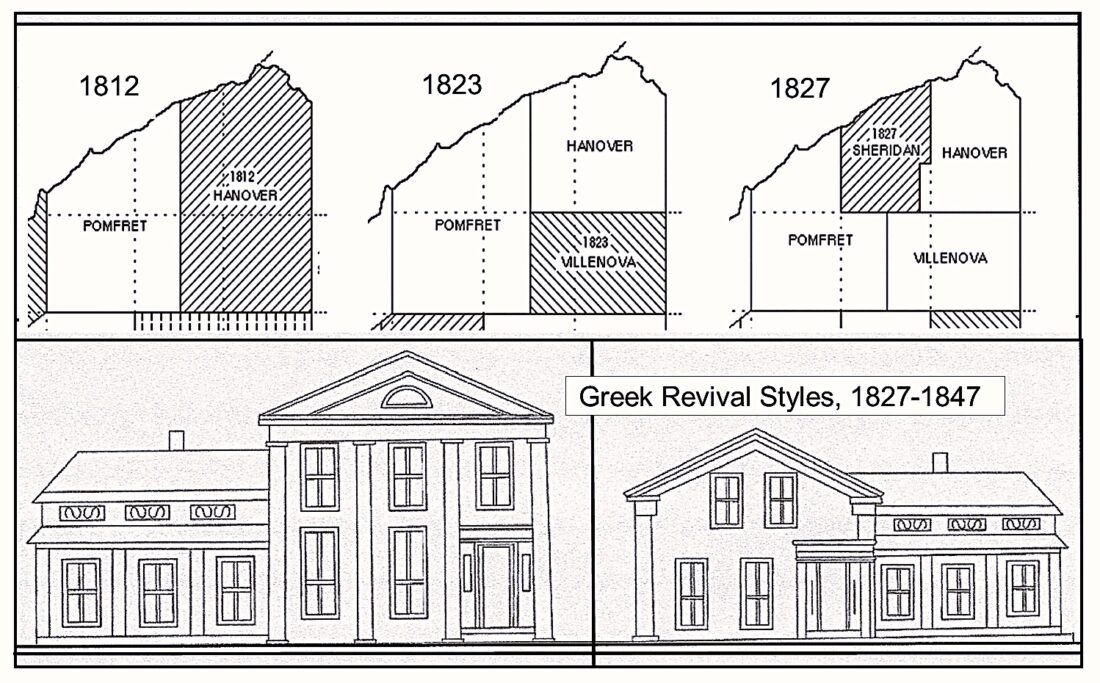
Top row: Maps by Richard Sheil demonstrate how the Town of Sheridan was born from the Towns of Pomfret and Hanover in 1827. Bottom row: Sheridan’s most popular pattern for Greek Revival homes was similar to the 1.5-story diagram by Matthew Pietro at lower right.
These Greek Revival homes were illustrated on the 1854 county map and on the 1856 Jamestown map, then scanned and enhanced by SUNY Fredonia Professor Emeritus Richard Sheil. The most popular style in the Town of Sheridan was similar to the 1.5-story pattern shown at upper left.
Top row: Maps by Richard Sheil demonstrate how the Town of Sheridan was born from the Towns of Pomfret and Hanover in 1827. Bottom row: Sheridan’s most popular pattern for Greek Revival homes was similar to the 1.5-story diagram by Matthew Pietro at lower right.
Trending
On July 8, the Sheridan Historical Society and this author will offer a program about Sheridan's early houses of a celebrated design. Please join us at the Museum at Main and Center Roads. The Museum opens at 5 that evening, and the illustrated presentation begins at 6:30.
The Town of Sheridan was born in 1827, when America was 51 years old, and when Chautauqua County was 16. The year 1827 also marked the sudden expansion in Greek Revival construction in this county.
Today's residents of the north county are familiar with the wood-frame mansions of the Risley brothers in Fredonia, and with the brick mansion of Austin Smith in Westfield. However, that same Greek Revival pattern was also prevalent in smaller homes across rural areas of the county.
Sheridan is a perfect example. There, it may be seen that key elements of the Greek Revival design were applied to many 1.5-story houses. An inventory in 2006 showed that Sheridan still featured at least 35 examples of the pattern.
It was in 1827 that the carpenter/architect Asher Benjamin released The American Builder's Companion (sixth edition). It popularized Greek Revival embellishments.
As SUNY Fredonia Professor Emeritus Daniel D. Reiff points out in his landmark publication Houses from Books (Pennsylvania State University Press, 2000), Benjamin's manual had a great impact on the rapid spread of Greek Revival details.
Reiff explains that the movement had begun slowly around 1821, with John Haviland's manual The Builder's Assistant. Yet, the Greek Revival trend suddenly skyrocketed with Benjamin's guidebook, then with another Benjamin manual in 1830, and then through books by Minard Lafever in 1833 and 1835.
The style's popularity tapered off shortly before the Civil War. However, the 1855 NYS census suggests that homes with Greek Revival details still ranged in value from $500 to $5000, at a time when a decent, annual wage was $300 to $500.
To see the 2006 inventory of Greek Revival homes, choose Posters at the menu bar for Map 1 at the website https://chqhistoricbldgs.com, or choose Filtered Views at the lower right on the Map 1 screen.