
Molitor: state data center delay is hypocritical
Trending
Both Assemblyman Andrew Molitor and state Sen. George Borrello opposed legislation creating a one-year moratorium on new data center construction in the state.
As The Post-Journal and OBSERVER reported in early June, the state Legislature did what was expected and passed the moratorium, though the legislation (A.11560/S.10642) has yet to be sent to Gov. Kathy Hochul for her approval.
Molitor said on the Assembly floor that he opposed the legislation because it took local control away from the data center discussion while still allowing the state to pursue data centers under the Empire AI project, a $500 million public-private consortium launched by New York state to advance artificial intelligence research for the public good. It is centered around a state-of-the-art supercomputing facility at the State University at Buffalo and provides researchers with the computing power required to develop next-generation AI technologies. Molitor also asked specifically if the legislation had exceptions for the redevelopment of brownfield sites like the former NRG power plant in Dunkirk.
"I think this is a good example of what’s good for me but not for thee," Molitor said. "The state is going to put a moratorium on data centers in places where there could be a former industrial site that could be easily converted into a data center that the local municipality could benefit from the increased tax revenue, but they’re going to be under a moratorium. Meanwhile the state, as long as it’s under an Empire AI project, will be able to create their own data center. The state will still benefit from all those companies that offer artificial intelligence and cloud computing, but they won’t have to allow for those companies to build data centers in their state."
In addition to the one-year moratorium on permits for data centers, the bill requires hearings before a data center permit is issued and requires the Department of Environmental Conservation to prepare an environmental impact report on data center development in the state. The state Public Service Law would be amended to require each electric corporation, gas corporation and municipality to establish an independent classification of service for large energy use facilities while the state Public Service Law would be changed to require each water works corporation to establish an independent classification of service for large energy use facilities. The state Public Service Commission would be prohibited from approving any change of rates or related updates to a tariff unless a data center proposal includes a service classification for large energy use facilities, and an adjustment mechanism.
State lawmakers are also proposing a new section in the Public Authorities Law authorizing NYSERDA, in conjunction with the federal bulk system operator, the Public Service Commission and the state Climate Action Council to determine reasonable energy consumption efficiency goals for the design and operation of data centers, including the recycling of waste heat, and a new section in the state Energy Law requiring data centers to derive increasing percentages of their electricity consumption from renewable energy systems, either via on-site production or power purchase agreements.
Data centers, including within the Long Island Power Authority service territory, would also be required to provide their host communities with benefits including residential energy technologies and community infrastructure as well as prevent adverse impacts on local waters.
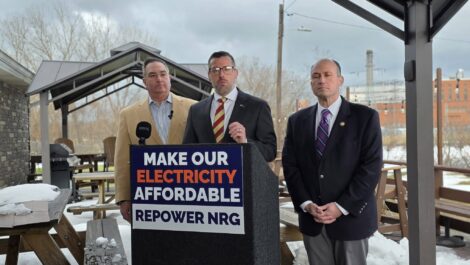
There has been vocal opposition to the possibility of a data center in the town of Portland, while one possible use listed in planning documents for the former NRG power plant in Dunkirk has been as a data center. The plant was recently purchased by Genover, a firm focused on responsibly redeveloping legacy industrial properties. Genover will lead the next phase of future site planning, preparation, and redevelopment. Genover looks forward to closely working with City of Dunkirk and Chautauqua County officials to identify future redevelopment efforts.
Molitor said, in his opinion, the state's decision to limit options for local governments is a problem.
"This, I think, is very problematic," Molitor said. "As many of my colleagues have already said, but I'll repeat, I think this bill is sort of an admission that our grid capacity and capabilities are in a seriously bad place right now. If we had greater energy generation and better transmission lines, we wouldn’t have to worry about the amount of energy data centers use and we could rely on SEQRA and local governments to determine whether a new data center in their area would be beneficial for them. This takes away that local control as well. ... I understand the intent of this bill. I think there are certainly good things about it, but overall I will not be able to support it."