
State responds to growing fisher numbers
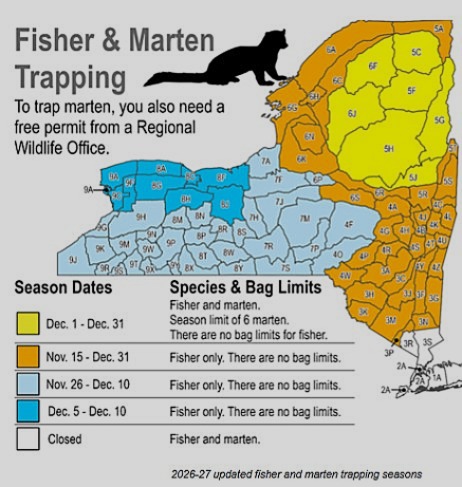
Illustration courtesy of NYSDEC Responding to scientific research and public input, the NYSDEC has updated trapping regulations for fishers and martens. The changes are based on research conducted in partnership with Cornell University and the State University of New York College of Environmental Science and Forestry.
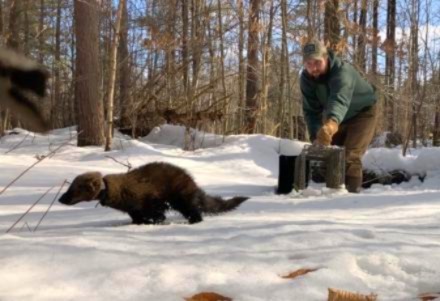
Photo courtesy of NYSDEC Trapping season changes were influenced not only by biological research, but also by a statewide survey of more than 7,000 licensed trappers. Here, a fisher is released with a GPS collar to track movements.
Illustration courtesy of NYSDEC Responding to scientific research and public input, the NYSDEC has updated trapping regulations for fishers and martens. The changes are based on research conducted in partnership with Cornell University and the State University of New York College of Environmental Science and Forestry.
Photo courtesy of NYSDEC Trapping season changes were influenced not only by biological research, but also by a statewide survey of more than 7,000 licensed trappers. Here, a fisher is released with a GPS collar to track movements.
Trending
For years, many Western New York residents have voiced concerns about the growing number of fishers across the region. Farmers, gardeners, pet owners, hunters and trappers have all reported more frequent encounters with the elusive predator, leading to renewed calls for stronger wildlife management.
Fishers are members of the weasel family -- not fish and not cats -- and are highly adaptable predators that have expanded their range significantly over the past several decades. Once uncommon in many parts of New York, they are now well established throughout much of the state, including Western New York. While they are wary of people, I have watched them cross a country road on several occasions, so their numbers are expanding.
Farmers have reported losses of poultry, rabbits and other small livestock, while pet owners worry about the safety of outdoor cats and small dogs. Although attacks on pets are relatively uncommon, fishers are capable predators and can prey on small animals when the opportunity arises. Hunters have also expressed concerns that fishers may contribute to lower wild turkey numbers by climbing trees and preying on roosting birds, particularly hens and poults. Wildlife biologists note, however, that while fishers are one of many predators of wild turkeys, habitat quality, weather during nesting season, and other predators also play significant roles in turkey population trends.
Responding to both scientific research and public input, the New York State Department of Environmental Conservation (DEC) has adopted updated trapping regulations for fishers and martens. The changes are based on nearly a decade of research conducted in partnership with Cornell University and the State University of New York College of Environmental Science and Forestry.
According to DEC, studies beginning in 2016 found fisher populations have increased substantially in many parts of New York, especially in Western New York, while remaining stable in areas such as the central Adirondacks. The research concluded that carefully managed trapping can help maintain healthy, sustainable populations without threatening the species’ long-term stability.
The new regulations expand trapping opportunities by opening additional areas to fisher trapping and extending seasons in parts of central and Western New York. Season dates have also been moved later into the winter (see photo), when pelts are considered to be at their prime quality, benefiting licensed trappers.
DEC also modified restrictions on baited body-gripping traps outside the fisher season in areas beyond Adirondack wildlife management units, providing trappers with additional flexibility while maintaining safeguards for wildlife conservation.
The changes were influenced not only by biological research, but also by a statewide survey of more than 7,000 licensed trappers. Trapper participants consistently said that quality pelts and adequate time in the field were among their highest priorities. DEC said it balanced those preferences with scientific population data and public expectations when establishing the new regulations.
While some residents would prefer broader hunting or trapping opportunities, DEC continues to manage fishers as a valuable native furbearer. State officials emphasize that the updated regulations are intended to keep populations stable while providing ethical and sustainable trapping opportunities.
For many Western New Yorkers who have watched fisher numbers steadily increase over the years, the regulatory changes represent the state’s acknowledgement that the species has become far more common than it once was -- and that active management is now warranted. For more information on the decision process (PDF) and the fisher management plan (PDF), visit DEC's fisher management webpage at https://dec.ny.gov/nature/animals-fish-plants/fisher.
Gotta love the outdoors.
CALENDAR
July 5: Ellington Rod and Gun, "Don't Know Partner Trap League," 1045 Hagerdon Hill Road, Ellington; Info: 716-287-3987.
July 10: 21st annual Con Club Walleye Tournament in-person registration day, 4-7 p.m., 1 N. Mullet St., Dunkirk. For more info: email Chris at ncccwalleyederby@protonmail.com.
July 11: Firecracker Shoot, Hanover Fish & Game, 125 sporting and 50 five-stand, register on "SCORECHASER;" 9 a.m. start time for shooting; chicken barbecue on site; Info: Matt Holtz, 716-912-2624.