
Senators propose more authority for DEC to handle algal bloom response and research
Trending
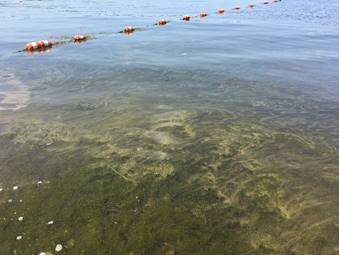
Two state lawmakers want the state Department of Environmental Conservation to do more to curb harmful algal blooms on New York's lakes.
Assemblywoman Dr. Anna Kelles, D-Ithaca, and state Sen. Rachel May, D-Syracuse, have introduced legislation (A.8867/S.8356) to create the Harmful Algal Bloom Monitoring and Prevention Act. The act would establish a coordinated statewide HAB monitoring and prevention program that Kelles and May say will do a better job preventing algal blooms.
"Without coordinated intervention, HABs in the Finger Lakes and across the state have been escalating and will certainly continue to worsen over time," Kelles and May wrote in their legislative justification. "The DEC has begun this important process with the 2018 multiagency HABs Initiative, including water-body specific HABs Action Plans and targeted mitigation studies. However, while we now have more information about where HABs are appearing, we still lack comprehensive information about the sources of HABs, and thus the means to implement forward-looking solutions in the most effective way."
Harmful algal blooms have been a growing problem on Chautauqua Lake, with Gov. Kathy Hochul including a section in her State of the State book earlier this month about Chautauqua Lake, which along with the eastern Finger Lakes will receive help from the state to deal with harmful algal blooms with an effort to restore recreational opportunities on the lakes. Hochul said she will direct the state Department of Environmental Conservation to work with state, federal and non-profit organizations to implement pollution reduction strategies, advanced water quality monitoring and complete a feasibility study to determine the extent and severity of internal phosphorus loading in Chautauqua Lake. At the same time Hochul wants to work on projects that reduce nutrients entering the lake, including streambed stabilization, weed buffers on the lake shore and rain gardens.
Kelles and May are calling for more of a focus on algal blooms statewide. Their legislation calls for the DEC to develop a comprehensive statewide HABs data collection, consolidation and analysis program relating to monitoring, evaluation, prevention and mitigation of HABs, and, within five years, issue a report which includes analysis, findings and recommendations for a coordinated system of HABs outbreak monitoring and mitigation in all relevant water bodies, to be incorporated into the DEC's regulations.
The lawmakers also want to require the DEC to establish a clearinghouse on algal blooms that includes potential and known causes, best practice interventions, expertise and funding resources. All of that information would be made available on a publicly accessible website. The DEC would also be required to develop regulations to support and coordinate efforts by federal, state, municipal and nongovernmental organizations in monitoring, mitigating and preventing algal blooms.
"While the general drivers of HABs are known (high temperatures and excessive nutrient loads), effective solutions have so far remained elusive as the problem worsens," Kelles and May wrote. "This is because the specific combination of factors that lead to HABs on any given water body is complex (depending on lake size, depth, watershed features, etc.), and because there is a lack of comprehensive, longitudinal data on water body temperature,nutrients, and HABs occurrence. Compounding the difficulty in identifying sources of the problem is that efforts at HABs mitigation have so far been local and waterbody-specific. This means they have been relatively isolated from one another, lacking in the coordination that could allow for identification of patterns in aggregate data and fully harness existing knowledge and funding resources."
Lastly, A.8867/S.8356 would create a Harmful Algal Bloom Prevention and Mitigation Grant Program that would provide funding to municipalities or intermunicipal organizations using best practices for local harmful algal bloom monitoring and prevention programs and create a state HABs Prevention and Mitigation Program fund.
"This bill would charge the DEC with establishing a coordinated system of HABs monitoring, evaluation, prevention and mitigation, finally putting New York State on a path to be able to predict and prevent the occurrence of Harmful Algal Blooms in our water bodies," Kelles and May wrote.
ANOTHER PROPOSAL
The funding issue may have at least one ally in the state Senate. Sen. Dan Stec, R-Glens Falls, reintroduced legislation that hasn't been introduced since the 2017-18 legislative session that would also direct additional funding toward harmful algal blooms. His bill (S.7227) attacks harmful algal blooms differently than Kelles and May are proposing because it would use Soil and Water Conservation Districts to work in their areas to fight harmful algal blooms.
Stec would establish a multi-agency emergency response team that can be deployed if drinking water sources are suspected to be contaminated by a harmful algal bloom or hypoxia as well as including detection and monitoring of harmful algal blooms within the state's coastal and inland waterway policies.
Stec would then allow Soil and Water Conservation Districts to make money available to monitor and respond to harmful algal blooms. His bill also would create a Harmful Algal Bloom and Hypoxia Commission made up of various state agency heads, as well as a Harmful Algal Bloom and Hypoxia Advisory Committee that would develop a plan to monitor and respond to harmful algal blooms, as well as local and regional assessments.
Cornell University would also be called upon to complete a peer-reviewed study of harmful algal blooms and provide the study to the governor, legislature, state agencies and the Harmful Algal Bloom and Hypoxia Commission. Lastly, Stec would change stage law to allow the state Environmental Facilities Corporation to provide funding for emergency drinking water supplies when contamination has resulted from harmful algal blooms or hypoxia.
"Previous administrations announced major investments to combat algal blooms that threaten recreational use of lakes as well as drinking water," Stec wrote. "Yet, the state still lacks a specific program and inter-agency approach to this emerging threat to our water supply."