Historical marker unveiled in Clymer Cemetery on Sunday
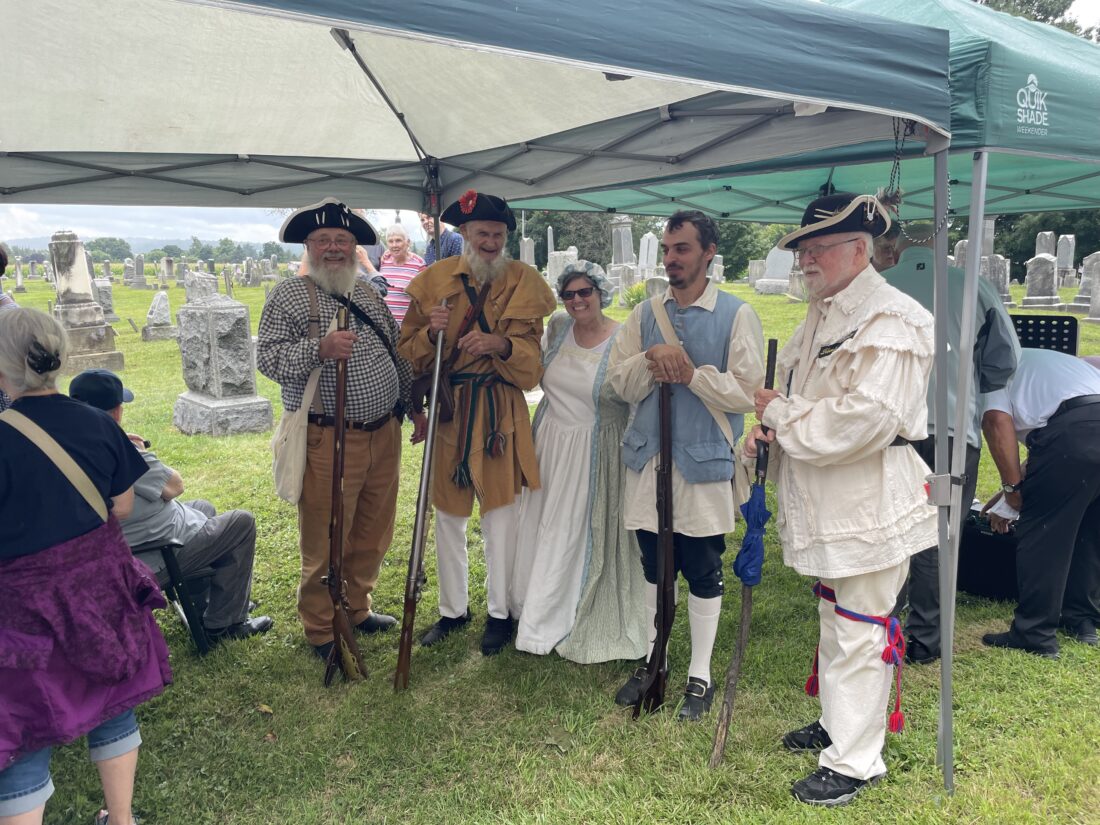
OBSERVER Photos by Sara Holthouse Members of the Sons and Daughters of the American Revolution during the marker unveiling Sunday afternoon.
-
- OBSERVER Photos by Sara Holthouse Members of the Sons and Daughters of the American Revolution during the marker unveiling Sunday afternoon.
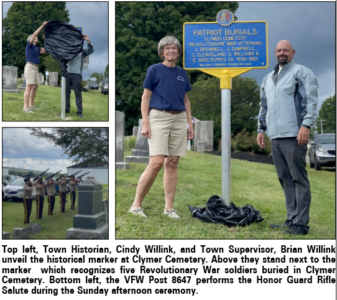
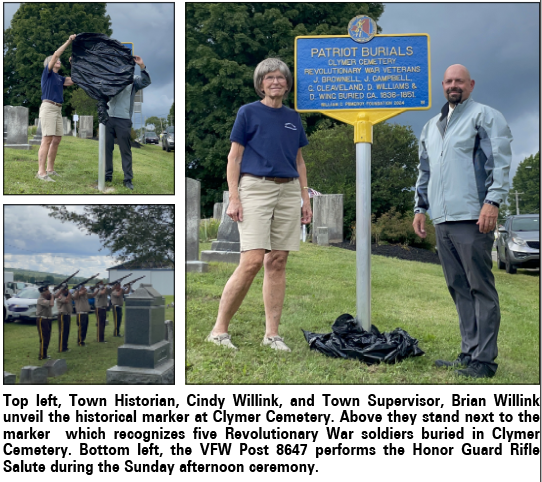
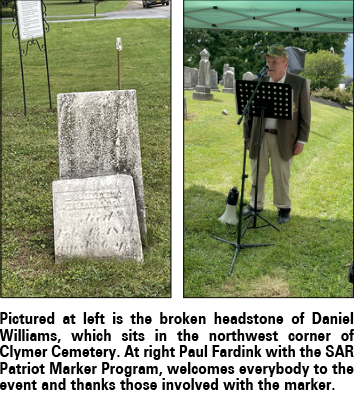
The historical marker was placed in the cemetery through the Patriot Marker Program with the Chautauqua County Chapter of the Sons of the American Revolution. It recognizes five Revolutionary War soldiers buried in Clymer Cemetery: Joseph Brownell, John Campbell, Gardner Cleveland, Daniel Williams, and Daniel Wig.
Paul Fardink with the SAR Patriot Marker Program began the ceremony with a welcome and introduction of significant figures in regards to the days events, such as members of the Sons and Daughters of the American Revolution, who came dressed in costumes to go with the time period, some family members and descendants of the Revolutionary War soldiers being recognized, the VFW Post 8647 and members of the town of Clymer’s government. Michael Ganske did the invocation to help start off the ceremony, and President of the Chautauqua County SAR, Jeff Crossley, said a few words about the SAR.
“The SAR is a male lineage organization whose members can document that we had an ancestor that served or somehow assisted the patriot cause of the Revolutionary War,” Crossley said. “SAR is a nonprofit, nonpartisan organization dedicated to promoting patriotism, preserving American history and promoting education to our future generations.”
Crossley acknowledged the William J Pomeroy Foundation, who the SAR partnered with for the historical marker and ceremony.
“Today we are here to officially unveil our chapter’s eighth official patriot burial marker, completely and generously funded by the Pomeroy Foundation,” Crossley said. “A huge thank you to them for providing us the means for us to memorialize these veterans.”
Crossley also thanked Scott Trisket, Clymer highway superintendent, for installing the marker and VFW Post 8647 for their participation, and to town supervisor Brian Willink and town historian Cindy Willink for their support of the project.
Brian Willink also thanked those in attendance for coming, adding that he was glad that the rain was managing to hold off for the moment for the ceremony. He acknowledged the SAR, Crossley, and everyone else involved in the unveiling ceremony on Sunday.
“We appreciate the support and this is quite a blessing for us to be able to host such a thing,” he said.
Following Willink’s remarks the marker was unveiled, which was then followed by the Honor Guard Rifle Salute from the VFW Post 8647 and the Playing of TAPS by Al Johnson. Cindy Willink read the roll call of the veterans buried in the cemetery, giving the crowd a history of each.
Joseph Brownell performed as a private in the third regiment of the Dutchess County, New York militia, according to family records, though his years of service are unknown. Brownell was born April 6, 1761 in Dutchess County and was 14 when the war broke out. He married Polly Draper in 1784 and moved to Clymer about 1824, and by then the two had 13 children.
“His name lives on in the existence of Brownell Road and Brownell Branch Creek,” Willink said.
John Campbell served from 1776 to 1783, enlisting five different times and earning several ranks; private, orderly sergeant and corporal. During his fifth service in 1782 he was a crew member of the ship, “The Mohawk”, that was captured by the British ship, “Enterprise”. Campbell was taken prisoner and held for six months until peace was declared in 1783. Campbell was born in Massachusetts on Jan 31, 1762.
“Most of his married life was spent in Ticonderoga, NY and he came to Clymer with his wife in 1838,” Willink said. “Even though he was locally known as Captain John, he never held that rank in either the army or the navy. Captain John Campbell is the name forever engraved on his headstone.”
Gardner Cleveland was born at Pomfret, Connecticut Sept 25, 1763. He enlisted in the military three different times from July 1, 1780 until the end of the war in the fall of 1783.
“His name is not spelled correctly in official military records and on his tombstone here in Clymer,” Willink said. “It is spelled Cleaveland. He participated in the siege and victory at Yorktown. He was an early settler in Clymer, apparently the first, is what I’m hearing, arriving with his wife, Mary, and two of their three children, in 1820.”
Cleveland is known best in Clymer for hosting the first town meeting at his home on Feb 9, 1821, and he was also town supervisor from 1824 to 1827. Some of Cleveland’s family members were in the audience at the ceremony, and one said Cleveland’s father was also in the war, fighting at Bunker Hill and was killed during the Siege of Boston. Cleveland’s son Gardner Junior is also buried in Clymer Cemetery, and he fought in the War of 1812.
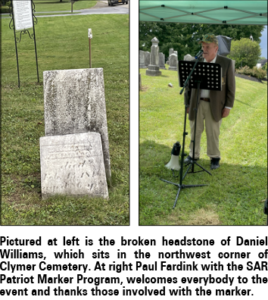
Daniel Williams was born Feb 2, 1759 in Norwich, Connecticut. He enlisted twice as a private, serving 23 months, losing two fingers during the Battle of Saratoga. Williams came to Clymer with his wife, preceding some of his sons. They had seven sons and nine daughters.
“His stone is broken and sits in the northwest corner of the cemetery,” Willink said.
Daniel Wing was born July 2, 1757 in Dartmouth, Massachusetts. His tour of duty began in Oct 1778, when he was ordered to Fort Ann in Washington County, NY.
“Five days later the fort surrendered to the British and he was taken prisoner,” Willink said. “He was confined for one year at Montreal, then removed to Prisoner Island in the St Lawrence River. He was a prisoner of war for 20 months and one day.”
Wing and his wife had four children and purchased a lot in Clymer in 1821. All five veterans were early settlers in the town of Clymer and went on to live long lives, into their 80s. Willink acknowledged each of the stones is in various states of disrepair and legibility but welcomed everyone to visit each site.
Fardink wrapped up the ceremony with one more brief connection to the Revolutionary War for the town.
“Many of you already know this, but the town of Clymer was named for George Clymer, Revolutionary War, he’s one of our founding fathers,” Fardink said. “He was one of six founding fathers that signed not only the Declaration of Independence but also the Constitution. So, there is a lot of history here in Clymer.”
Local/Region
United Way AG Team Golf tourney is June 22
Community Health Assessment, Improvement Plan completed
MAYVILLE, N.Y. — The Chautauqua County Health Department (CCHD), in collaboration with Brooks-TLC Hospital ...
Borrello backs budget bill delaying electric bus mandate
As was reported by The Post-Journal and OBSERVER last week, the state budget will include a five-year delay of the ...
As prices rise, Gillibrand seeks assistance for school meals
U.S. Sen. Kirsten Gillibrand (D-NY) held a virtual press conference this week to call for passage of her ...
SUNY to centralize services in Jewett Hall renovation