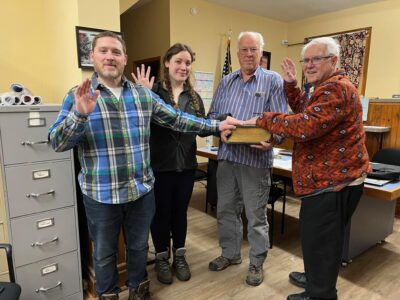
Borrello questions DEC on Wetlands Act
Amanda Lefton, state DEC commissioner, was saved by the bell recently.
Lefton was answering a question by state Sen. George Borrello, R-Sunset Bay, during a joint legislative budget hearing when Borrello’s time expired. The former Chautauqua County Executive had asked Lefton about the use of artificial intelligence to help decide which parts of Chautauqua Lake fell under additional wetlands protections under the Freshwater Wetlands Act.
“What concerns me the most in the particular case of Chautauqua Lake, we were told by one of the officials that works on the lake that DEC officials used AI to determine what areas are considered wetlands,” Borrello said. “So that’s very concerning for me. If you’re not actually boots on the ground, when you’re doing something that can really negatively impact the ability for people to use their property, that’s concerning.”
Two Chautauqua County organizations are among those challenging the wetlands act changes in state Supreme Court. Oral arguments took place in state Supreme Court in Albany on Friday. A decision has not yet been reached.
Lefton began to respond to Borrello’s question by referencing the number of jurisdictional determinations that have been requested.
“As we move forward with the implementation of this, I’ll say that we’ve received over 8,000 jurisdictional determination requests,” Lefton said. “That’s about 125 a week. We have now gotten to a place where we’re processing about 150 of them a week to address that backlog and looking at innovative solutions to make sure we’re able to expeditiously implement our new regulations which came into effect this year.”
That’s where Borrello’s time – and Lefton’s answer – ended. Lefton said she would reach out to Borrello privately to discuss the issue further.
Local opposition to the Freshwater Wetlands Act revisions began with concerns about property values around Chautauqua Lake before expanding into concerns that home sales could slow down because homeowners could face increasing limits on what they can do with lake front properties. There have been public comments saying some home sales have fallen through because of concerns fueled by the Freshwater Wetlands Act. Borrello also took the opportunity to pitch his legislation (S3656/A.4692) that would exempt inland freshwater lakes like Chautauqua Lake from the wetland regulation changes.
“We have many inland lakes that have been impacted by this and I will say that, I guess the fear mongering is really the issue,” Borrello said. “People are out there saying, people are canceling real estate contracts because of the impact that they claim is happening as a result of this. So I understand that there’s the reality versus the rumor, but it is having a significant real impact on property values and on people’s ability to do what they want with their property.”
Borrello began his time by thanking Lefton for the DEC’s help with the Great Lake Cheese Facility’s pollution into Ischua Creek. The state Department of Environmental Conservation, in coordination with the state Department of Health, lifted its recreational use advisory for Ischua Creek in November after water quality sampling and data collection along the creek show conditions have improved allowing for a return to normal fishing/fish consumption, boating, and swimming. The DEC and Health Department issued the precautionary advisory on August 28, 2025, due to environmental impacts from wastewater discharged from the Great Lakes Cheese facility in Franklinville.
DEC is continuing to closely monitor water quality in Ischua Creek. Monitoring shows improved compliance with ambient water quality standards and successful implementation of many treatment plant corrective actions to stabilize effluent water quality entering the creek. There continue to be no indications of impacts to public drinking water supplies.
“I want to start off by thanking you very much for what you did when we had the crisis in Farmersville with Great Lakes Cheese,” Borrello said. “DEC came in and worked with us, local elected officials on the ground. Obviously there’s a lot of work still to be done, and I know that you are working on that. We’ve had conversations recently, but I just wanted to recognize you publicly for the great work that DEC did.”
Local/Region
Cold collection
Borrello running for re-election as state senator
Dave says early spring, Phil sees shadow
From staff and wire reports On a chilling Monday, Dunkirk Dave offered some optimism. When venturing out in the ...
Siena poll finds Hochul leading race for governor
State Gov. Kathy Hochul continues to hold a commanding lead over Nassau County Executive Bruce Blakeman, 54-28%, ...
Borrello questions DEC on Wetlands Act
Amanda Lefton, state DEC commissioner, was saved by the bell recently. Lefton was answering a question by state ...