
Sunny disposition: Dunkirk approves community solar project
Trending
A renewable energy project has been given the green light in the town of Dunkirk.
At a recent meeting of the Dunkirk Town Board, a community solar project named Dunkirk Solar One and Dunkirk Solar Two -- also referred to as Dunkirk Solar A and Dunkirk Solar B -- was officially approved. The vote was unanimous among all Town Board members on both the acceptance of the negative declaration under the State Environmental Quality Review (SEQR) and the overall site plan and special use permit.
"Welcome to the town," said Town Supervisor Juan Pagan.
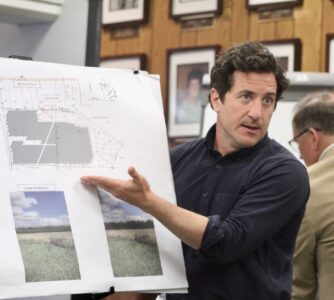
Dan Leary of Dunkirk Solar One and Solar Two presented the project to the Dunkirk Town Board at a public hearing on the project, held prior to the regular meeting of the Dunkirk Town Board. He was joined by Mike Metzger, the head of Metzger Civil Engineering.
Leary said at the public hearing that he hopes the project will be operational "hopefully by this time next year."
The project spans two parcels of land, each slightly over 20 acres of land, located just off East Lake Shore Drive. The parcels neighbor the Lakeside Park community -- the landowner of the project -- and are located behind the vacant Athenex building. "The site itself is not adjacent to any public roads," Leary said.
The approved site plan includes setback variances granted by the Planning Board, as well as an easement with the adjacent property, Farrell Roofing, for access to the project coming off East Lake Shore Drive.
"We made some changes to the plans to ensure that we were compliant with the code," said Metzger.
The project's site plan and special use permit approval contains conditions including the submission of an acceptable operation and maintenance plan, a decommissioning plan, and inclusion of setback variances granted pertaining to the project. The Dunkirk Planning Board recommended the project under similar conditions.
A major sticking point for the Dunkirk Planning Board with the project's plan was emergency vehicle access. The developers accounted for this concern with the easement to access the project through Farrell Roofing and also adjusted the turning radius of the access lanes for emergency vehicles.
"(The Planning Board) wanted to make sure that we had an access road, not only across the top of the site, but that we were able to bring emergency vehicles down to the back of both of the sites," Metzger said.
The developers plan to implement a vegetative screening of the project -- meaning trees will be planted to obstruct the view of the panels from a distance. An artistic rendering of the screening showed the panels would be partially hidden within two years and fully hidden within five years.
The approval of the SEQR form means the board accepted the assessment that the project will not drastically impact the environment in a negative way.
The town will execute a Host Community Agreement with the project owner, which has already been submitted to the town.
As a community solar project, the energy generated from the project will connect to the National Grid power lines to be distributed to nearby homes and businesses. Homeowners and business owners can enroll in the community solar plan through National Grid to save 10% off their energy bill each month. A project of the size of Dunkirk Solar One and Dunkirk Solar Two would typically service between 1,500 to 2,000 customers.
"Any homeowner in the region that doesn't have the means or the ability to capitalize from using solar on their own facility, their own rooftop ... can still benefit from locally sourced clean, renewable energy at an immediate discount," Leary said. "It's a great benefit for (enrollees) who otherwise can't take advantage of it."
Residents and business owners will be contacted once the project is near operation to enroll in the community solar plan.