
Discovery fight stalls 2019 wind turbine lawsuit
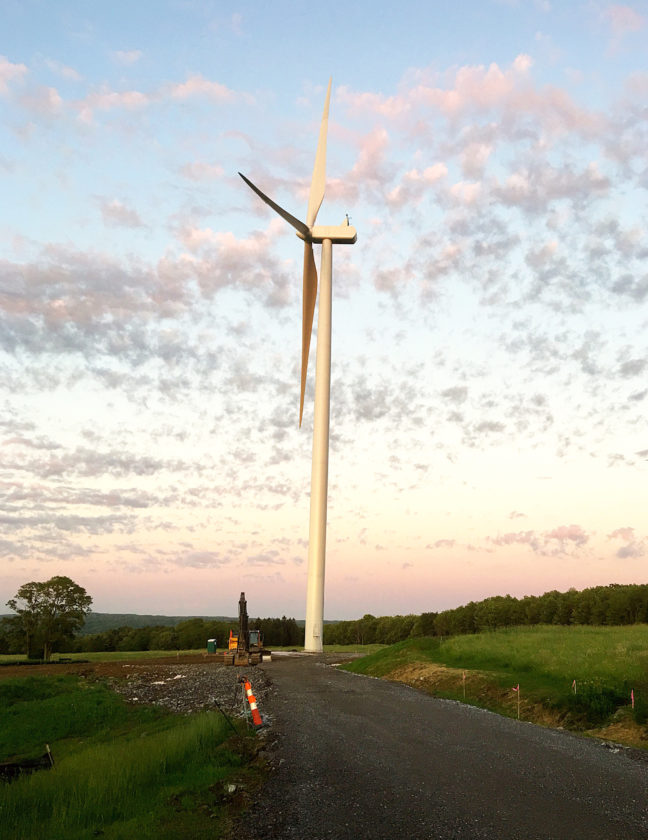
OBSERVER file photo A wind turbine sits on Center Road in Arkwright in 2018.
Some documents included requested by residents suing the developer of the Arkwright Summit Wind Farm will be kept out of the public eye.
Possible disclosure of trade secrets were the latest point of contention in a four-year-old lawsuit filed over 46 wind turbines installed in Arkwright in 2018. The lawsuit was originally filed Sept. 24, 2019, by dozens of north county residents over the Arkwright Summit Wind Farm, which consists of 47 wind turbines erected in 2018. Residents are asking the court for unspecified damages related to loss of property values, compensatory damages for destruction of homes and lifestyle, loss of use and enjoyment of their properties, damages for relocation costs and time spent relocating, mental anguish, destruction of scenic countryside, physical pain and suffering, difficulty sleeping, nuisance, trespass, interference with electronics in their homes such as satellites, telephones and televisions, loss of business profits, special damages for stress, anxiety, worry and inconvenience, and the effects lights and noise from the turbines have on their properties.
Over the past four years attorneys for both the residents and the defendants — EDP Renewables North America LLC and several other companies, have haggled over documents that should be given from one side to the other, depositions and interrogations and other procedural matters. In November 2021, the residents’ attorneys served discovery demands on EDP Renewables, with a November 2022 response saying the residents could expect a rolling disclosures in the following days and weeks. The residents then complied with requests by defendants in the case to sit for depositions in the case, while the residents’ attorney says discovery requests by the wind turbine company haven’t been fulfilled for nearly a year before the August request to extend confidentiality protections for some materials.
Filings in the lawsuit earlier this month continue the document fight, with attorneys for the Arkwright-area residents pushing for as much documentation from the wind turbine companies as possible while EDP Renewables’ attorney argues the state Supreme Court Judge Grace Hanlon should issue a protective order to keep confidential information out of the public eye in the lawsuit.
“Plaintiffs’ Notice to Produce includes demands for documents which, among other things, are subject to confidentiality requirements, contain proprietary business information, contain trade secrets, and information that, if disclosed, would hinder EDP Renewables ability to compete in its market,” attorney Charles Englert wrote in an affirmation supporting the protective order. “In an attempt to avoid unnecessary motion practice or discovery disputes the defendants agreed to produce its project vault, containing all documents maintained by EDP Renewables related to the wind farm at issue in this action. EDP Renewables does wish to prevent the disclosure of any document that is not subject to the traditional privileges (e.g. attorney work product, attorney-client communications). EDP Renewables only seeks an order protecting from the disclosure of confidential business and non-public information to unrequired parties and outside of this action.”
On Friday, Hanlon ruled on the request and placed limits on who can see certain documents as well as the destruction of copies once the case comes to an end. Documents requested by the residents can be marked confidential or highly confidential by EDP Renewables’ attorneys, with that material’s distribution limited to only the attorneys. But, any open court proceeding accessible by the public is not covered under the order. Lawyers would have to file a motion to close court or seal the record in order for information typically available in open court to be removed from the public record. Items that can’t be marked confidential or highly confidential include documents regarding compliance with local, state and federal regulations concerning noise levels, environmental protection and health and safety standards; environmental impact assessments; complaints; air and water quality assessments and wildlife impact statements; mitigation eforts for noise, the environment or health; safety studies and protocols; and project location selection analysis.
Ann Marie Murzin, the attorney representing the Arkwright residents, argued EDP Renewables is arguing for court approval to make its confidentiality agreements apply to all documents, which would allow the company to retrieve documents mistakenly given to the residents without any demonstration of cause. That language, Murzin wrote, is an attempt to make Murzin file a motion to demonstrate why information is necessary without the turbine company showing why the document must be protected in the first place. She also argued the proposed order would require Murzin to file a motion in court to discuss the facts inside a document with her clients.
“Therefore, should the court find the movant sustained its burden, and conduct analysis of the proposed order, it will become abundantly clear that the defendants seek to protect much more than trade secrets,” Murzin wrote. “In David and Goliath fashion, defendants seek to shift the well-established legal burden to demonstrate good cause to plaintiffs, and also lay the groundwork for a malpractice claim by asking plaintiffs’ counsel to agree not to discuss discovery with their clients.”
TOP STORIES

An ‘amazing’ tenure

Health officials discuss smoking, vaping challenges
Hochul hails development projects for Westfield
Governor Kathy Hochul today announced awards for a total of 21 transformational projects for Western New York --- ...

PVCS budget, reserves facing scrutiny
Fredonia hotel owner fights closure
Dunkirk Hospitality LLC is fighting the village of Fredonia’s attempts to force those staying at the former Route ...
Person Dies After Sunday Stabbing In Jamestown
Jamestown police are investigating a Sunday stabbing that has left a person dead. On Sunday, May 3, around 4:30 ...