Chautauqua ZBA rejects development decision’s appeal
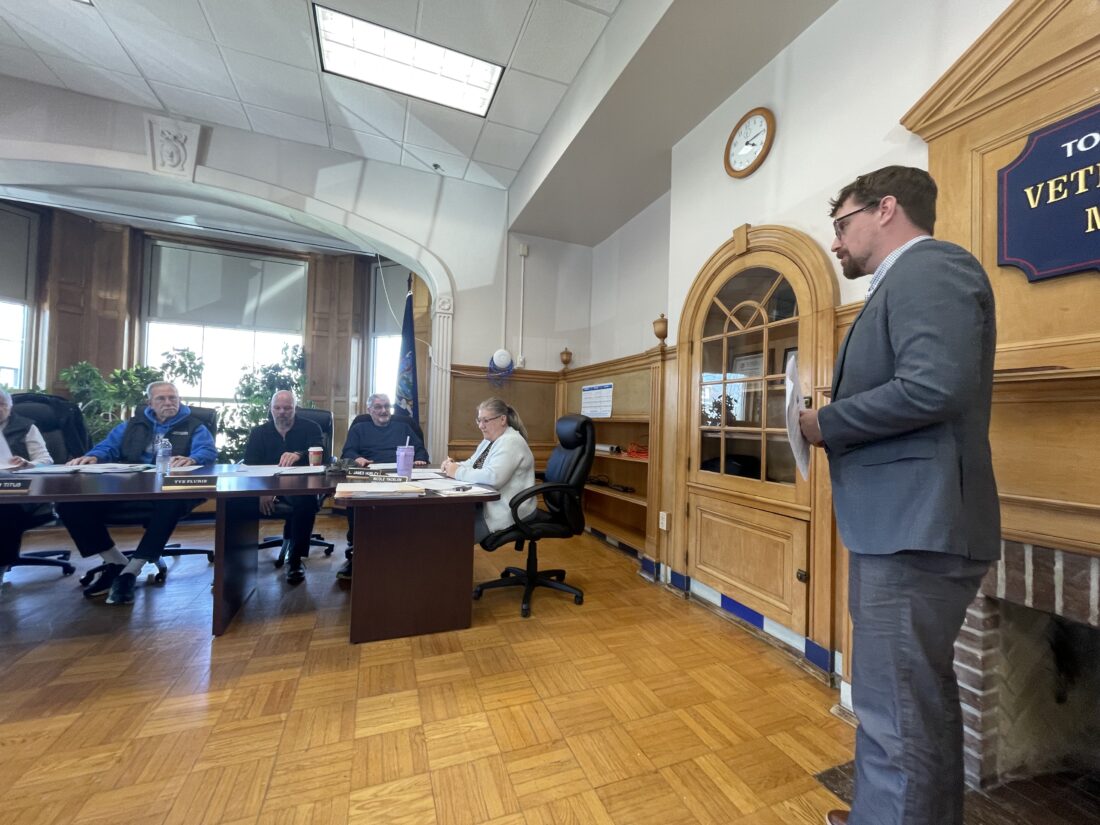
OBSERVER Photo by Gregory Bacon Attorney Stephen Daly, right, speaks at the Chautauqua town Zoning Board of Appeals meeting.
A $70 million development at a former golf course in the town of Chautauqua can still move forward after the town’s Zoning Board of Appeals rejected a request to reconsider a previous decision that helped the project get approval.
On Tuesday, the zoning board was asked to “consider an appeal of the Code Enforcement Officer’s interpretations of the Town’s Zoning Code dated December 4, 2025, regarding the Sunset View Planned Unit Development Project.”
Attorney Stephen Daly, representing Chautauqua Protect, which is an association of local residents concerned about the proposed development, had alleged that three of the code enforcement officer’s interpretations of the zoning code were incorrect.
Daly stated that he wasn’t asking the ZBA members to overrule the town board’s decision for a special use permit; instead he wanted the zoning board to review the code officer’s interpretations, arguing that their decision would “set precedent” for future projects.
On the first issue, the zoning code sets a maximum density requirement for Planned Unit Developments, which is what Sunset View is classified as. The development calls for a number of single family homes, townhouses, condominiums, along with a restaurant/tap house. There would also be a public dock.
Daly alleged that the code enforcement officer interpreted the zoning code to allow “unlimited density” in Planned Unit Developments. “A future applicant will be able to pack as many units in a tight area for a proposed PUD and then say to this board or the town board that there is no maximum density,” he said.
Secondly, Daly argued that the zoning code’s subdivision regulations were not applied to Sunset View. “If this interpretation is upheld, a future developer, they could design a project that is 95% subdivision, include one mixed-use structure, and say that they qualify because it’s not exclusively a subdivision,” he said.
Daly’s third objection was regarding the public dock, saying the zoning code has strict “anti-funneling” regulations, designed for safety. “Funneling lots of people in a very tight area creates congestion, safety issues, and decreases the enjoyment of the lake,” he said.
After Daly spoke, attorney Sean Hopkins with Ellicott Development, the developer behind Sunset View, responded.
Hopkins rejected Daly’s allegation that the code officer’s interpretation would allow for undesired development in the future. “Any future request for a PUD has to go to the town board. It has to go through the review progress. It’s not automatically approved,” he said.
Hopkins defended the code officer’s interpretation of the zoning code, saying that each one was made following a thorough review.
After both attorneys spoke, a handful of residents expressed various concerns regarding the marketability of the project and why the project couldn’t fully comply with the town’s zoning code.
Afterward, the members of the zoning board unanimously rejected Daly’s request to overturn the code officer’s interpretation of the zoning code.
Following the vote, Daly was asked by The Post-Journal/OBSERVER if he was planning on appealing the zoning board’s vote. He said he needed to talk to his client first and will go from there.
Construction has yet to begin for Sunset View. Hopkins said while the town has given all of its approvals, there are some permits they are still waiting for, but the developers hope to start the project sometime this year.
TOP STORIES
State urges residents to be ready for extreme heat
New Yorkers are being urged to prepare for a period of extreme heat starting Tuesday with "feels-like" temperatures ...
Repair work to continue on Dunkirk breakwater
City holds line on expenses, but tax collection lags
The city of Dunkirk “is still $1.5 million ahead on our expenses” for the year so far, Fiscal Affairs Officer ...
Options remain for former NRG plant

Texas data center to use Cummins natural gas generators