Area trout effort reeling in results
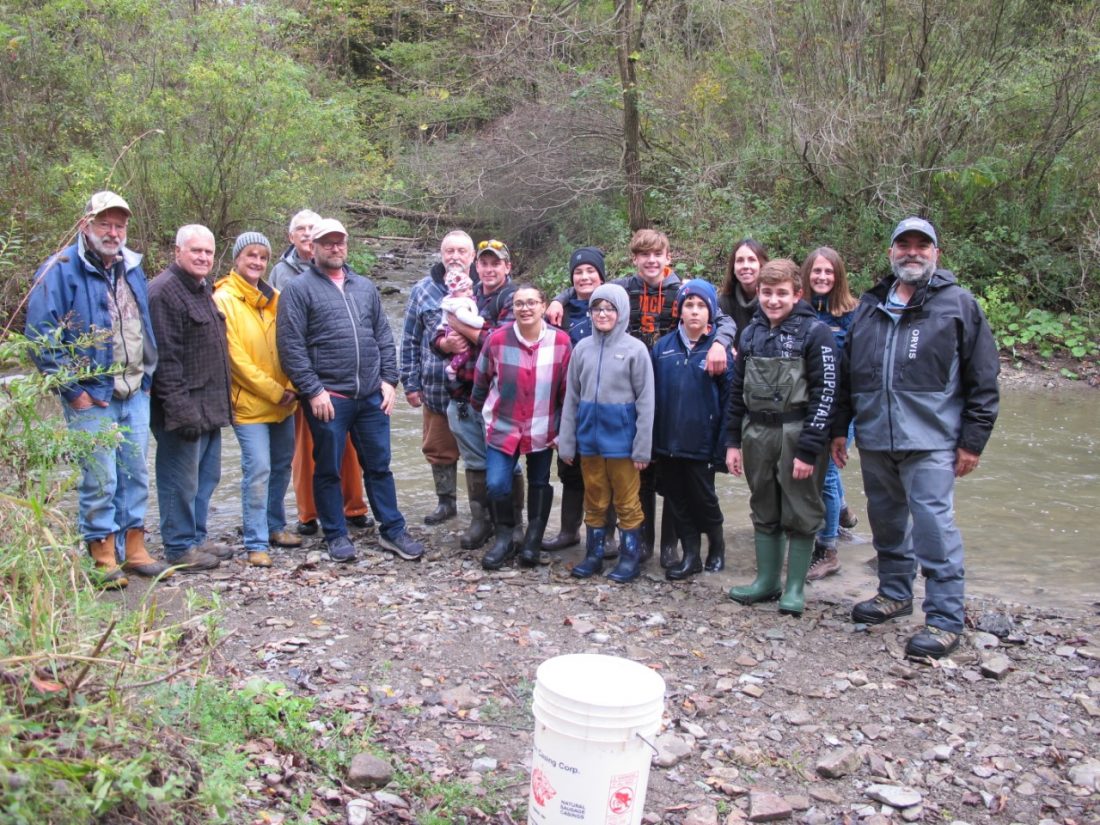
OBSERVER Photo by Anthony Dolce Participants took part in the Brook Trout Restoration Project earlier this month, including Alberto Rey, at right.
ARKWRIGHT — Decades ago, brook trout had a dense population in the northeastern region. Over the years, however, these trout slowly died off in the area. The Brook Trout Restoration Project, however, has been working to restock the local waters by putting in a number of the trout every year at Canadaway Creek.
The Restoration Project, led by State University of New York at Fredonia professor Alberto Rey, is responsible for releasing 2-year-old brook trout into the headwaters of Canadaway Creek. They’re released in the middle of fall as the water temperature is most ideal for the trout to start reproducing immediately.
“It used to be the native trout of the northeast and over the decades as pollution and development effected the water, the fish died off, so there were no more,” Rey said. “We wanted to create a strain of fish that would reproduce in the stream.”
So far, Rey said the project is seemingly having its intended impact. According to Rey, anecdotal evidence has been found that these same fish were found in other local streams, meaning the fish have gone into the lake and back into other streams.
“We know this because of the size of the brook trout that have been caught,” Rey said. “We also had brook trout come back up into the stream and we knew it was ours because they were so fat, they had been eating in the lake.”
Rey has led this project, which is funded and hosted by the Children in the Stream 4-H program that he has run for 20 years. The group meets weekly to tie flies and periodically go fishing, while also helping to maintain the environment. The program is open to children over the age of 12, or younger children if they have an adult with them, as well as community members. The program is also free, as Rey believes the hobby should be accessible.
“I’ve always felt that people should be able to get into this sport without feeling any economic difficulty,” Rey said. “So everything we do is free.”
Rey noted an important part of the project was getting the youth participating to feel like they’re doing something important in order to restore their local stream.
“It builds a sense of stewardship,” Rey said. “As they get older, they’ll protect their streams and environments in their neighborhood. It’s important to start them young.”
Rey said they are always looking for sponsors to help finance the purchase of the trout every year, and wanted to pass on to people that should one of these trout be caught while fishing, it should be put back. The trout are released yearly after the close of the fishing season to avoid them being caught too early, but down the line, the reproduction of the trout needs to continue for the project to truly be successful.
“Because these fish are put in at an age and time that they’re ready to reproduce, we put them in after the fishing season is over so that nobody can fish for them,” Rey said. “In the future if they’re caught, we hope people will release them so they can continue to reproduce.”
TOP STORIES
Mayor files suit on former dog officer
County helps fund Ripley regional dog shelter
No magic can fix city’s disappearing funds
Langworthy wants brake on CDLs for illegals
U.S. Rep. Nick Langworthy wants a New York state crackdown on commercial driving licenses given to illegal ...
Irish dance showcase tonight at SUNY Fredonia